Science: Physics (Light & Electricity)
From the class 10 cbse curriculum
TL;DR
Light helps us see things through reflection and refraction, following laws that describe how it behaves with mirrors and lenses. Electricity is the flow of charge, powering our world through circuits, and its effects can be understood using concepts like Ohm's Law and magnetic fields. Both light and electricity are fundamental to understanding the physical world around us and have countless practical applications.
1. The Mental Model
Think of light as tiny, super-fast messengers carrying visual information. Electricity is like water flowing through pipes, where voltage is the pressure and current is the flow rate. These two concepts, though seemingly different, are the basic building blocks of many everyday phenomena and technologies.
2. The Core Material
Let's break down Light and Electricity into their key parts.
Light: The World We See

Photo by Design Bits www.dbits.cc on Pexels
Light is a form of energy that enables us to see. It travels in straight lines (rectilinear propagation) and has a dual nature – it acts like both a wave and a particle.
Reflection of Light
When light hits a surface and bounces back, that's reflection.
* Laws of Reflection:
1. The angle of incidence (angle between the incident ray and the normal) is equal to the angle of reflection (angle between the reflected ray and the normal).
2. The incident ray, the reflected ray, and the normal to the surface at the point of incidence all lie in the same plane.
* Plane Mirrors: Form virtual, erect, and laterally inverted images of the same size as the object, located as far behind the mirror as the object is in front.
* Spherical Mirrors (Concave & Convex): These are parts of a sphere.
* Concave Mirror: Converges light rays. Can form real and inverted images, or virtual and erect images, depending on the object's position. Used in headlights, shaving mirrors.
* Convex Mirror: Diverges light rays. Always forms virtual, erect, and diminished images. Used as rearview mirrors in vehicles.
* Mirror Formula: 1/v + 1/u = 1/f (where v = image distance, u = object distance, f = focal length)
* Magnification (m): m = h'/h = -v/u (h' = image height, h = object height)
Refraction of Light
When light passes from one transparent medium to another, it changes direction. This bending is called refraction.
* Cause: Change in the speed of light as it moves from one medium to another.
* Laws of Refraction (Snell's Law):
1. The incident ray, the refracted ray, and the normal to the interface at the point of incidence all lie in the same plane.
2. sin i / sin r = constant (where i = angle of incidence, r = angle of refraction). This constant is the refractive index (n) of the second medium with respect to the first.
* Lenses (Convex & Concave):
* Convex Lens (Converging): Thicker in the middle, converges light. Can form real and inverted, or virtual and erect images. Used in spectacles, cameras, magnifying glasses.
* Concave Lens (Diverging): Thinner in the middle, diverges light. Always forms virtual, erect, and diminished images. Used in spectacles to correct short-sightedness.
* Lens Formula: 1/v - 1/u = 1/f
* Power of a Lens (P): P = 1/f (f in meters). Unit is Dioptre (D).
graph TD
    A["Light Energy"] --> B{Interaction with Matter}
    B -- Reflects Off --> C["Mirrors (Plane, Concave, Convex)"]
    C --> C1["Image Formation (Real/Virtual)"]
    B -- Passes Through --> D["Lenses (Convex, Concave)"]
    D --> D1["Refraction"]
    D1 --> D2["Image Formation (Real/Virtual)"]
    D2 --> D3["Correction of Vision"]
    C1 --> C2["Applications (e.g., Rearview, Shaving)"]
    D3 --> D4["Applications (e.g., Spectacles, Cameras)"]
Electricity: The Flow of Charge
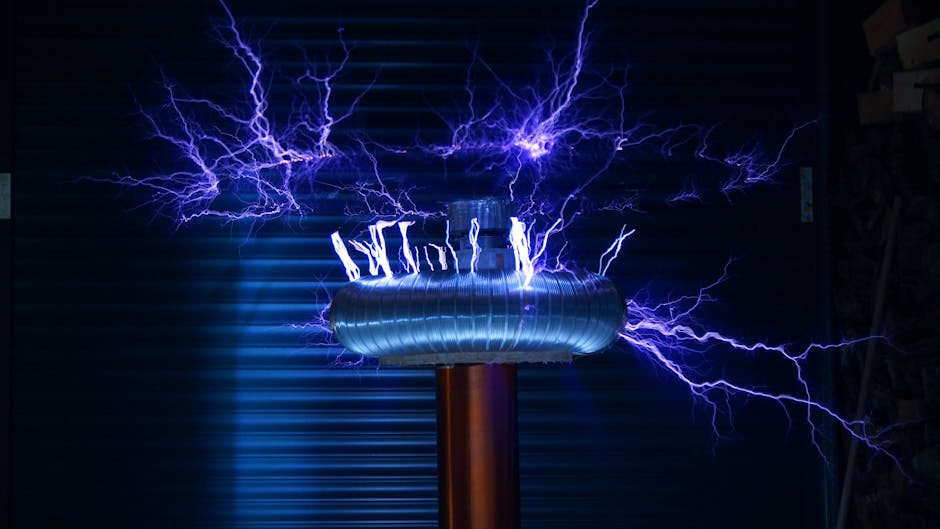
Photo by Killian Eon on Pexels
Electricity is the study of charges at rest (static electricity) and in motion (current electricity).
Electric Current and Circuit
- Electric Current (I): The rate of flow of electric charge.
I = Q/t(where Q = charge in Coulombs, t = time in seconds). Unit: Ampere (A). - Electric Circuit: A continuous and closed path for the flow of electric current.
- Potential Difference (V): The work done to move a unit charge from one point to another.
V = W/Q(where W = work done in Joules). Unit: Volt (V). It's what "pushes" the charge.
Ohm's Law
This law relates potential difference, current, and resistance.
* Statement: At constant temperature, the current flowing through a conductor is directly proportional to the potential difference across its ends.
* Formula: V = IR (where R = Resistance). Unit: Ohm (Ω).
* Resistance (R): The opposition offered by a conductor to the flow of current. It depends on:
* Length of the conductor (L): R ∝ L
* Area of cross-section (A): R ∝ 1/A
* Nature of the material: R = ρL/A (where ρ = resistivity, a material property).
* Temperature: Generally increases with temperature for metals.
Combination of Resistors
- Series Combination: Resistors connected end-to-end.
R_eq = R1 + R2 + R3 + ...- Same current flows through each resistor.
- Voltage divides across them.
- Parallel Combination: Resistors connected across the same two points.
1/R_eq = 1/R1 + 1/R2 + 1/R3 + ...- Same voltage across each resistor.
- Current divides among them.
Heating Effect of Electric Current
When current flows through a resistor, electrical energy is converted into heat.
* Joule's Law of Heating: H = I²Rt (where H = heat produced in Joules).
* Applications: Electric heaters, toasters, geysers, electric bulbs (incandescent).
Electric Power
The rate at which electrical energy is consumed or dissipated.
* Formula: P = VI = I²R = V²/R. Unit: Watt (W).
* Commercial unit of energy: Kilowatt-hour (kWh). 1 kWh = 3.6 x 10^6 J.
Magnetic Effects of Electric Current
A current-carrying wire produces a magnetic field around it.
* Oersted's Experiment: Showed that an electric current produces a magnetic field.
* Right-Hand Thumb Rule: If you hold a current-carrying wire with your right thumb pointing in the direction of current, your curled fingers show the direction of the magnetic field lines.
* Solenoid: A coil of many circular turns of insulated copper wire closely wound in the shape of a cylinder. It behaves like a bar magnet when current passes through it.
* Electromagnet: A temporary magnet formed by passing current through a coil wound around a soft iron core.
Electric Motor
Converts electrical energy into mechanical energy.
* Principle: A current-carrying conductor placed in a magnetic field experiences a force (Fleming's Left-Hand Rule).
* Components: Armature, strong magnetic field, split ring (commutator), brushes, battery.
Electromagnetic Induction (EMI)
Producing an induced current in a coil by changing the magnetic field passing through it.
* Faraday's Law: The magnitude of the induced current is proportional to the rate of change of magnetic flux.
* Fleming's Right-Hand Rule: Used to find the direction of induced current.
* Electric Generator: Converts mechanical energy into electrical energy based on EMI.
3. Worked Example
Let's calculate the total resistance and current in a simple series-parallel circuit.
Problem: A circuit has two resistors, R1 = 4 Ω and R2 = 6 Ω, connected in series. This combination is then connected in parallel with a third resistor, R3 = 10 Ω. If the entire arrangement is connected to a 12 V battery, calculate:
1. The equivalent resistance of the circuit.
2. The total current drawn from the battery.
Solution:
Step 1: Calculate the equivalent resistance of R1 and R2 in series.
R_series = R1 + R2
R_series = 4 Ω + 6 Ω
R_series = 10 Ω
Step 2: Calculate the equivalent resistance of R_series and R3 in parallel.
Now, R_series (10 Ω) is in parallel with R3 (10 Ω).
1/R_eq = 1/R_series + 1/R3
1/R_eq = 1/10 Ω + 1/10 Ω
1/R_eq = 2/10 Ω
1/R_eq = 1/5 Ω
R_eq = 5 Ω
Step 3: Calculate the total current drawn from the battery using Ohm's Law.
V = I * R_eq
We know V = 12 V and R_eq = 5 Ω.
12 V = I * 5 Ω
I = 12 V / 5 Ω
I = 2.4 A
Answer:
1. The equivalent resistance of the circuit is 5 Ω.
2. The total current drawn from the battery is 2.4 A.
4. Key Takeaways
- Light reflects off surfaces (like mirrors) and refracts (bends) when passing through different materials (like lenses), forming images.
- The Mirror and Lens formulas, along with magnification, help us locate and describe images formed by spherical mirrors and lenses.
- Electric current is the flow of charge, driven by potential difference (voltage), and opposed by resistance.
- Ohm's Law (
V=IR) is fundamental to understanding basic circuits, relating voltage, current, and resistance. - Resistors combine differently in series (adding directly) and parallel (reciprocal sum), affecting total resistance and current distribution.
- Electric current produces heat (
H=I²Rt) and also creates magnetic fields, which are the basis for motors and generators. - Electromagnetic induction is the principle behind generators, where changing magnetic fields create electric current.
Common Mistakes to Avoid:
* Confusing the sign conventions for mirror and lens formulas (e.g., focal length for convex mirrors vs. concave mirrors).
* Mixing up series and parallel resistor formulas – remember current divides in parallel, voltage divides in series.
* Forgetting that the power of a lens is in Dioptres when its focal length is in meters.
* Misapplying Right-Hand Thumb Rule (for magnetic field direction) and Fleming's Rules (Left for motor, Right for generator).
5. Now Try It
Spend 15 minutes reviewing the key formulas for mirrors, lenses, Ohm's Law, and resistor combinations. Then, draw a simple circuit with a 9V battery, a 2Ω resistor, and a 4Ω resistor connected in parallel. Calculate the equivalent resistance of this parallel combination and the total current flowing from the battery. Success looks like correctly applying the parallel resistance formula and then Ohm's Law to find the total current.
Frequently asked about Science: Physics (Light & Electricity)
Study this next
Get the full class 10 cbse curriculum
Clone the complete plan to your dashboard for unlimited AI-generated notes, practice quizzes, and a personalised revision schedule.
Save this course free