DNA Structure and Organization
From the DNA curriculum
TL;DR
DNA is a double helix, a twisted ladder made of nucleotides, which are its building blocks. This double helix then wraps around proteins called histones, compacting into chromatin to fit inside the cell's nucleus. This supercoiling and organization allows vast amounts of genetic information to be stored efficiently.
1. The Mental Model
Think of DNA like an incredibly long, delicate thread. To fit into a tiny bead (your cell's nucleus), this thread isn't just wadded up; it's carefully wound around spools and then further folded, much like how you'd neatly pack a very long extension cord.
2. The Core Material
Your genetic information is stored in DNA, a molecule with a fascinating and precise structure. Let's break down how it's built and organized.
The Double Helix: DNA's Basic Form

Photo by Google DeepMind on Pexels
At its most fundamental level, DNA is a double helix. Imagine a twisted ladder. The "side rails" of this ladder are made of alternating sugar (deoxyribose) and phosphate groups, forming the sugar-phosphate backbone. The "rungs" are made of pairs of nitrogenous bases, connected by hydrogen bonds.
There are four types of nitrogenous bases:
* Adenine (A)
* Guanine (G)
* Cytosine (C)
* Thymine (T)
These bases pair up in a very specific way:
* A always pairs with T (A-T)
* G always pairs with C (G-C)
This specific pairing is called complementary base pairing and is crucial for DNA replication and repair. Each "rung" of the ladder consists of one A-T pair or one G-C pair.
Each side of the ladder runs in opposite directions, which we call antiparallel. One strand goes from 5' to 3' (five-prime to three-prime), and the other goes from 3' to 5'. This naming refers to the carbon atoms in the deoxyribose sugar molecule.
From Double Helix to Chromosomes: DNA Organization
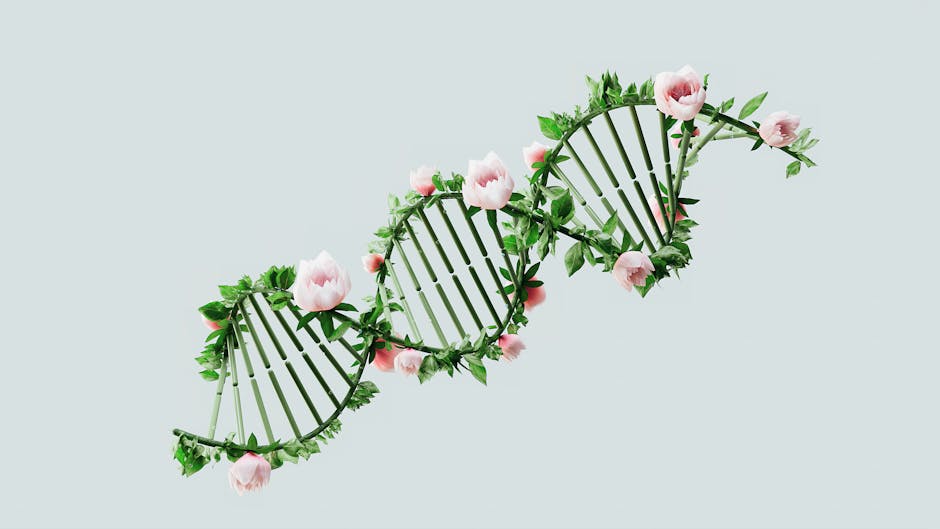
Photo by Google DeepMind on Pexels
If you stretched out all the DNA from a single human cell, it would be about 2 meters long! How does that fit into a nucleus that's only about 6 micrometers wide? Through an amazing feat of organization:
-
Nucleosomes: The first level of packing involves DNA wrapping around proteins called histones. A nucleosome is formed when a segment of DNA (about 147 base pairs) wraps nearly twice around a core of eight histone proteins (an octamer). This looks like beads on a string.
-
Chromatin Fiber: These nucleosomes then coil and stack together to form a more compact 30-nanometer fiber. This structure is called chromatin. Chromatin is what your DNA exists as for most of the cell's life.
-
Loops and Domains: The 30-nanometer fiber is further organized into larger loops, anchored to a protein scaffold within the nucleus. These loops form distinct domains.
-
Chromosomes: During cell division (mitosis or meiosis), the chromatin condenses even further into the highly compact, visible structures we know as chromosomes. This super-coiled state makes it easier for the cell to accurately separate its genetic material into new daughter cells.
Here's a diagram to visualize this hierarchical organization:
graph TD
    A["DNA Double Helix (2 nm)"] --> B["DNA wrapped around Histones"]
    B --> C["Nucleosome ('bead' - ~11 nm)"]
    C --> D["30 nm Chromatin Fiber"]
    D --> E["Looped Chromatin (300 nm)"]
    E --> F["Condensed Chromosome (700 nm)"]
    F --> G["Metaphase Chromosome (1400 nm)"]
3. Worked Example
Let's trace a small segment of DNA. Imagine you have one strand of a DNA double helix with the sequence: 5'-A T G C C A-3'.
Based on complementary base pairing (A with T, G with C), the complementary strand would be:
* A pairs with T
* T pairs with A
* G pairs with C
* C pairs with G
* C pairs with G
* A pairs with T
So, the complementary strand sequence, running antiparallel (3' to 5'), would be: 3'-T A C G G T-5'.
Together, these two strands form a segment of the double helix. Now, imagine this segment is part of a much longer DNA molecule, perhaps 147 base pairs long. This longer segment would then wrap around an octamer of histone proteins (two copies each of H2A, H2B, H3, and H4) to form a single nucleosome. If you had many such nucleosomes, they'd look like beads on a string, which then coil up further to form the 30 nm chromatin fiber.
4. Key Takeaways
- DNA is a double helix with two antiparallel strands, resembling a twisted ladder.
- The "sides" of the ladder are made of sugar-phosphate backbones, and the "rungs" are complementary base pairs (A-T, G-C).
- Nucleotides (a base, a sugar, and a phosphate) are the basic building blocks of DNA.
- DNA is tightly organized into nucleosomes, chromatin fibers, and ultimately chromosomes to fit within the cell nucleus.
- Histone proteins are crucial for the initial level of DNA compaction into nucleosomes.
Common Mistakes to Avoid:
- Confusing complementary base pairing (A-T, G-C) or forgetting which bases pair together.
- Thinking DNA is just a loose string inside the nucleus; it's highly organized.
- Mixing up the components of a nucleotide (sugar, phosphate, base).
- Believing chromosomes are the only form DNA takes; they're just the most condensed form during cell division.
5. Now Try It
Take a piece of string (your "DNA") and 8 small beads (your "histones").
1. Wrap your string twice around your 8 beads to create a "nucleosome" structure.
2. Now, imagine you have many more of these bead-wrapped strings. How would you further coil or stack them to make them even more compact, like the 30 nm chromatin fiber? Try to visualize or sketch this next level of organization.
Success looks like: You can clearly explain or draw the basic double helix, then show how it wraps around histones to form nucleosomes, and then describe or sketch how these nucleosomes might further coil into a more compact structure.
Try it yourself: DNA double helix 3D model
Frequently asked about DNA Structure and Organization
More from DNA
Get the full DNA curriculum
Clone the complete plan to your dashboard for unlimited AI-generated notes, practice quizzes, and a personalised revision schedule.
Save this course free