Modern Physics: Nuclear, Particle, and Applied Physics
From the Physics curriculum
TL;DR
Modern physics explores the fundamental building blocks of matter and energy, from the atomic nucleus to elementary particles. It explains phenomena like radioactivity, nuclear reactions, and how we use these principles in technology and medicine. Understanding these concepts helps us grasp the universe's behavior at its smallest scales and its practical applications.
1. The Mental Model
Think of modern physics as zooming in on the universe. First, you're looking inside the atom at the nucleus, then even smaller to the particles within. It's about understanding how these tiny bits interact and the powerful forces that govern them, leading to energy and new substances.
2. The Core Material
Modern physics branches out significantly from classical physics, focusing on phenomena at very high speeds, very small scales, or very strong gravitational fields. For this topic, we'll zero in on nuclear, particle, and applied physics.
Nuclear Physics: Inside the Atom's Heart

Photo by Pietro Battistoni on Pexels
Nuclear physics is the study of the atomic nucleus. The nucleus is made of protons (positively charged) and neutrons (no charge), collectively called nucleons. These particles are held together by the strong nuclear force, which is incredibly powerful over short distances, overcoming the electrostatic repulsion between protons.
- Isotopes: Atoms of the same element (same number of protons) but with different numbers of neutrons. For example, Carbon-12 and Carbon-14 are isotopes of carbon.
- Radioactivity (Nuclear Decay): Unstable atomic nuclei transform into more stable forms by emitting particles and energy. This process is spontaneous and random.
- Alpha (α) Decay: A nucleus emits an alpha particle, which is essentially a helium nucleus (2 protons, 2 neutrons). The parent nucleus loses 2 protons and 2 neutrons, changing into a different element.
- Beta (β) Decay: A neutron transforms into a proton (or vice versa), emitting an electron (beta-minus decay) or a positron (beta-plus decay) and an antineutrino or neutrino. The atomic number changes, but the mass number stays the same.
- Gamma (γ) Decay: An excited nucleus releases energy in the form of high-energy photons (gamma rays) without changing its composition. This often follows alpha or beta decay.
- Half-Life: The time it takes for half of the radioactive nuclei in a sample to decay. This is a characteristic property for each radioactive isotope.
- Nuclear Reactions:
- Fission: A heavy nucleus splits into two or more smaller nuclei, releasing a large amount of energy. This is what powers nuclear reactors and atomic bombs. It's often initiated by bombarding a heavy nucleus with a neutron.
- Fusion: Two light nuclei combine to form a heavier nucleus, releasing even more energy than fission. This is the process that powers the sun and other stars.
graph TD
    A[Unstable Nucleus] --> B{Decay Mode?}
    B -- Alpha Decay --> C[Emits Helium Nucleus]
    B -- Beta-Minus Decay --> D[Emits Electron + Antineutrino]
    B -- Beta-Plus Decay --> E[Emits Positron + Neutrino]
    B -- Gamma Decay --> F[Emits High-Energy Photon]
    C --> G[New, Lighter Nucleus (Z-2, A-4)]
    D --> H[New Nucleus (Z+1, A)]
    E --> I[New Nucleus (Z-1, A)]
    F --> J[More Stable Nucleus (Same Z, A)]
    G --> K{More Stable?}
    H --> K
    I --> K
    J --> K
    K -- Yes --> L[Stable Nucleus]
    K -- No --> A
Particle Physics: The Subatomic Zoo
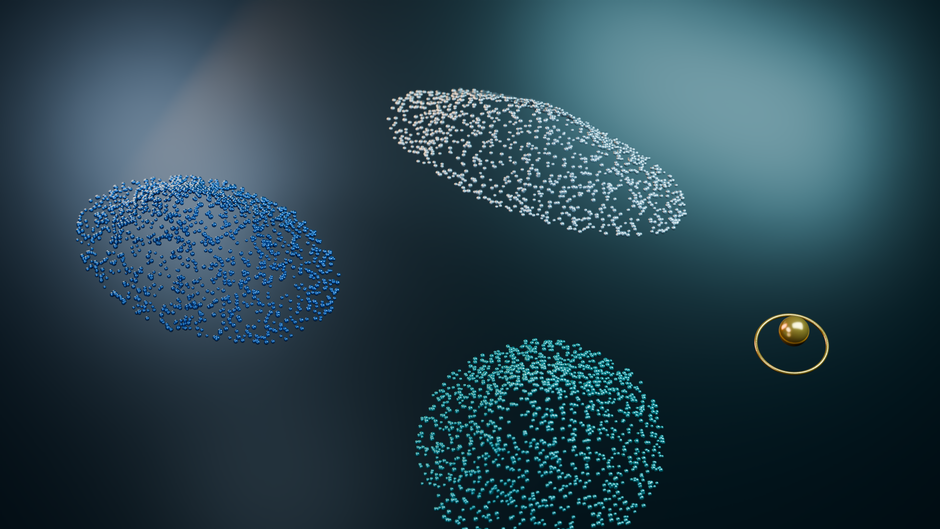
Photo by Santhosh Kanthala on Pexels
Particle physics studies the most fundamental particles and forces in the universe. Our current understanding is summarized by the Standard Model of Particle Physics.
- Elementary Particles: Particles not made of smaller components.
- Quarks: Fundamental particles that make up protons and neutrons. There are six "flavors": up, down, charm, strange, top, bottom. Protons are "up-up-down" quarks, neutrons are "up-down-down."
- Leptons: Include electrons, muons, taus, and their corresponding neutrinos. These particles don't experience the strong nuclear force.
- Bosons: Force-carrying particles.
- Photons: Carry the electromagnetic force (light).
- Gluons: Carry the strong nuclear force (bind quarks together).
- W and Z Bosons: Carry the weak nuclear force (responsible for radioactive decay).
- Higgs Boson: Responsible for giving other particles mass.
- Antiparticles: Every particle has an antiparticle with the same mass but opposite charge and other quantum numbers (e.g., electron and positron). When a particle and antiparticle meet, they annihilate, converting their mass into energy.
- Fundamental Forces:
- Strong Nuclear Force: Strongest force, binds quarks in protons/neutrons and nucleons in the nucleus.
- Electromagnetic Force: Acts between charged particles, responsible for electricity, magnetism, and light.
- Weak Nuclear Force: Responsible for radioactive beta decay.
- Gravity: Weakest force, acts between all particles with mass or energy. (Not fully integrated into the Standard Model).
Applied Physics: Practical Uses

Photo by MART PRODUCTION on Pexels
Modern physics principles have numerous real-world applications:
- Nuclear Energy: Fission reactors generate electricity.
- Medical Applications:
- Radiation Therapy: Uses high-energy radiation to treat cancer.
- Diagnostic Imaging: PET scans (Positron Emission Tomography) use positrons from radioactive isotopes to visualize body processes. MRI (Magnetic Resonance Imaging) uses strong magnetic fields and radio waves, based on nuclear magnetic resonance, to create detailed images of organs and soft tissues.
- Sterilization: Radiation can sterilize medical equipment and food.
- Carbon Dating: Uses the known half-life of Carbon-14 to determine the age of organic materials.
- Smoke Detectors: Many use a small amount of Americium-241 (an alpha emitter) to ionize air, detecting smoke when it disrupts the current.
- Particle Accelerators: Used in research to study elementary particles by smashing them together at high speeds.
3. Worked Example
Let's look at a nuclear fission example for Uranium-235.
When a slow-moving neutron strikes a Uranium-235 nucleus, it can cause the nucleus to become unstable and split. A common fission reaction is:
$$ \text{n} + ^{235}\text{U} \rightarrow ^{141}\text{Ba} + ^{92}\text{Kr} + 3\text{n} + \text{Energy} $$
Let's break this down:
-
Initial State: You start with one neutron (n) and one Uranium-235 nucleus ($^{235}\text{U}$).
- Uranium has an atomic number (Z) of 92 (meaning 92 protons).
- Mass number (A) = 235 (92 protons + 143 neutrons).
- Total protons: 0 (from neutron) + 92 (from U) = 92
- Total neutrons: 1 (from neutron) + 143 (from U) = 144
- Total mass number (A) = 1 + 235 = 236
-
Fission Products: The Uranium nucleus splits into Barium-141 ($^{141}\text{Ba}$), Krypton-92 ($^{92}\text{Kr}$), and releases three new neutrons ($3\text{n}$).
- Barium (Ba) has Z = 56. A = 141 (56 protons + 85 neutrons).
- Krypton (Kr) has Z = 36. A = 92 (36 protons + 56 neutrons).
- Three neutrons (3n).
- Check Conservation of Charge (Protons):
- Left side: 92 protons (from U)
- Right side: 56 (from Ba) + 36 (from Kr) + 0 (from 3 neutrons) = 92 protons.
- Charge is conserved!
- Check Conservation of Mass Number (Nucleons):
- Left side: 1 (from neutron) + 235 (from U) = 236
- Right side: 141 (from Ba) + 92 (from Kr) + 3 * 1 (from 3 neutrons) = 141 + 92 + 3 = 236.
- Mass number is conserved!
-
Energy Release: A tiny amount of mass is converted into a huge amount of energy according to Einstein's $E=mc^2$. This energy is what makes fission so powerful. The three released neutrons can go on to strike other Uranium-235 nuclei, causing a chain reaction.
4. Key Takeaways
- Atomic nuclei are made of protons and neutrons, held together by the strong nuclear force.
- Radioactivity is the spontaneous decay of unstable nuclei, emitting alpha, beta, or gamma particles/rays.
- Half-life is the time for half a radioactive sample to decay and is unique for each isotope.
- Nuclear fission splits heavy nuclei, releasing energy; fusion combines light nuclei, releasing even more energy.
- The Standard Model describes fundamental particles like quarks (make up protons/neutrons), leptons (e.g., electrons), and bosons (force carriers).
- These physics principles enable nuclear power, medical diagnostics/treatments, carbon dating, and research into the universe's smallest components.
- Antimatter particles have the same mass but opposite charge and annihilate when they meet matter.
Common Mistakes to Avoid:
- Confusing fission (splitting) with fusion (combining).
- Thinking radioactivity is always "bad"; it has many beneficial applications.
- Assuming the number of protons and neutrons are always equal in a nucleus.
- Forgetting that the weak nuclear force is responsible for beta decay, not the strong force.
- Mixing up fundamental particles with composite particles (like protons/neutrons, which are made of quarks).
5. Now Try It
Imagine you have a sample of Iodine-131, which has a half-life of 8 days. If you start with 100 grams of Iodine-131, calculate how much will remain after 24 days. What type of decay do you expect Iodine-131 (which is used in medicine) to most likely undergo if it's considered a beta-minus emitter? What would be the resulting element? Success means you can correctly calculate the remaining amount and identify the new element formed after decay, showing conservation of mass number andatomic number.
The calculation for the remaining amount involves determining how many half-lives have passed:
24 days / 8 days/half-life = 3 half-lives.
After 1st half-life: 100 g / 2 = 50 g
After 2nd half-life: 50 g / 2 = 25 g
After 3rd half-life: 25 g / 2 = 12.5 g
So, 12.5 grams of Iodine-131 will remain after 24 days.
For beta-minus decay, a neutron transforms into a proton, emitting an electron and an antineutrino.
Iodine (I) has an atomic number (Z) of 53.
The mass number (A) remains the same, but the atomic number increases by 1.
So, $^{131}_{53}\text{I} \rightarrow ^{131}_{54}\text{Xe} + \text{e}^- + \bar{\nu}_e$
The resulting element is Xenon (Xe) with an atomic number of 54.
Frequently asked about Modern Physics: Nuclear, Particle, and Applied Physics
Study this next
Get the full Physics curriculum
Clone the complete plan to your dashboard for unlimited AI-generated notes, practice quizzes, and a personalised revision schedule.
Save this course free