Human Geography: Population and Settlement
From the Geography curriculum
TL;DR
Population and settlement explores how many people live where, why they choose those places, and how these choices impact both human societies and the environment. We'll look at population distribution, growth, migration, and the forms and functions of settlements. Understanding these dynamics helps explain global challenges like resource scarcity and urbanization.
1. The Mental Model
Think of it like a giant, ever-shifting puzzle: people are the pieces, and settlements are the shapes they form on the land. We're trying to understand not just where the pieces are, but why they move, how they connect, and what kind of picture they create over time.
2. The Core Material
Human geography's population and settlement components are deeply intertwined. Population refers to the number of people, their characteristics, and how they change over time. Settlement describes where people live and the physical structures and social organizations they create.
Population Dynamics
Population dynamics involve three main factors that cause changes in population size: births, deaths, and migration.
- Birth Rate: The number of live births per 1,000 people in a year.
- Death Rate (Mortality Rate): The number of deaths per 1,000 people in a year.
- Natural Increase/Decrease: The difference between birth rate and death rate. If births > deaths, there's natural increase.
- Fertility Rate: The average number of children a woman is expected to have in her lifetime.
- Infant Mortality Rate: The number of deaths of infants under one year old per 1,000 live births. It's a key indicator of a region's health and development.
Understanding these rates helps us predict future population trends and the challenges/opportunities they present.
Population Distribution and Density

Photo by César Gaviria on Pexels
- Distribution: Where people live across the Earth's surface. It's often uneven, with some areas sparsely populated and others densely packed.
- Density: The number of people per unit area (e.g., people per square kilometer). High density can lead to pressures on resources and infrastructure.
Factors influencing distribution include physical geography (climate, landforms, water availability), economic opportunities (jobs, resources), and political stability.
Population Migration
Migration is the movement of people from one place to another with the intention of settling. It can be internal (within a country) or international (between countries).
- Push Factors: Reasons that force people to leave a place (e.g., war, famine, lack of jobs, natural disasters).
- Pull Factors: Reasons that attract people to a new place (e.g., better jobs, education, safety, freedom, good climate).
Migration significantly impacts both the origin and destination areas, affecting population structures, culture, and economies.
The Demographic Transition Model (DTM)
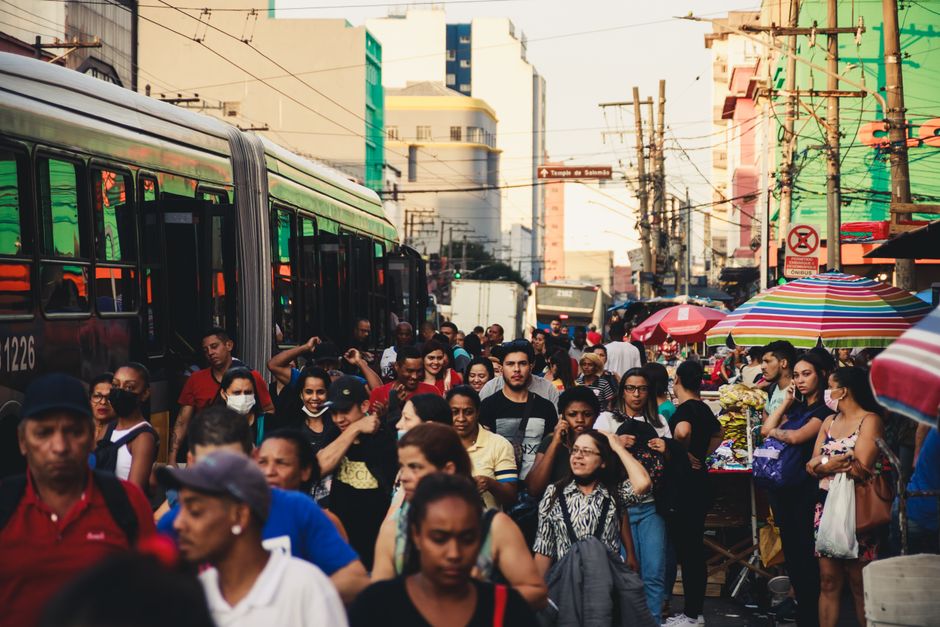
Photo by Th2city Santana on Pexels
The DTM is a four- or five-stage model that describes population change over time as a country develops economically. It links birth and death rates to levels of economic and social development.
graph TD
    Stage1["Stage 1: High fluctuating (Pre-industrial)"] --> Stage2["Stage 2: Early expanding (Early industrial)"]
    Stage1 -- "High Births & Deaths" --> Stage2
    Stage2 -- "Falling Deaths, High Births" --> Stage3["Stage 3: Late expanding (Mature industrial)"]
    Stage3 -- "Falling Births, Low Deaths" --> Stage4["Stage 4: Low fluctuating (Post-industrial)"]
    Stage4 -- "Low Births & Deaths" --> Stage5["Stage 5: Declining (Super post-industrial)"]
    Stage5 -- "Deaths > Births (population decline)" --> Stage4
- Stage 1: High Fluctuating – High birth rates and high death rates, resulting in little population growth. Common in pre-industrial societies.
- Stage 2: Early Expanding – Death rates fall rapidly due to improvements in sanitation, healthcare, and food supply. Birth rates remain high, leading to rapid population growth. Many developing countries are in this stage.
- Stage 3: Late Expanding – Birth rates start to fall as societies become more urbanized, women get more education and job opportunities, and access to contraception increases. Population growth continues but slows down.
- Stage 4: Low Fluctuating – Low birth rates and low death rates. Population growth is minimal or even slightly declining. Most developed countries are here.
- Stage 5: Declining (or 'Super Post-Industrial') – Some demographers add this stage where birth rates fall below death rates, leading to an overall population decline. Japan and some European countries are examples.
Settlement Patterns and Hierarchy
Settlements are places where people live. They vary greatly in size, function, and pattern.
- Rural Settlements: Small, often dispersed, with economies typically based on agriculture, forestry, or mining.
- Nucleated: Buildings clustered together (e.g., a village).
- Dispersed: Buildings spread out over a large area (e.g., isolated farmsteads).
- Linear: Buildings arranged in a line along a road or river.
- Urban Settlements: Larger, more dense, with diverse economies (industry, services, retail).
- Urbanization: The increase in the proportion of people living in urban areas. It's a major global trend.
- Conurbation: When several large towns/cities grow and merge.
- Megacity: A city with a population over 10 million.
- Megalopolis: A very large, heavily urbanized area, often formed by merging conurbations.
Settlement Hierarchy: A classification of settlements based on their size and range of services. A pyramid shape often illustrates this, with many small hamlets at the bottom and few large cities at the top. Larger settlements offer more specialized goods and services that serve a wider area.
Functions of Settlements
Settlements perform various functions that define their character and importance.
* Residential: Primarily housing.
* Commercial: Retail, offices, business services.
* Industrial: Manufacturing and production.
* Administrative: Government and public services.
* Recreational: Tourism and leisure.
* Religious/Educational: Centers for faith or learning.
Many larger settlements have multiple functions.
3. Worked Example
Let's look at Japan's population dynamics through the lens of the Demographic Transition Model.
- Mid-1800s (Pre-industrial): Japan was likely in Stage 1. High birth rates, high death rates (due to disease, limited healthcare, occasional famine). Population grew slowly.
- Late 1800s - Early 1900s (Industrialization): Japan rapidly industrialized. Improvements in sanitation, medicine, and food supply led to a sharp drop in death rates. Birth rates remained high due to cultural norms and agricultural economies needing more labor. This pushed Japan into Stage 2 with rapid population growth.
- Mid-20th Century (Post-WWII economic boom): As Japan became more urbanized and educated, birth rates began to fall significantly. Women had more opportunities, and contraception became available. Death rates remained low. Japan entered Stage 3, with population growth slowing down.
- Late 20th Century - Present: Japan is firmly in Stage 4 and arguably moving into Stage 5. Both birth rates and death rates are very low. The total fertility rate has dropped significantly (well below the replacement level of 2.1 children per woman), leading to an aging population and, recently, an overall population decline. This creates challenges like a shrinking workforce, increased burden on social security, and a need for more elder care.
This example shows how a country's economic and social development directly impacts its population structure and growth patterns, moving it through the stages of the DTM.
4. Key Takeaways
- Population dynamics are driven by births, deaths, and migration, impacting a region's size and structure.
- The Demographic Transition Model explains how countries' birth and death rates change with economic development.
- Population distribution and density are shaped by physical, economic, and social factors.
- Migration, influenced by push and pull factors, causes significant shifts in population globally.
- Settlements are organized into hierarchies based on size and the range of services they offer.
- Urbanization is a global trend leading to more people living in cities, which transforms landscapes and societies.
- Every settlement has functions that define its character, from residential to industrial or administrative.
Common Mistakes to Avoid:
- Don't confuse birth rate (per 1,000 people) with total fertility rate (average children per woman).
- Avoid thinking that all developing countries are in the same DTM stage; development varies greatly.
- Don't assume all migration is international; internal migration is also very significant.
- Remember that "density" refers to people per area, not just the total number of people.
- Don't simplify settlement functions; most larger settlements have multiple, complex functions.
5. Now Try It
Choose a country you're interested in, perhaps one that's currently in the news or one you've visited. Research its current birth rate, death rate, and net migration rate. Based on these figures and what you know about its level of economic development, try to identify which stage of the Demographic Transition Model you think it's in. Then, identify one major pull factor and one major push factor that might be influencing migration to or from that country.
Success looks like: You can confidently place your chosen country into a DTM stage and provide at least two relevant migration factors, explaining your reasoning for both.
Frequently asked about Human Geography: Population and Settlement
Study this next
Get the full Geography curriculum
Clone the complete plan to your dashboard for unlimited AI-generated notes, practice quizzes, and a personalised revision schedule.
Save this course free