Chemical Reactions and Stoichiometry
From the atoms ,molecules and stoichiometry curriculum
TL;DR
Chemical reactions rearrange atoms into new molecules, always conserving mass. Stoichiometry uses these balanced reaction equations to predict the amounts of reactants consumed and products formed. Mastering it helps you understand how much of each substance you need or will get in a reaction.
1. The Mental Model
Think of chemical reactions like building with LEGOs: you take apart existing structures (reactants) and use the same bricks (atoms) to build new structures (products). Stoichiometry is like following the instruction manual to know exactly how many of each type of brick you need and how many finished models you'll get.
2. The Core Material
Chemical reactions are fundamental processes where substances transform into different ones. During a chemical reaction, atoms are rearranged, but they are never created or destroyed. This is the Law of Conservation of Mass.
2.1 Representing Reactions: Chemical Equations
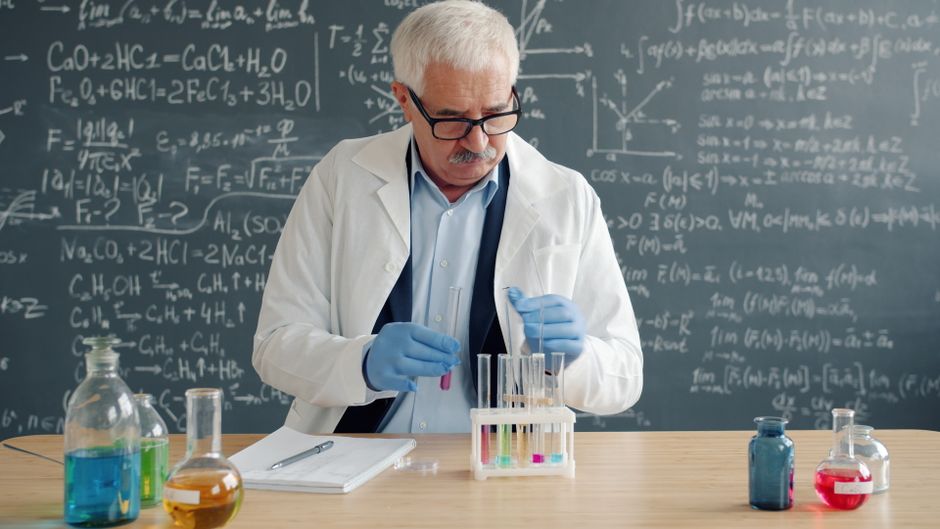
Photo by Vitaly Gariev on Pexels
We use chemical equations to represent reactions. These equations show the reactants (starting materials) on the left side and the products (new substances formed) on the right side, separated by an arrow ($\rightarrow$).
For example, when hydrogen gas (H₂) reacts with oxygen gas (O₂) to form water (H₂O), the unbalanced equation is:
H₂ + O₂ $\rightarrow$ H₂O
2.2 Balancing Chemical Equations
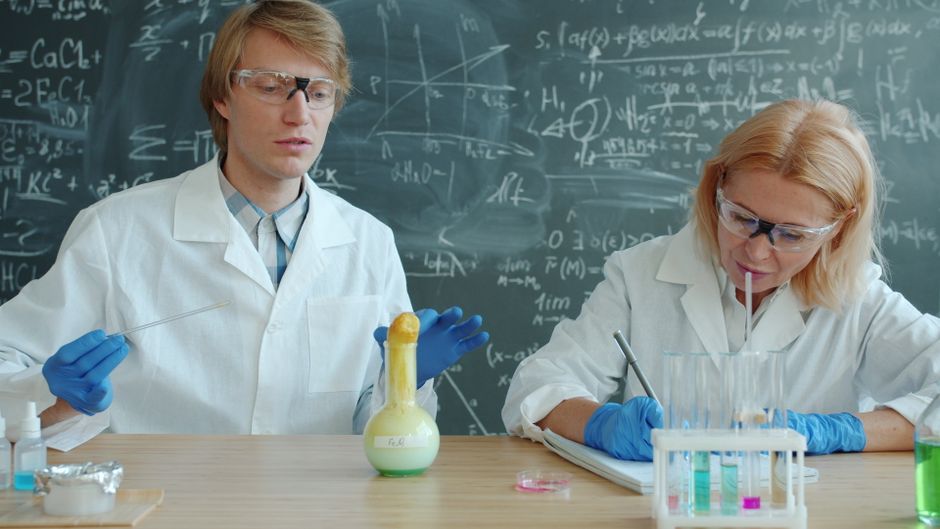
Photo by Vitaly Gariev on Pexels
According to the Law of Conservation of Mass, the number of atoms of each element must be the same on both sides of a chemical equation. This is called balancing the equation. You balance an equation by placing coefficients (whole numbers) in front of the chemical formulas. Never change the subscripts within a chemical formula; that changes the identity of the substance!
Let's balance the water formation reaction:
-
Start with the unbalanced equation:
H₂ + O₂ $\rightarrow$ H₂O -
Count atoms on each side:
- Left: H = 2, O = 2
- Right: H = 2, O = 1
-
Balance oxygen atoms: We have 2 O on the left and 1 O on the right. Put a coefficient of 2 in front of H₂O on the right side.
H₂ + O₂ $\rightarrow$ 2H₂O
Now: Left (H = 2, O = 2), Right (H = 4, O = 2) -
Balance hydrogen atoms: We now have 2 H on the left and 4 H on the right. Put a coefficient of 2 in front of H₂ on the left side.
2H₂ + O₂ $\rightarrow$ 2H₂O
Now: Left (H = 4, O = 2), Right (H = 4, O = 2) -
Check: The equation is balanced!
2.3 Stoichiometry: The Quantitative Relationships
Once an equation is balanced, the coefficients tell us the mole ratios of reactants and products. This is the core of stoichiometry. A mole is a unit that represents 6.022 x 10²³ particles (atoms, molecules, ions). We use molar mass (the mass of one mole of a substance, found by adding up atomic masses from the periodic table) to convert between grams and moles.
Here's how stoichiometry allows us to predict quantities:
graph TD
    A["Known Mass of Substance A"] --> B["Moles of Substance A (using Molar Mass A)"]
    B --> C["Moles of Substance B (using Mole Ratio from Balanced Equation)"]
    C --> D["Mass of Substance B (using Molar Mass B)"]
Essentially, stoichiometry helps answer questions like:
* "If I start with X grams of reactant A, how many grams of product B will I make?"
* "How many grams of reactant A do I need to completely react with Y grams of reactant B?"
2.4 Limiting Reactants
In most real-world reactions, reactants aren't present in perfect stoichiometric ratios. One reactant will run out first, stopping the reaction. This is called the limiting reactant. The reactant left over is the excess reactant. The amount of product formed is always determined by the limiting reactant.
To find the limiting reactant:
1. Calculate the moles of product that could be formed from each reactant, assuming the other reactant is in excess.
2. The reactant that produces the least amount of product is the limiting reactant.
2.5 Percent Yield
The theoretical yield is the maximum amount of product that could be formed based on the stoichiometry of the limiting reactant. The actual yield is the amount of product actually obtained from the reaction (usually less due to incomplete reactions, losses during purification, etc.).
Percent Yield = (Actual Yield / Theoretical Yield) x 100%
3. Worked Example
Let's consider the combustion of propane (C₃H₈), a common fuel:
C₃H₈(g) + O₂(g) $\rightarrow$ CO₂(g) + H₂O(g)
Problem: If you burn 22.0 g of propane (C₃H₈) in excess oxygen, how many grams of carbon dioxide (CO₂) will be produced?
Step 1: Balance the chemical equation.
- C₃H₈ + O₂ $\rightarrow$ CO₂ + H₂O
- Balance C: C₃H₈ + O₂ $\rightarrow$ 3CO₂ + H₂O
- Balance H: C₃H₈ + O₂ $\rightarrow$ 3CO₂ + 4H₂O
- Balance O: On the right, we have (3 x 2 O from CO₂) + (4 x 1 O from H₂O) = 6 + 4 = 10 O atoms.
So, we need 10 O atoms on the left. Put 5 in front of O₂.
C₃H₈ + 5O₂ $\rightarrow$ 3CO₂ + 4H₂O - Check: C=3, H=8, O=10 on both sides. It's balanced!
Step 2: Convert the known mass of propane to moles.
- Molar mass of C₃H₈ = (3 x 12.01 g/mol C) + (8 x 1.01 g/mol H) = 36.03 + 8.08 = 44.11 g/mol
- Moles of C₃H₈ = 22.0 g C₃H₈ / 44.11 g/mol = 0.49875 mol C₃H₈
Step 3: Use the mole ratio from the balanced equation to find moles of CO₂.
From the balanced equation, 1 mole of C₃H₈ produces 3 moles of CO₂.
- Moles of CO₂ = 0.49875 mol C₃H₈ x (3 mol CO₂ / 1 mol C₃H₈) = 1.49625 mol CO₂
Step 4: Convert moles of CO₂ to grams.
- Molar mass of CO₂ = (1 x 12.01 g/mol C) + (2 x 16.00 g/mol O) = 12.01 + 32.00 = 44.01 g/mol
- Mass of CO₂ = 1.49625 mol CO₂ x 44.01 g/mol = 65.85 g CO₂
So, burning 22.0 g of propane will produce approximately 65.9 g of carbon dioxide.
4. Key Takeaways
- Chemical reactions involve rearranging atoms, not creating or destroying them, which is the Law of Conservation of Mass.
- Balancing chemical equations ensures the number of atoms of each element is equal on both sides of the reaction.
- Coefficients in a balanced equation represent the mole ratios between reactants and products.
- Molar mass is the bridge between the mass of a substance (grams) and the number of moles.
- Stoichiometry uses balanced equations and molar masses to calculate the amounts of substances involved in a reaction.
- The limiting reactant determines the maximum amount of product that can be formed.
- Percent yield compares the actual amount of product obtained to the theoretically possible amount.
Common Mistakes to Avoid
- Not balancing the equation correctly: All stoichiometric calculations rely on a correctly balanced equation. Double-check your balancing!
- Confusing subscripts with coefficients: Never change subscripts in a chemical formula; change only the coefficients to balance.
- Forgetting to convert to moles: You must convert masses to moles before using mole ratios from the balanced equation.
- Ignoring the limiting reactant: Always identify the limiting reactant if you're given amounts for more than one reactant, as it dictates product formation.
5. Now Try It
You're trying to synthesize ammonia (NH₃) from nitrogen gas (N₂) and hydrogen gas (H₂). The balanced reaction is: N₂(g) + 3H₂(g) $\rightarrow$ 2NH₃(g).
If you start with 28.0 g of N₂ and 6.0 g of H₂, what is the maximum mass of NH₃ you can produce?
What to do:
1. Calculate the moles of N₂ and H₂ you start with.
2. Determine which reactant is the limiting reactant.
3. Calculate the moles of NH₃ produced based on the limiting reactant.
4. Convert the moles of NH₃ to grams.
What success looks like: You will have identified the limiting reactant and correctly calculated the theoretical yield of ammonia in grams.
Frequently asked about Chemical Reactions and Stoichiometry
Study this next
Get the full atoms ,molecules and stoichiometry curriculum
Clone the complete plan to your dashboard for unlimited AI-generated notes, practice quizzes, and a personalised revision schedule.
Save this course free