Stoichiometry and Chemical Reactions
From the Chem curriculum
TL;DR
Stoichiometry is all about the quantitative relationships in chemical reactions, helping us predict how much of each substance is involved. It relies on balanced chemical equations, which show the exact ratios of reactants and products. You'll use these ratios, often through moles, to convert between amounts of different substances in a reaction.
1. The Mental Model
Think of chemical reactions like recipes. A recipe tells you exactly how much of each ingredient you need and how much of the finished dish you'll get. Stoichiometry is the chemistry version of this, using balanced equations as your recipe to calculate ingredient amounts.
2. The Core Material
Stoichiometry lets us understand the "how much" in chemical reactions. It connects the mass of reactants to the mass of products, or the amount of one reactant needed to fully react with another.
Balanced Chemical Equations: The Foundation
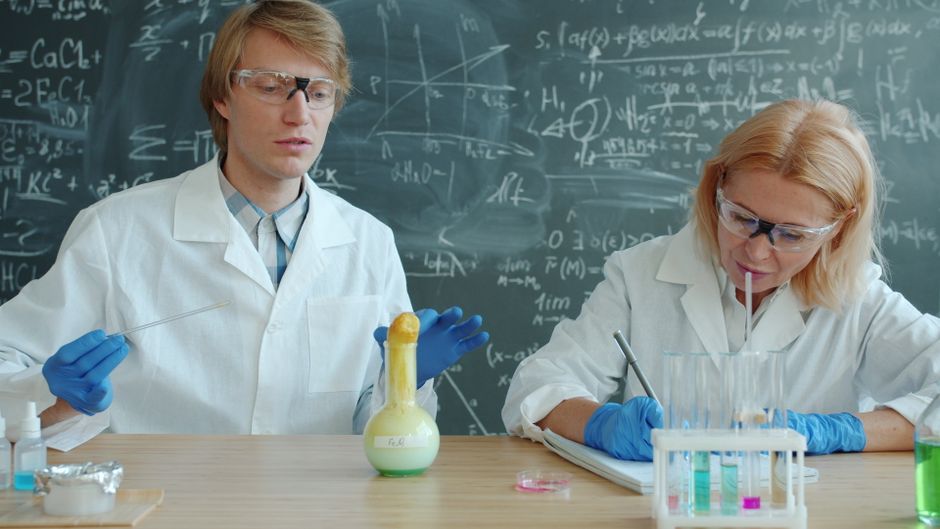
Photo by Vitaly Gariev on Pexels
Every stoichiometric calculation starts with a balanced chemical equation. This equation shows the identity of reactants and products, and the stoichiometric coefficients (the numbers in front of each formula) ensure that the number of atoms of each element is the same on both sides of the equation. This respects the Law of Conservation of Mass.
For example, the reaction of hydrogen and oxygen to form water:
2H₂(g) + O₂(g) → 2H₂O(l)
Here, the coefficients (2, 1, 2) tell us that two molecules of hydrogen react with one molecule of oxygen to produce two molecules of water. More importantly for stoichiometry, these coefficients also represent the mole ratio.
The Mole: Your Bridge
The mole is the central concept in stoichiometry. It's a way to count huge numbers of atoms or molecules, much like a "dozen" counts 12 items.
* Molar mass: The mass of one mole of a substance (in grams), numerically equal to its atomic or molecular weight (in amu). You find this on the periodic table.
* Avogadro's Number: One mole always contains 6.022 x 10²³ particles (atoms, molecules, ions).
The Stoichiometric Process
Most stoichiometry problems follow a similar path:
1. Start with a balanced chemical equation. (If not given, you'll need to write and balance it.)
2. Convert the given quantity to moles. If you have mass, use molar mass. If you have volume of a gas at STP, use 22.4 L/mol.
3. Use the mole ratio from the balanced equation to convert from moles of the known substance to moles of the desired substance. This is the crucial step.
4. Convert moles of the desired substance to the desired units. This might be mass (using molar mass), number of particles (using Avogadro's number), or volume of a gas.
Here's a visual of the process:
graph TD
    A["Given Mass of Substance A"] --> B["Moles of Substance A"];
    B --> C["Moles of Substance B"];
    C --> D["Desired Mass of Substance B"];

    B -- "Divide by Molar Mass A" --> C;
    C -- "Multiply by Mole Ratio (coeff B / coeff A)" --> D;
    D -- "Multiply by Molar Mass B" --> E;

    style A fill:#f9f,stroke:#333,stroke-width:2px;
    style E fill:#ccf,stroke:#333,stroke-width:2px;
Limiting Reactants
Sometimes, one reactant runs out before the others. This reactant is called the limiting reactant because it limits the amount of product that can be formed. The other reactant(s) are in excess. To find the limiting reactant:
1. Calculate the moles of product that could be formed from each reactant, assuming the other is in excess.
2. The reactant that produces the least amount of product is the limiting reactant.
Percent Yield
In real experiments, you often don't get 100% of the theoretical product. Percent yield compares your actual yield (what you actually get in the lab) to the theoretical yield (what you should get based on stoichiometry).
Percent Yield = (Actual Yield / Theoretical Yield) x 100%
The actual yield is found experimentally, while the theoretical yield is calculated using stoichiometry.
3. Worked Example
Let's say you react 10.0 g of hydrogen gas (H₂) with excess oxygen gas (O₂) to produce water (H₂O). How many grams of water can you produce?
- Balanced Equation:
2H₂(g) + O₂(g) → 2H₂O(l) - Convert given to moles:
- Molar mass of H₂ = 2 * 1.008 g/mol = 2.016 g/mol
- Moles of H₂ = 10.0 g H₂ / 2.016 g/mol = 4.96 mol H₂
- Use mole ratio to find moles of desired substance:
- From the balanced equation, 2 moles of H₂ produce 2 moles of H₂O. So, the ratio is 2 mol H₂O / 2 mol H₂ = 1.
- Moles of H₂O = 4.96 mol H₂ * (2 mol H₂O / 2 mol H₂) = 4.96 mol H₂O
- Convert moles of desired substance to desired units (grams):
- Molar mass of H₂O = (2 * 1.008 g/mol) + 16.00 g/mol = 18.016 g/mol
- Mass of H₂O = 4.96 mol H₂O * 18.016 g/mol = 89.4 g H₂O
So, you can produce 89.4 grams of water.
4. Key Takeaways
- Always start with a balanced chemical equation to get the correct mole ratios.
- The mole is your central unit for converting between different substances in a reaction.
- Molar mass is essential for converting between grams and moles.
- Use the mole ratio from the balanced equation to switch from moles of one substance to moles of another.
- The limiting reactant determines the maximum amount of product you can make.
- Percent yield compares what you actually get to what you theoretically should get.
Common Mistakes to Avoid:
- Forgetting to balance the chemical equation before starting calculations.
- Using mass ratios directly from the coefficients instead of mole ratios.
- Not correctly identifying the limiting reactant when multiple reactant amounts are given.
- Mixing up actual yield and theoretical yield when calculating percent yield.
5. Now Try It
You have 25.0 g of magnesium (Mg) and 30.0 g of oxygen (O₂). They react to form magnesium oxide (MgO).
- Write and balance the chemical equation for this reaction.
- Determine the limiting reactant.
- Calculate the theoretical yield of magnesium oxide in grams.
Success means you've correctly balanced the equation, identified which reactant runs out first, and accurately calculated the maximum mass of MgO that can be formed.
Frequently asked about Stoichiometry and Chemical Reactions
Study this next
Get the full Chem curriculum
Clone the complete plan to your dashboard for unlimited AI-generated notes, practice quizzes, and a personalised revision schedule.
Save this course free