Designing Investigable Experiments
From the Science curriculum
TL;DR
Designing a good experiment means clearly defining what you're testing, how you'll measure it, and controlling other factors. You need a testable hypothesis, specific variables, and a plan to collect and analyze data. This structured approach ensures your results are meaningful and reliable.
1. The Mental Model
Think of an experiment as a carefully constructed question you're asking the world. You're not just observing; you're actively changing one thing to see how it affects another, while making sure everything else stays the same.
2. The Core Material
Designing an investigable experiment means setting it up so you can actually get clear, meaningful answers. It's about being organized and precise before you even start.
The Hypothesis: Your Educated Guess

Photo by Tara Winstead on Pexels
An experiment always starts with a hypothesis. This is a testable statement, often an "If..., then..." prediction, about the relationship between two or more things. It's your educated guess about what will happen.
- Example: "If I increase the amount of sunlight a plant receives, then its growth rate will increase."
Variables: What You Measure and Control

Photo by DS stories on Pexels
Variables are the factors that can change in an experiment. You need to identify three main types:
- Independent Variable (IV): This is the one thing you intentionally change or manipulate.
- Example (from above): Amount of sunlight.
- Dependent Variable (DV): This is what you measure to see if it changes in response to your independent variable. It "depends" on the IV.
- Example: Plant growth rate (e.g., height, number of leaves).
- Control Variables: These are all the other factors you must keep constant throughout the experiment so they don't influence your results. If these change, you won't know if your IV or something else caused the effect.
- Example: Type of plant, amount of water, type of soil, temperature, pot size.
Experimental and Control Groups

Photo by MART PRODUCTION on Pexels
Often, you'll have two groups:
- Experimental Group: This group receives the manipulation of the independent variable.
- Control Group: This group does not receive the independent variable manipulation, or receives a standard/baseline amount. It serves as a comparison to see what happens under normal conditions.
Procedures and Data Collection
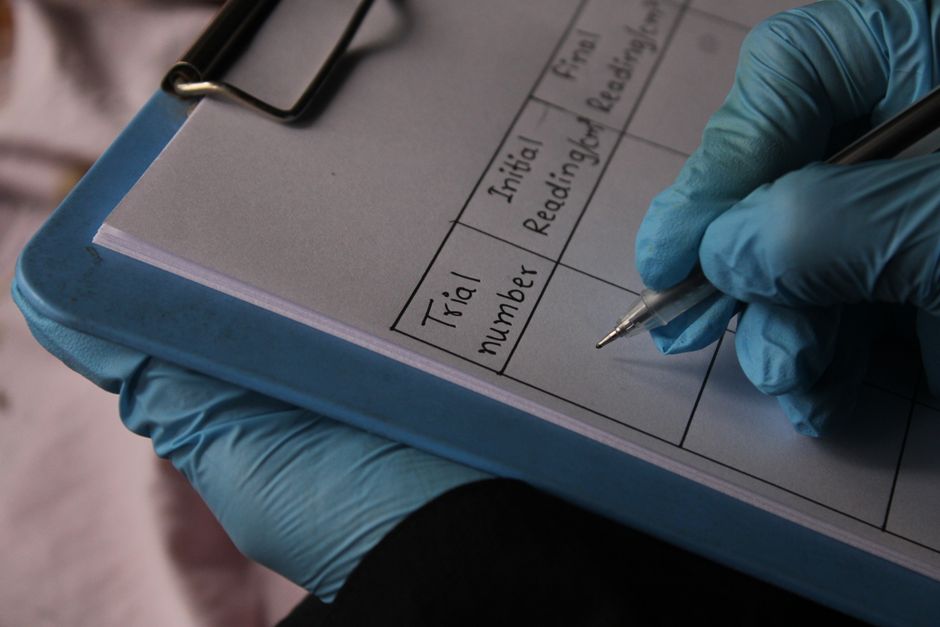
Photo by Jahra Tasfia Reza on Pexels
Your procedure is a step-by-step guide on how you'll conduct the experiment. It needs to be detailed enough for someone else to replicate it. You also need a plan for how you'll collect data (what you'll measure, how often, and how you'll record it).
Here's how these steps generally flow:
graph TD
    A["Formulate a Question"] --> B["Develop a Testable Hypothesis"]
    B --> C["Identify Independent Variable (IV)"]
    B --> D["Identify Dependent Variable (DV)"]
    C & D --> E["List Control Variables"]
    E --> F["Design Procedure & Materials"]
    F --> G["Determine Data Collection Method"]
    G --> H["Plan for Analysis & Conclusion"]
Reproducibility and Validity
A good experiment is reproducible, meaning someone else can follow your steps and get similar results. It's also valid if it actually measures what it's supposed to measure and controls for other influences.
3. Worked Example
Let's design an experiment to test if a new fertilizer (Fertilizer X) increases the height of tomato plants.
1. Question: Does Fertilizer X increase the height of tomato plants?
2. Hypothesis: If tomato plants are treated with Fertilizer X, then they will grow taller than tomato plants not treated with Fertilizer X.
3. Variables:
* Independent Variable (IV): Application of Fertilizer X (e.g., Group 1 gets Fertilizer X, Group 2 doesn't).
* Dependent Variable (DV): Height of the tomato plants (measured in cm).
* Control Variables:
* Type of tomato plant (e.g., all 'Roma' tomatoes).
* Amount of water given daily.
* Amount and type of soil in each pot.
* Amount of sunlight received daily.
* Temperature exposure.
* Pot size.
* Starting height of plants (use seedlings of similar height).
* Frequency and amount of fertilizer application (for the experimental group).
4. Groups:
* Experimental Group: 10 tomato plants, each receiving 5g of Fertilizer X mixed with water once a week.
* Control Group: 10 tomato plants, each receiving the same amount of plain water (no fertilizer) once a week.
5. Procedure Sketch:
* Obtain 20 'Roma' tomato seedlings of similar height.
* Plant each seedling in an identical pot with the same amount of identical soil.
* Place all 20 pots in the same location to ensure equal sunlight and temperature.
* Label 10 pots "Experimental" and 10 pots "Control."
* For 4 weeks, every Monday:
* Water all plants with 200ml of water.
* For "Experimental" plants, add 5g of Fertilizer X to the 200ml water.
* For "Control" plants, use only 200ml of plain water.
* Measure the height of each plant (from soil level to the tallest point) every Friday and record it in a table.
6. Data Analysis: Compare the average growth (final height - initial height) of the experimental group to the control group. If the experimental group shows significantly more growth, our hypothesis is supported.
4. Key Takeaways
- Start with a clear, testable hypothesis before doing anything else.
- Identify and clearly define your independent (what you change) and dependent (what you measure) variables.
- List all control variables you need to keep constant to ensure a fair test.
- Include a control group for comparison whenever possible.
- Write a detailed, step-by-step procedure so others can replicate your work.
- Plan how you'll collect and analyze your data to get meaningful results.
Common Mistakes to Avoid:
- Changing too many things at once: If your independent variable isn't the only thing you change, you won't know what caused your results.
- Vague measurements: Not being specific about how you'll measure your dependent variable (e.g., "plant health" vs. "number of green leaves").
- Insufficient sample size: Testing only one or two subjects might lead to unreliable or unrepresentative results.
- Ignoring control variables: Forgetting to keep external factors constant, which can skew your findings.
5. Now Try It
You want to investigate if different types of music affect students' memory recall. Design a simple experiment for this.
What to do:
1. Formulate a clear, testable hypothesis.
2. Identify your independent, dependent, and at least three control variables.
3. Describe your experimental and control groups.
4. Outline a brief procedure for how you would conduct this experiment over one session.
What success looks like:
You'll have a clear, concise plan that directly addresses the question, defines measurable variables, and accounts for factors that could bias your results.
Frequently asked about Designing Investigable Experiments
Study this next
Get the full Science curriculum
Clone the complete plan to your dashboard for unlimited AI-generated notes, practice quizzes, and a personalised revision schedule.
Save this course free