Review of Key Concepts and Problem Solving
From the chem curriculum
TL;DR
This note will help you solidify your understanding of core chemistry concepts and improve your ability to tackle problems effectively. We'll refresh key ideas and walk through a structured approach to problem-solving. Mastering these will boost your confidence in chemistry.
1. The Mental Model
Think of chemistry problem-solving like baking: you need to understand the ingredients (concepts), know the recipe (steps), and be able to adjust if something goes wrong. It's about combining knowledge with a systematic approach.
2. The Core Material
To ace chemistry problems, you need a strong grasp of foundational concepts and a solid problem-solving strategy. Let's break down some key areas and then a universal approach.
2.1 Essential Chemistry Concepts
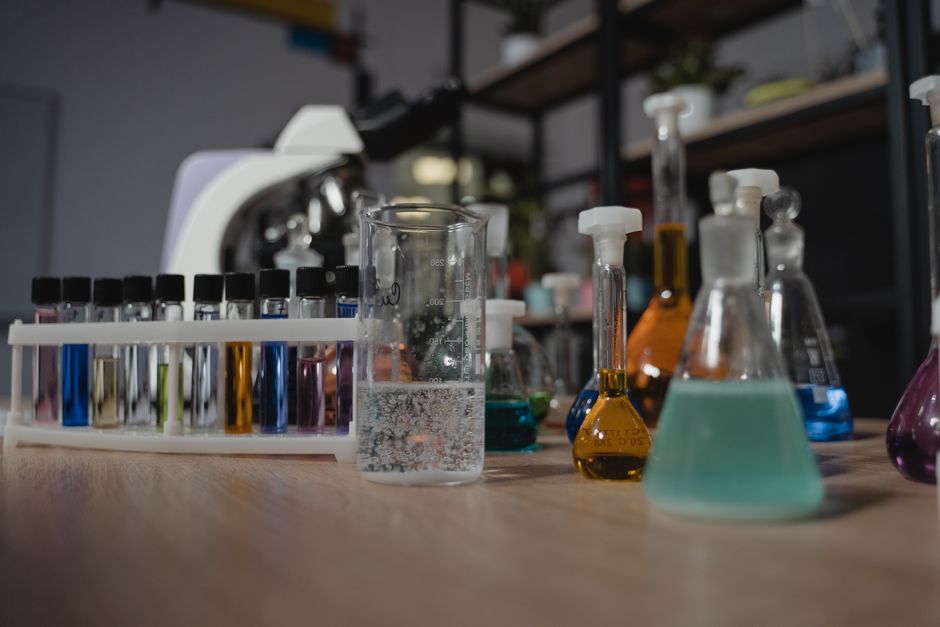
Photo by Tima Miroshnichenko on Pexels
Here's a quick refresher on areas that often appear in problems:
- Stoichiometry: This is about the quantitative relationships between reactants and products in chemical reactions. Think moles, molar mass, limiting reactants, and theoretical yield. If you can balance an equation and convert between grams and moles, you're on the right track.
- Atomic Structure & Periodicity: Remember protons, neutrons, electrons, electron configurations, and how elements' properties vary across the periodic table (e.g., electronegativity, ionization energy, atomic radius).
- Bonding & Molecular Geometry: Understand ionic vs. covalent bonds, Lewis structures, VSEPR theory (to predict shapes like tetrahedral, trigonal planar), and polarity. Molecular shape impacts properties!
- States of Matter & Intermolecular Forces (IMFs): Why do some substances boil at low temperatures and others at high? It's often due to IMFs like hydrogen bonding, dipole-dipole, and London dispersion forces.
- Acids & Bases: Know your strong vs. weak acids/bases, pH calculations, and acid-base reactions.
- Chemical Equilibrium: Understand Le Chatelier's Principle and how changes in concentration, temperature, or pressure affect a system at equilibrium.
2.2 The Problem-Solving Blueprint

Photo by RDNE Stock project on Pexels
Solving chemistry problems isn't just about knowing the right formula; it's about applying it correctly and systematically. Here's a flow you can follow:
graph TD
    A["Read & Understand the Problem"] --> B["Identify Given & Unknowns"]
    B --> C["Plan Your Approach (Concepts & Formulas)"]
    C --> D["Execute the Plan (Calculations)"]
    D --> E["Check Your Work (Units, Sig Figs, Reasonableness)"]
    E --> F["State Your Final Answer Clearly"]
- Read & Understand: Don't just skim! Read the problem carefully, perhaps twice. What is it asking? What context is provided?
- Identify Given & Unknowns: List all the information explicitly provided (e.g., mass, volume, temperature) and what you need to find. This helps organize your thoughts.
- Plan Your Approach: This is crucial. What concepts relate to the problem? What formulas might you need? Sometimes you need multiple steps. Think backwards from the unknown to the known.
- Execute the Plan: Do the calculations, step-by-step. Show your work clearly.
- Check Your Work:
- Units: Did your units cancel out to give the correct final unit?
- Significant Figures: Is your answer reported with the correct number of significant figures?
- Reasonableness: Does the answer make sense? If you calculated a mass of 1000 kg for a small reaction, something's probably wrong.
- State Final Answer: Write down your answer clearly with correct units and significant figures.
3. Worked Example
Let's try a stoichiometry problem:
Problem: How many grams of water (H₂O) are produced when 10.0 grams of methane (CH₄) react completely with excess oxygen (O₂) according to the following balanced equation?
CH₄(g) + 2O₂(g) → CO₂(g) + 2H₂O(l)
Solution:
- Read & Understand: The problem asks for the mass of water produced from a given mass of methane. It's a stoichiometry problem.
- Identify Given & Unknowns:
- Given: Mass of CH₄ = 10.0 g
- Unknown: Mass of H₂O (g)
- Reaction: CH₄(g) + 2O₂(g) → CO₂(g) + 2H₂O(l) (already balanced)
-
Plan Your Approach:
- First, convert grams of CH₄ to moles of CH₄ using its molar mass.
- Then, use the mole ratio from the balanced equation to convert moles of CH₄ to moles of H₂O.
- Finally, convert moles of H₂O to grams of H₂O using its molar mass.
-
Execute the Plan:
-
Molar masses:
- CH₄: 12.01 g/mol (C) + 4 * 1.008 g/mol (H) = 16.04 g/mol
- H₂O: 2 * 1.008 g/mol (H) + 16.00 g/mol (O) = 18.02 g/mol
-
Calculation:
10.0 g CH₄ * (1 mol CH₄ / 16.04 g CH₄) * (2 mol H₂O / 1 mol CH₄) * (18.02 g H₂O / 1 mol H₂O) = 22.4563... g H₂O
-
-
Check Your Work:
- Units: g CH₄ * (mol CH₄/g CH₄) * (mol H₂O/mol CH₄) * (g H₂O/mol H₂O) = g H₂O. Units are correct.
- Sig Figs: Initial given (10.0 g CH₄) has 3 significant figures. Molar masses are typically known to at least 4 sig figs, and the mole ratio is exact. So, the answer should have 3 sig figs.
- Reasonableness: Methane has a molar mass of ~16 g/mol, and water is ~18 g/mol. From the equation, 1 mole of CH₄ produces 2 moles of H₂O. So, you'd expect to produce more than 10.0 g of water, which 22.5 g is. Seems reasonable.
-
State Final Answer: 22.5 g H₂O are produced.
4. Key Takeaways
- Always read the problem carefully to understand what's asked and given.
- Break down complex problems into smaller, manageable steps.
- Use molar masses and balanced equations to convert between grams and moles, and between different substances.
- Always include units in your calculations and ensure they cancel correctly.
- Pay attention to significant figures in your final answer.
- Develop a habit of checking if your answer makes sense in the real world.
Common Mistakes to Avoid:
- Not balancing the chemical equation before doing stoichiometry.
- Mixing up molar mass for individual atoms with molar mass for molecules.
- Forgetting to convert to moles before using mole ratios.
- Ignoring units or significant figures in calculations.
- Jumping straight to calculations without a clear plan.
5. Now Try It
Spend 15 minutes reviewing the chapter on gases (e.g., Ideal Gas Law, partial pressures). Then, try to solve the following problem: "A 2.00 L container holds 4.00 grams of an unknown gas at 27 °C and 1.50 atm. What is the molar mass of the gas?" Your success looks like you applying the problem-solving blueprint to arrive at the correct molar mass (around 32.8 g/mol) with correct units and significant figures.
Frequently asked about Review of Key Concepts and Problem Solving
More from chem
Get the full chem curriculum
Clone the complete plan to your dashboard for unlimited AI-generated notes, practice quizzes, and a personalised revision schedule.
Save this course free