Centre of Mass
From the system of particles curriculum
TL;DR
The Centre of Mass (CM) is a special point representing the average position of all the mass in a system. It's where you can imagine the entire mass of an object or system is concentrated for simplified analysis. This point helps predict how an object moves or balances without needing to track every single particle individually.
1. The Mental Model
Imagine you're trying to balance an oddly shaped object on your fingertip. There's usually just one spot where it balances perfectly without falling. That spot is its Centre of Mass. It's the "balancing point" of an object or a system of objects.
2. The Core Material
The Centre of Mass (CM) is a fundamental concept in physics, especially when dealing with the motion of multiple particles or extended objects. Instead of calculating forces and movements for every tiny piece of an object, we can often simplify things by considering only the CM.
What is it, really?

Photo by Ann H on Pexels
The CM is a weighted average of the positions of all the particles in a system, where the "weight" is the mass of each particle. This means heavier particles have a greater influence on the CM's location.
How to Calculate the Centre of Mass

Photo by artmondday _ on Pexels
For a System of Discrete Particles
If you have several distinct particles, each with its own mass and position, you can find the CM using these formulas:
For the x-coordinate of the CM:
$X_{CM} = \frac{m_1x_1 + m_2x_2 + ... + m_nx_n}{m_1 + m_2 + ... + m_n} = \frac{\sum m_i x_i}{\sum m_i}$
For the y-coordinate of the CM:
$Y_{CM} = \frac{m_1y_1 + m_2y_2 + ... + m_ny_n}{m_1 + m_2 + ... + m_n} = \frac{\sum m_i y_i}{\sum m_i}$
And similarly for the z-coordinate in 3D:
$Z_{CM} = \frac{\sum m_i z_i}{\sum m_i}$
Here:
* $m_i$ is the mass of the i-th particle.
* $(x_i, y_i, z_i)$ are the coordinates of the i-th particle.
* $\sum m_i$ is the total mass of the system ($M_{total}$).
For Continuous Objects
For solid objects (where mass is continuously distributed), you'd use integration instead of summation. This is more complex and involves density functions, but the idea is the same: averaging the positions weighted by mass. For many uniform, symmetric objects (like a sphere or a cube), the CM is simply at its geometric center.
Why is the Centre of Mass Important?

Photo by Ann H on Pexels
- Simplified Motion Analysis: When an external force acts on a system, the CM moves as if all the system's mass were concentrated there and all external forces acted directly on it. This simplifies Newton's second law for the system: $F_{net} = M_{total} a_{CM}$.
- Balancing and Stability: An object is stable if its CM is within its base of support. Think about why a wide-based stool is harder to tip over than a narrow one – its CM needs to be moved further outside its base.
- Collision Analysis: In collisions, the total momentum of a system of particles is conserved, and often, analyzing the motion of the CM before and after a collision is key.
Relationship to other concepts:
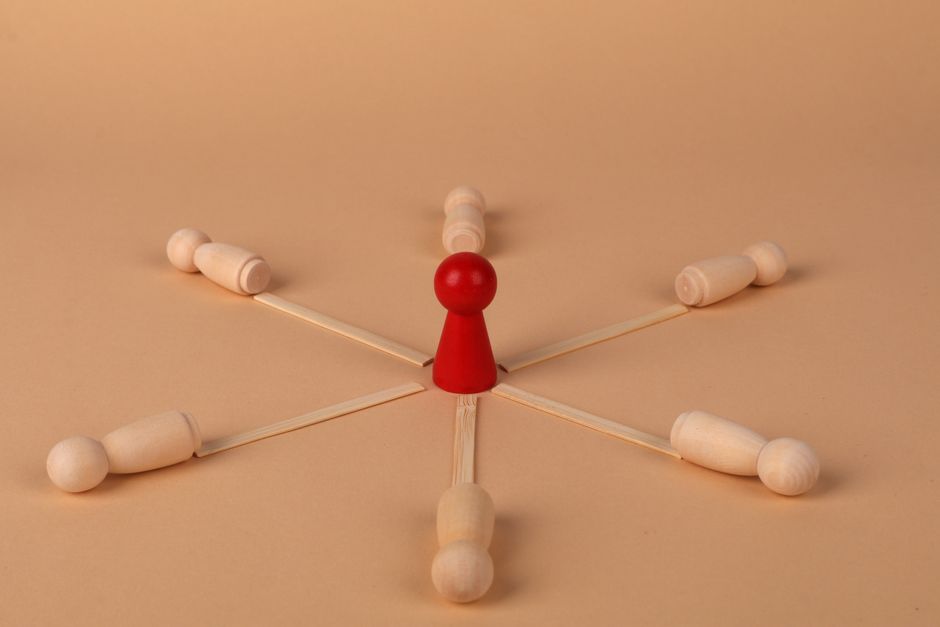
Photo by Ann H on Pexels
graph TD
    A["System of Particles"] --> B["Individual Masses & Positions"]
    B --> C["Weighted Average Calculation"]
    C --> D["Centre of Mass (CM)"]
    D --> E["Simplifies Newton's Laws"]
    D --> F["Key for Stability & Balance"]
    D --> G["Crucial for Collision Analysis"]
    E --> H["F_net = M_total * a_CM"]
3. Worked Example
Let's find the Centre of Mass for a simple system.
Imagine you have three particles:
* Particle 1: $m_1 = 2 \text{ kg}$ at position $(1 \text{ m}, 2 \text{ m})$
* Particle 2: $m_2 = 3 \text{ kg}$ at position $(-2 \text{ m}, 1 \text{ m})$
* Particle 3: $m_3 = 5 \text{ kg}$ at position $(0 \text{ m}, -3 \text{ m})$
First, calculate the total mass of the system:
$M_{total} = m_1 + m_2 + m_3 = 2 \text{ kg} + 3 \text{ kg} + 5 \text{ kg} = 10 \text{ kg}$
Now, let's find the x-coordinate of the CM ($X_{CM}$):
$X_{CM} = \frac{m_1x_1 + m_2x_2 + m_3x_3}{M_{total}}$
$X_{CM} = \frac{(2 \text{ kg})(1 \text{ m}) + (3 \text{ kg})(-2 \text{ m}) + (5 \text{ kg})(0 \text{ m})}{10 \text{ kg}}$
$X_{CM} = \frac{2 \text{ kg}\cdot\text{m} - 6 \text{ kg}\cdot\text{m} + 0 \text{ kg}\cdot\text{m}}{10 \text{ kg}}$
$X_{CM} = \frac{-4 \text{ kg}\cdot\text{m}}{10 \text{ kg}} = -0.4 \text{ m}$
Next, find the y-coordinate of the CM ($Y_{CM}$):
$Y_{CM} = \frac{m_1y_1 + m_2y_2 + m_3y_3}{M_{total}}$
$Y_{CM} = \frac{(2 \text{ kg})(2 \text{ m}) + (3 \text{ kg})(1 \text{ m}) + (5 \text{ kg})(-3 \text{ m})}{10 \text{ kg}}$
$Y_{CM} = \frac{4 \text{ kg}\cdot\text{m} + 3 \text{ kg}\cdot\text{m} - 15 \text{ kg}\cdot\text{m}}{10 \text{ kg}}$
$Y_{CM} = \frac{-8 \text{ kg}\cdot\text{m}}{10 \text{ kg}} = -0.8 \text{ m}$
So, the Centre of Mass for this system of particles is at $(-0.4 \text{ m}, -0.8 \text{ m})$.
4. Key Takeaways
- The Centre of Mass is the "average" position of all the mass in a system, weighted by each mass's magnitude.
- It's a single point that represents the entire system for analyzing its overall motion.
- For symmetric, uniform objects, the CM is usually at their geometric center.
- The CM concept simplifies complex problems involving multiple particles or extended bodies.
- The external forces acting on a system cause its CM to accelerate as if all the mass were concentrated there.
Common mistakes to avoid:
- Forgetting to include all masses in the total mass calculation in the denominator.
- Not correctly using the signs (positive/negative) of the coordinates.
- Confusing Centre of Mass with Centre of Gravity: They are the same in a uniform gravitational field, but theoretically, the Centre of Gravity depends on the local gravitational field and can be different if gravity varies significantly over the object.
- Assuming the CM must be inside the physical object: For objects like a doughnut or an L-shaped rod, the CM can be in empty space.
5. Now Try It
Calculate the Centre of Mass for a system of two particles: a 4 kg particle at (3 m, 0 m) and a 6 kg particle at (-2 m, 0 m). What would happen to the CM if the 6 kg particle was moved to (-2 m, 5 m) instead? Success looks like finding both CM coordinates for the first scenario and explaining the change for the second.
Frequently asked about Centre of Mass
More from system of particles
Get the full system of particles curriculum
Clone the complete plan to your dashboard for unlimited AI-generated notes, practice quizzes, and a personalised revision schedule.
Save this course free