Torque and Angular Momentum
From the system of particles curriculum
TL;DR
Torque is the rotational equivalent of force, causing an object to rotate or change its rotational motion. Angular momentum is the rotational equivalent of linear momentum, representing an object's tendency to keep rotating. The principle of conservation of angular momentum states that an object's total angular momentum remains constant unless an external torque acts on it.
1. The Mental Model
Think of torque as the "oomph" that gets something spinning or changes its spin. Angular momentum is how much "spin" an object has, and it tends to stay constant unless something specifically tries to change it.
2. The Core Material
What is Torque?

Photo by Nic Wood on Pexels
Torque, often represented by the Greek letter tau (τ), is a twisting force that can cause an object to rotate around an axis. It's not just about the strength of the force, but also where and how you apply it.
The formula for torque is:
$\tau = rF\sin\theta$
Where:
* $\tau$ is the torque.
* $r$ is the distance from the pivot point (axis of rotation) to where the force is applied (this is often called the lever arm).
* $F$ is the magnitude of the applied force.
* $\theta$ is the angle between the force vector and the lever arm vector.
The maximum torque occurs when the force is applied perpendicular ($\theta = 90^\circ$, so $\sin\theta = 1$) to the lever arm. If you push directly towards or away from the pivot, there's no torque ($\theta = 0^\circ$ or $180^\circ$, so $\sin\theta = 0$).
What is Angular Momentum?
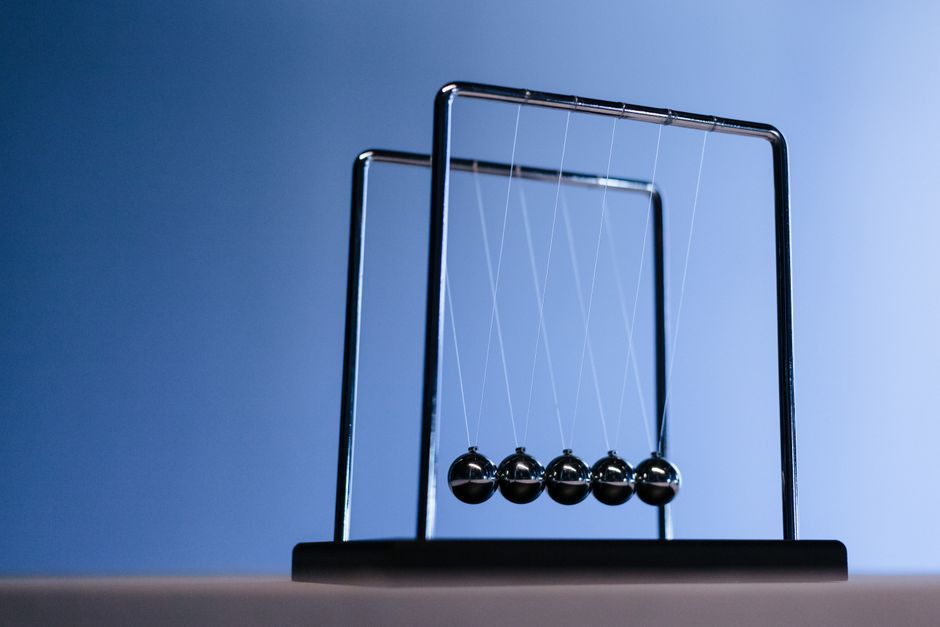
Photo by Ron Lach on Pexels
Angular momentum, represented by $L$, is a measure of the rotational motion of an object. For a single particle moving in a circle, or a rigid body rotating around an axis, it's given by:
$L = I\omega$
Where:
* $L$ is the angular momentum.
* $I$ is the moment of inertia, which is a measure of an object's resistance to changes in its rotational motion. It depends on the object's mass and how that mass is distributed relative to the axis of rotation.
* $\omega$ (omega) is the angular velocity, which is how fast the object is rotating (in radians per second).
Think of moment of inertia as the rotational equivalent of mass. A heavy object far from the axis is harder to get spinning than a light object close to the axis, even if they have the same total mass.
Conservation of Angular Momentum

Photo by Jose Manuel Gonzalez Lupiañez Photography on Pexels
This is a super important principle! Just like linear momentum, angular momentum is conserved if there's no external net torque acting on the system. This means if $L_{initial} = L_{final}$, then $I_{initial}\omega_{initial} = I_{final}\omega_{final}$.
This principle explains a lot of cool phenomena:
* An ice skater spins faster when she pulls her arms in (reducing her moment of inertia, $I$, so her angular velocity, $\omega$, must increase to keep $L$ constant).
* A planet speeds up when it's closer to the sun (its $I$ changes, so its $\omega$ must adjust).
Here's a visual of how torque relates to angular momentum:
graph TD
    A["Force (F) applied at distance (r) from pivot"] --> B{"Angle (θ) between F and r"};
    B -- "If θ = 90°" --> C["Maximum Torque"];
    B -- "If θ = 0° or 180°" --> D["Zero Torque"];
    C --> E["Torque (τ) produced"];
    D --> E;
    E --> F{"Is there an external net torque?"};
    F -- "Yes" --> G["Angular Momentum (L) changes"];
    F -- "No" --> H["Angular Momentum (L) is conserved"];
    G --> I["Change in angular velocity (Δω)"];
    H --> J["Constant angular velocity or adjustable moment of inertia"];
3. Worked Example
Let's say you have a merry-go-round with a moment of inertia $I_1 = 100 \text{ kg}\cdot\text{m}^2$ spinning at an angular velocity $\omega_1 = 2 \text{ rad/s}$. A child of mass $25 \text{ kg}$ standing still then jumps onto the edge of the merry-go-round, $2 \text{ m}$ from its center. What's the new angular velocity of the merry-go-round with the child on it?
Assume no external torque (like friction) acts on the system.
-
Initial Angular Momentum:
The merry-go-round's initial angular momentum is $L_1 = I_1\omega_1 = (100 \text{ kg}\cdot\text{m}^2)(2 \text{ rad/s}) = 200 \text{ kg}\cdot\text{m}^2/\text{s}$.
The child is initially not spinning with the merry-go-round, so their initial angular momentum relative to the merry-go-round's center is zero.
So, $L_{initial} = 200 \text{ kg}\cdot\text{m}^2/\text{s}$. -
Final Moment of Inertia:
When the child jumps on, they add to the system's moment of inertia. For a point mass (like the child) at a distance $r$ from the axis, $I_{child} = mr^2$.
$I_{child} = (25 \text{ kg})(2 \text{ m})^2 = (25 \text{ kg})(4 \text{ m}^2) = 100 \text{ kg}\cdot\text{m}^2$.
The total final moment of inertia is $I_{final} = I_1 + I_{child} = 100 \text{ kg}\cdot\text{m}^2 + 100 \text{ kg}\cdot\text{m}^2 = 200 \text{ kg}\cdot\text{m}^2$. -
Final Angular Velocity (using Conservation of Angular Momentum):
Since no external torque acts, $L_{initial} = L_{final}$.
$L_{initial} = I_{final}\omega_{final}$
$200 \text{ kg}\cdot\text{m}^2/\text{s} = (200 \text{ kg}\cdot\text{m}^2)\omega_{final}$
$\omega_{final} = \frac{200 \text{ kg}\cdot\text{m}^2/\text{s}}{200 \text{ kg}\cdot\text{m}^2} = 1 \text{ rad/s}$.
So, the merry-go-round now spins at $1 \text{ rad/s}$, half its original speed, because the total moment of inertia doubled.
4. Key Takeaways
- Torque is the rotational force that causes an object's angular velocity to change.
- Torque depends on the force's magnitude, the lever arm's length, and the angle between them.
- Angular momentum is a measure of an object's "spin," depending on its moment of inertia and angular velocity.
- The moment of inertia quantifies how mass is distributed relative to the axis of rotation, affecting resistance to rotational change.
- Angular momentum is conserved (stays constant) unless an external net torque acts on the system.
- Objects speed up rotation when their moment of inertia decreases, and slow down when it increases, due to conservation of angular momentum.
Common Mistakes to Avoid:
- Forgetting the $\sin\theta$ term in the torque formula, especially if the force isn't perpendicular to the lever arm.
- Confusing moment of inertia with mass; they're related but distinct, with moment of inertia also considering mass distribution.
- Not identifying all parts of a system when calculating total moment of inertia, particularly when components are added or removed.
- Assuming angular momentum is always conserved; remember, it only holds when net external torque is zero.
5. Now Try It
Imagine you're holding a spinning bicycle wheel by its axle. The wheel has a moment of inertia of $0.5 \text{ kg}\cdot\text{m}^2$ and is spinning clockwise at $10 \text{ rad/s}$. Now, you apply a force of $5 \text{ N}$ tangential to the rim of the wheel, $0.3 \text{ m}$ from the axle, trying to speed it up in the same direction for $2 \text{ seconds}$. Calculate the torque you applied and the wheel's new angular velocity after 2 seconds. Success means you correctly calculate both values, paying attention to units.
Frequently asked about Torque and Angular Momentum
More from system of particles
Get the full system of particles curriculum
Clone the complete plan to your dashboard for unlimited AI-generated notes, practice quizzes, and a personalised revision schedule.
Save this course free