Physics: Mechanics and Heat
From the class 10 ICSE curriculum
TL;DR
Mechanics deals with motion, forces, and energy, explaining how things move and interact. Heat studies energy transfer due to temperature differences and its effects on matter. Both are fundamental to understanding how the physical world works around us.
1. The Mental Model
Imagine you're watching a cricket ball being hit: that's mechanics in action. Now think about boiling water for tea: that's heat. These two big ideas explain how objects move, how forces affect them, and how energy changes form, whether it's pushing something or making it hotter.
2. The Core Material
Let's break down Mechanics and Heat into their main parts.
Mechanics: Understanding Motion and Forces

Photo by Pixabay on Pexels
Mechanics is all about why and how things move.
- Force: A push or a pull that can change an object's state of rest or motion. Measured in Newtons (N).
- Work: When a force moves an object through a distance in the direction of the force. Calculated as
Work = Force × Distance(W = F × d). Measured in Joules (J). - Energy: The ability to do work.
- Kinetic Energy (KE): Energy due to motion.
KE = 1/2 mv^2(wheremis mass,vis velocity). - Potential Energy (PE): Stored energy due to position or state. For gravity,
PE = mgh(wheremis mass,gis acceleration due to gravity,his height).
- Kinetic Energy (KE): Energy due to motion.
- Power: The rate at which work is done or energy is transferred.
Power = Work / Time(P = W / t). Measured in Watts (W). - Machines: Devices that help us do work more easily, often by changing the direction of force or multiplying its effect (e.g., levers, pulleys).
- Mechanical Advantage (MA): Ratio of load to effort (
MA = Load / Effort). - Velocity Ratio (VR): Ratio of distance moved by effort to distance moved by load (
VR = Distance by effort / Distance by load). - Efficiency (η): Ratio of output work to input work, usually expressed as a percentage (
η = (Work output / Work input) × 100%). No machine is 100% efficient due to friction.
- Mechanical Advantage (MA): Ratio of load to effort (
Heat: The Flow of Thermal Energy
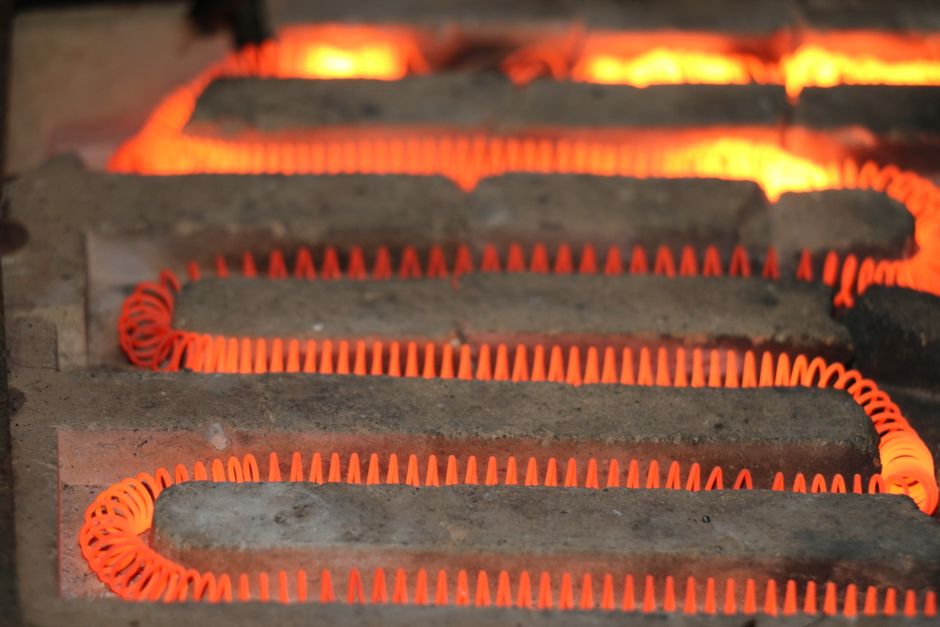
Photo by Zulfugar Karimov on Pexels
Heat is a form of energy that transfers due to temperature differences.
- Temperature: A measure of the average kinetic energy of the particles within a substance. Not energy itself, but indicates the "hotness" or "coldness." Measured in Celsius (°C) or Kelvin (K).
- Heat Capacity (C): The amount of heat energy required to raise the temperature of a substance by 1°C or 1K.
C = Q / ΔT(whereQis heat energy,ΔTis change in temperature). Measured in J/K or J/°C. - Specific Heat Capacity (c): The amount of heat energy required to raise the temperature of 1 kg of a substance by 1°C or 1K.
Q = mcΔT. Measured in J kg⁻¹ K⁻¹ or J kg⁻¹ °C⁻¹. Water has a high specific heat capacity (4200 J kg⁻¹ °C⁻¹), which is important for regulating climate. - Latent Heat: The heat absorbed or released during a phase change (like melting or boiling) without a change in temperature.
- Specific Latent Heat of Fusion (Lf): Heat needed to change 1 kg of solid to liquid at its melting point.
Q = mLf. - Specific Latent Heat of Vaporisation (Lv): Heat needed to change 1 kg of liquid to gas at its boiling point.
Q = mLv.
- Specific Latent Heat of Fusion (Lf): Heat needed to change 1 kg of solid to liquid at its melting point.
- Transfer of Heat:
- Conduction: Heat transfer through direct contact, common in solids.
- Convection: Heat transfer through the movement of fluids (liquids or gases). Hotter fluid rises, cooler fluid sinks.
- Radiation: Heat transfer through electromagnetic waves, doesn't need a medium (e.g., heat from the sun).
Here's how energy flows in a simple machine:
graph TD
    A["Input Energy (Effort × Distance by effort)"] --> B["Useful Output Energy (Load × Distance by load)"]
    A --> C["Wasted Energy (due to Friction)"]
    B --> D["Machine (does useful work)"]
    C --> D
3. Worked Example
Let's combine some ideas from both.
Problem: A block of mass 2 kg is lifted vertically by 5 meters using a pulley system. The effort applied is 25 N, and the distance the effort rope moves is 12 meters. If the block's initial temperature is 20°C and it absorbs 2000 J of heat, what is its final temperature? (Assume specific heat capacity of the block material is 500 J kg⁻¹ °C⁻¹).
Solution:
Part 1: Machine Calculations (Mechanics)
-
Work Output (Work done on the load):
Work output = Load (Force due to gravity) × Distance moved by load
Load = mass × g = 2 kg × 10 m/s² = 20 N(Assumingg = 10 m/s²)
Work output = 20 N × 5 m = 100 J -
Work Input (Work done by the effort):
Work input = Effort × Distance moved by effort
Work input = 25 N × 12 m = 300 J -
Efficiency:
Efficiency = (Work output / Work input) × 100%
Efficiency = (100 J / 300 J) × 100% = 33.33%
Part 2: Heat Calculation
- Heat absorbed (
Q): 2000 J - Mass (
m): 2 kg - Specific heat capacity (
c): 500 J kg⁻¹ °C⁻¹ - Initial temperature (
T_initial): 20°C -
Formula:
Q = mcΔTwhereΔT = T_final - T_initial2000 J = 2 kg × 500 J kg⁻¹ °C⁻¹ × ΔT
2000 = 1000 × ΔT
ΔT = 2000 / 1000 = 2°C -
Final Temperature:
T_final = T_initial + ΔT
T_final = 20°C + 2°C = 22°C
So, the pulley system is 33.33% efficient, and the block's final temperature after absorbing heat is 22°C.
4. Key Takeaways
- Force, work, energy, and power are interconnected concepts describing interaction and changes in motion.
- Machines help us perform work, but friction always reduces their efficiency.
- Temperature measures hotness, while heat is the energy transferred due to temperature differences.
- Specific heat capacity tells us how much heat a substance needs to change its temperature.
- Latent heat is involved in phase changes (melting, boiling) without changing temperature.
- Heat can transfer through conduction, convection, and radiation.
Common Mistakes to Avoid:
- Confusing work with force; work requires movement in the direction of the force.
- Mixing up temperature and heat; temperature is a measure of average kinetic energy, heat is energy transfer.
- Forgetting that latent heat applies during phase changes, not before or after.
- Assuming all machines are 100% efficient; friction always causes energy loss.
- Incorrectly using units; always check if you're using Joules for energy, Newtons for force, Watts for power, etc.
5. Now Try It
Imagine you have a 0.5 kg copper block (specific heat capacity of copper is 385 J kg⁻¹ °C⁻¹). You want to raise its temperature from 25°C to 75°C.
- Calculate how much heat energy (Q) is needed to achieve this temperature rise.
- If you heat it using a 100 W heater, how long would it take to supply this amount of heat, assuming all heat from the heater is absorbed by the block?
Success looks like calculating the correct heat energy in Joules and the correct time in seconds.
Frequently asked about Physics: Mechanics and Heat
Study this next
Get the full class 10 ICSE curriculum
Clone the complete plan to your dashboard for unlimited AI-generated notes, practice quizzes, and a personalised revision schedule.
Save this course free