Practical Application and Auditory Recognition
From the time/ key signatures curriculum
TL;DR
You'll learn to hear and understand time and key signatures by connecting what you see on the page to what you hear. This involves active listening, playing examples, and recognizing patterns in different musical pieces. The goal is to make these concepts intuitive, helping you perform and understand music better.
1. The Mental Model
Think of time and key signatures as the foundational "rules" of a musical piece. The time signature tells you how to count the rhythm, while the key signature tells you which notes will sound "at home" and which will sound "out of place." Understanding these helps you predict and appreciate the music's structure.
2. The Core Material
To truly grasp time and key signatures, you need to engage both your eyes and your ears. It's not enough to just see them; you need to hear how they shape the music.
2.1 Auditory Recognition of Time Signatures

Photo by Nikita Khandelwal on Pexels
A time signature like 4/4 means four beats per measure, with a quarter note getting one beat. When you hear music, try to tap your foot along. Where do the strong beats fall?
- 2/4 or 4/4 (Duple Meter): You'll often hear a "strong-weak" or "strong-weak-medium-weak" feel. Think of marches or simple pop songs.
- 3/4 (Triple Meter): This has a "strong-weak-weak" feel, like a waltz.
- 6/8 or 12/8 (Compound Meter): These feel like two or four main beats, but each main beat is divided into three smaller beats. Think of a lullaby or a jig.
Here's how you can connect what you see to what you hear:
graph TD
    A["Look at Time Signature"] --> B{"Is it 2, 3, 4, 6, or 12 in the top number?"}
    B -- "Top is 2 or 4" --> C["Expect Duple (strong-weak) feel"]
    B -- "Top is 3" --> D["Expect Triple (strong-weak-weak) feel"]
    B -- "Top is 6 or 12" --> E["Expect Compound (two or four main beats, each divided into three)"]
    C --> F["Listen to a piece (e.g., 'Twinkle, Twinkle Little Star' - 4/4)"]
    D --> G["Listen to a piece (e.g., 'Amazing Grace' - 3/4)"]
    E --> H["Listen to a piece (e.g., 'Greensleeves' - 6/8)"]
    F --> I["Tap/Conduct to confirm the strong beats and subdivisions"]
    G --> I
    H --> I
2.2 Auditory Recognition of Key Signatures
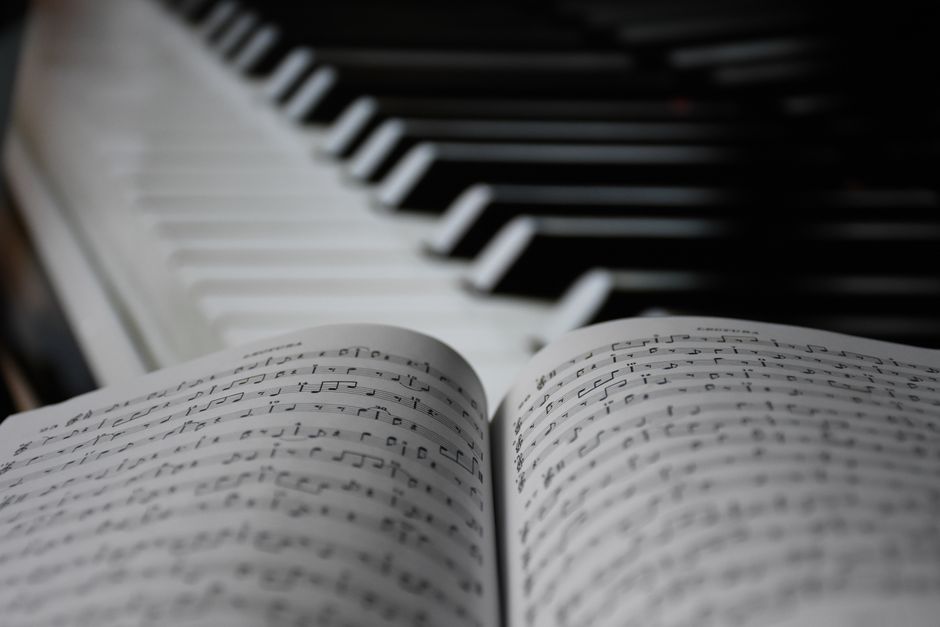
Photo by Sebastian Rivera on Pexels
A key signature tells you which notes are sharp or flat throughout the piece, defining the tonal center or "home base."
- Major Keys: Generally sound bright, happy, or triumphant.
- Minor Keys: Generally sound more serious, sad, or dramatic.
When listening, try to identify the "home note" or tonic. This is the note where the music feels resolved. Listen to the last note of a piece, as it's often the tonic. Also, pay attention to the overall emotional quality.
- No sharps/flats (C Major or A Minor): Can sound very natural, simple.
- One sharp (G Major or E Minor): G major often sounds bright. E minor can be poignant.
- One flat (F Major or D Minor): F major can sound warm. D minor is a common dramatic key.
The sharps and flats in the key signature change the natural half and whole step patterns of a scale, creating that distinct "major" or "minor" sound. For example, in C Major, all notes are natural. In G Major, F is sharp, which pushes the scale notes into the G Major pattern.
3. Worked Example
Let's take a simple piece, "Happy Birthday."
- Look at the score: You'll see a time signature of 3/4. You'll likely see one sharp in the key signature (F#), indicating G Major.
- Play/Listen to the piece:
- As you listen, tap your foot. You'll feel a clear "ONE-two-three, ONE-two-three" pattern, confirming the 3/4 time signature. It has that waltz-like flow.
- Notice the overall feel. It's bright and celebratory, fitting the G Major key. The song sounds "at home" on the note G. If you try to play an F natural anywhere, it would sound wrong, because the key signature tells you F should be F#.
- Connect: The 3/4 time signature gives it its dance-like rhythm, and the G Major key signature gives it its happy, resolved sound, centered around the note G.
4. Key Takeaways
- Actively listen to music, focusing on the rhythmic pulse and overall emotional feel.
- Tap along to music to identify the strong beats and determine if it's duple, triple, or compound meter.
- Pay attention to the "home note" or tonic, especially at the end of a piece, to help identify the key.
- Associate major keys with generally brighter sounds and minor keys with generally darker sounds.
- Practice by trying to predict the time and key signature of unfamiliar pieces before looking at the score.
- Use a metronome to internalize different time signature feels.
- Play scales and arpeggios in various keys to internalize their sound.
Common mistakes to avoid:
- Confusing duple and triple meters; listen carefully to how many beats are in each strong pulse group.
- Ignoring the key signature altogether, leading to playing wrong notes.
- Assuming all sad music is minor and all happy music is major; mood can be subjective and influenced by other factors.
- Only relying on theoretical knowledge without applying it to actual listening and playing.
5. Now Try It
Find two short songs you know well (e.g., a nursery rhyme, a folk song, or a simple pop tune). First, listen carefully to each song without looking at the sheet music. Try to guess the time signature (is it a march, a waltz, or something else?) and whether it's in a major or minor key. After you've made your guesses, find the sheet music for each song and check your answers. Were you correct? If not, listen again, trying to hear what you missed. Repeat this with new songs until you can consistently identify the meter and general key quality.
Frequently asked about Practical Application and Auditory Recognition
More from time/ key signatures
Get the full time/ key signatures curriculum
Clone the complete plan to your dashboard for unlimited AI-generated notes, practice quizzes, and a personalised revision schedule.
Save this course free