Classical Mechanics
From the Physics curriculum
TL;DR
Classical Mechanics describes how objects move under the influence of forces, primarily focusing on Newton's laws of motion. It provides the foundation for understanding everyday phenomena, from falling apples to planetary orbits. You'll use concepts like displacement, velocity, acceleration, force, and energy to predict and explain motion.
1. The Mental Model
Imagine the world as a giant billiard table where every ball (object) moves and interacts based on simple, predictable rules. Classical Mechanics gives you those rules, allowing you to figure out where a ball will go if you know how it starts and what forces act on it.
2. The Core Material
Classical Mechanics, often called Newtonian mechanics, deals with macroscopic objects moving at speeds much less than the speed of light. It's built on a few fundamental concepts and laws.
Kinematics: Describing Motion
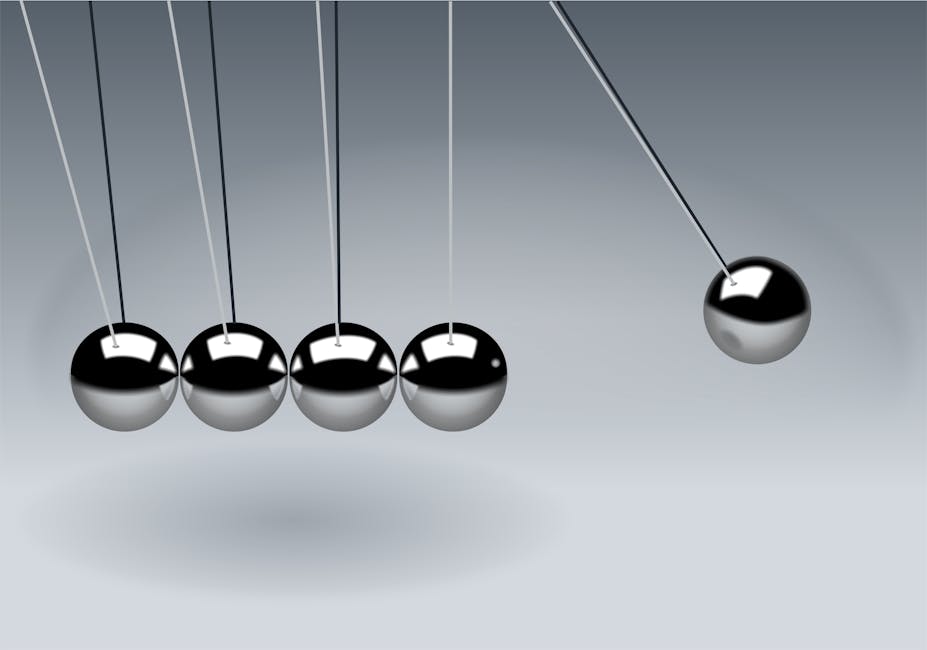
Photo by Pixabay on Pexels
Kinematics is all about describing how things move without considering why.
- Displacement ($\vec{d}$): Change in position, a vector (has both magnitude and direction).
- Velocity ($\vec{v}$): Rate of change of displacement, also a vector. It tells you how fast an object is moving and in what direction.
- Acceleration ($\vec{a}$): Rate of change of velocity, a vector. It describes how velocity is changing over time. If velocity isn't constant, there's acceleration.
These are related through equations like:
$v = v_0 + at$
$d = v_0t + \frac{1}{2}at^2$
$v^2 = v_0^2 + 2ad$
Dynamics: Explaining Motion
Photo by Thirdman on Pexels
Dynamics introduces forces and mass to explain why objects move the way they do.
- Mass ($m$): A measure of an object's inertia, its resistance to changes in motion.
- Force ($\vec{F}$): A push or a pull that can cause an object to accelerate.
Newton's Three Laws of Motion are the pillars of dynamics:
- First Law (Law of Inertia): An object at rest stays at rest, and an object in motion stays in motion with the same speed and in the same direction unless acted upon by an unbalanced force.
- Second Law: The acceleration of an object is directly proportional to the net force acting on it and inversely proportional to its mass. This is often written as $\vec{F}_{net} = m\vec{a}$.
- Third Law: For every action, there is an equal and opposite reaction. If object A exerts a force on object B, then object B simultaneously exerts an equal and opposite force on object A.
Work, Energy, and Power
Photo by Roman Castillo on Pexels
These concepts provide alternative ways to analyze motion and interactions.
- Work ($W$): Done when a force causes displacement. $W = \vec{F} \cdot \vec{d}$ (force times displacement in the direction of the force).
- Kinetic Energy ($KE$): Energy of motion. $KE = \frac{1}{2}mv^2$.
- Potential Energy ($PE$): Stored energy, often due to position (e.g., gravitational potential energy $PE_g = mgh$).
- Conservation of Energy: In a closed system, total energy (kinetic + potential) remains constant, although it can transform between forms.
- Power ($P$): The rate at which work is done or energy is transferred. $P = W/t$.
Here's a diagram showing the relationship between these core concepts:
graph TD
    A["Forces"] --> B["Mass"]
    B --> C["Acceleration (Newton's 2nd Law)"]
    C --> D["Change in Velocity"]
    D --> E["Displacement"]
    A --> F["Work Done"]
    F --> G["Change in Energy"]
    G --> H["Kinetic Energy"]
    G --> I["Potential Energy"]
    H --> J["Velocity"]
    I --> K["Position / Configuration"]
    J --> D
    E --> D
    F --> L["Power (Rate of Work)"]
    C --> D
3. Worked Example
Let's say you push a 2 kg box from rest across a frictionless floor with a constant force of 10 N for 3 seconds.
-
Find the acceleration:
Using Newton's Second Law: $\vec{F}_{net} = m\vec{a}$
$10 \text{ N} = (2 \text{ kg}) \times \vec{a}$
$\vec{a} = \frac{10 \text{ N}}{2 \text{ kg}} = 5 \text{ m/s}^2$ -
Find the final velocity after 3 seconds:
Using a kinematic equation: $v = v_0 + at$
Since it starts from rest, $v_0 = 0$.
$v = 0 + (5 \text{ m/s}^2)(3 \text{ s})$
$v = 15 \text{ m/s}$ -
Find the distance the box traveled:
Using a kinematic equation: $d = v_0t + \frac{1}{2}at^2$
$d = (0)(3 \text{ s}) + \frac{1}{2}(5 \text{ m/s}^2)(3 \text{ s})^2$
$d = \frac{1}{2}(5 \text{ m/s}^2)(9 \text{ s}^2)$
$d = 22.5 \text{ m}$
4. Key Takeaways
- Classical Mechanics uses Newton's Laws to predict how objects move under forces.
- Kinematics describes how objects move using displacement, velocity, and acceleration.
- Dynamics explains why objects move using forces and mass, linked by $\vec{F}_{net} = m\vec{a}$.
- Work is done when a force causes displacement, transferring energy.
- Energy (kinetic and potential) is conserved in a closed system.
Common mistakes to avoid:
- Confusing speed (scalar) with velocity (vector) or distance with displacement.
- Forgetting that $\vec{F}_{net}$ in Newton's Second Law is the sum of all forces.
- Applying kinematic equations when acceleration isn't constant.
- Not considering the direction of forces and motion (vector nature).
5. Now Try It
A 0.5 kg ball is thrown vertically upwards with an initial speed of 10 m/s. Ignore air resistance.
1. Calculate the maximum height the ball reaches.
2. Calculate the time it takes to reach that maximum height.
(Hint: At its maximum height, the ball's instantaneous vertical velocity is 0 m/s. The acceleration due to gravity is approximately $9.8 \text{ m/s}^2$ downwards.)
What success looks like: You should get a maximum height of around 5.1 meters and a time to reach that height of about 1.02 seconds.
Frequently asked about Classical Mechanics
Study this next
Get the full Physics curriculum
Clone the complete plan to your dashboard for unlimited AI-generated notes, practice quizzes, and a personalised revision schedule.
Save this course free