Introduction to Coordinate Geometry and Lines
From the slope, dilations curriculum
TL;DR
Coordinate geometry helps us describe shapes and positions using numbers on a grid, where lines are defined by their slope and y-intercept. Understanding slope tells you a line's steepness and direction, while dilations change an object's size from a fixed point without changing its shape. These concepts are fundamental for working with graphs and transformations in math.
1. The Mental Model
Imagine a perfectly flat map where you can pinpoint any location using two numbers: how far east or west, and how far north or south. That's coordinate geometry! Lines on this map have a consistent steepness (slope), and you can make shapes bigger or smaller (dilations) by stretching them from a central point.
2. The Core Material
Coordinate geometry is all about linking geometry (shapes) with algebra (numbers and equations). We use the Cartesian coordinate system, which is basically a grid formed by two perpendicular number lines: the x-axis (horizontal) and the y-axis (vertical). Any point on this grid can be uniquely identified by an ordered pair (x, y).
Points and Coordinates
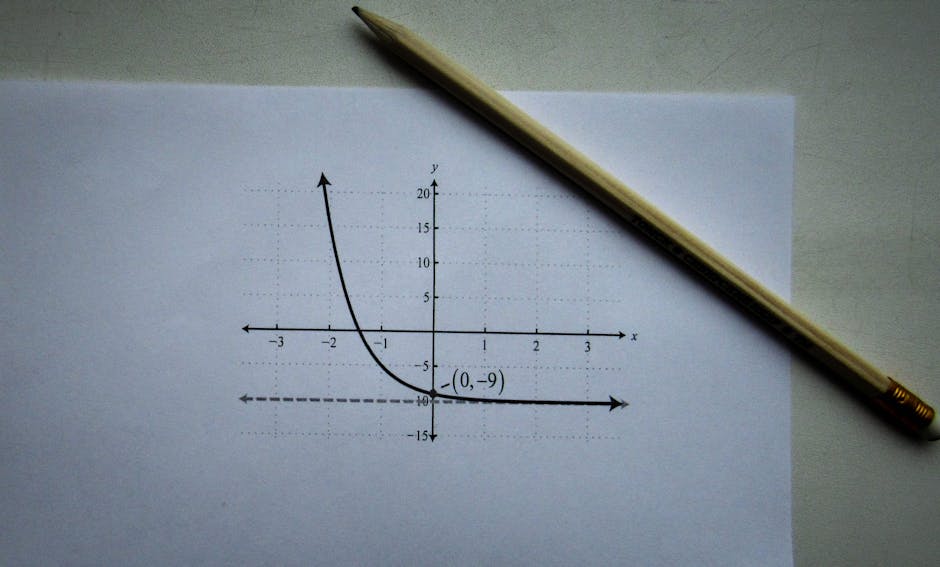
Photo by Sergey Meshkov on Pexels
A point's coordinates tell you its exact location. The first number, 'x', tells you how far right (positive) or left (negative) it is from the origin (0,0). The second number, 'y', tells you how far up (positive) or down (negative) it is from the origin.
Slope of a Line

Photo by Marek Piwnicki on Pexels
Slope (m) is a measure of a line's steepness and direction. It's often described as "rise over run".
$m = \frac{\text{rise}}{\text{run}} = \frac{\text{change in y}}{\text{change in x}} = \frac{y_2 - y_1}{x_2 - x_1}$
- A positive slope means the line goes up from left to right.
- A negative slope means the line goes down from left to right.
- A slope of zero means the line is horizontal.
- An undefined slope (vertical line) means the change in x is zero.
Equation of a Line
Photo by Sergey Meshkov on Pexels
The most common way to write the equation of a straight line is the slope-intercept form:
$y = mx + b$
Where:
* m is the slope
* b is the y-intercept, which is the point where the line crosses the y-axis (i.e., when x = 0).
Dilations
A dilation is a transformation that changes the size of a figure. It either stretches or shrinks the figure but maintains its original shape (it's similar to the original).
To perform a dilation, you need two things:
1. A center of dilation: This is a fixed point from which the dilation occurs.
2. A scale factor (k): This tells you how much the figure is stretched or shrunk.
- If
k > 1, the figure gets larger (enlargement). - If
0 < k < 1, the figure gets smaller (reduction). - If
k = 1, the figure stays the same size. - If
kis negative, the figure is dilated and then rotated 180 degrees around the center of dilation.
How to dilate a point (x, y) centered at the origin (0,0) by a scale factor k:
The new coordinates will be (kx, ky).
graph TD
    A["Start with a Point (x, y)"] --> B["Choose a Center of Dilation (e.g., Origin)"]
    B --> C["Choose a Scale Factor (k)"]
    C --> D{{"Is the Center of Dilation (0,0)?"}}
    D -- Yes --> E["New Point: (kx, ky)"]
    D -- No --> F["Translate Point so Center is at Origin"]
    F --> G["Dilate the Translated Point (kx', ky')"]
    G --> H["Translate Back to Original Center Position"]
    E --> I["Result: Dilated Point"]
    H --> I
3. Worked Example
Let's say you have a line passing through two points: Point A (2, 3) and Point B (6, 5).
First, let's find the slope (m) of the line:
$x_1 = 2, y_1 = 3$
$x_2 = 6, y_2 = 5$
$m = \frac{y_2 - y_1}{x_2 - x_1} = \frac{5 - 3}{6 - 2} = \frac{2}{4} = \frac{1}{2}$
So, the slope is 1/2. Now, let's find the y-intercept (b) using the slope-intercept form $y = mx + b$. We can use either point, let's use A (2, 3):
$3 = (\frac{1}{2})(2) + b$
$3 = 1 + b$
$b = 2$
So, the equation of the line is y = (1/2)x + 2.
Now, let's dilate a point on this line, say Point C (4, 4), with the center of dilation at the origin (0,0) and a scale factor of k = 2.
Original point C = (4, 4)
Scale factor k = 2
New point C' = (k * x, k * y) = (2 * 4, 2 * 4) = (8, 8).
4. Key Takeaways
- Coordinate geometry uses a grid (x, y axes) to locate points and describe geometric figures algebraically.
- The slope of a line measures its steepness and direction (rise over run).
- The equation $y = mx + b$ is the slope-intercept form, where 'm' is the slope and 'b' is the y-intercept.
- A dilation changes the size of a figure but preserves its shape.
- To dilate a point (x, y) from the origin by a scale factor 'k', you multiply both coordinates: (kx, ky).
- Positive slopes indicate an upward trend; negative slopes indicate a downward trend.
- A scale factor
k > 1means enlargement;0 < k < 1means reduction.
Common Mistakes to Avoid:
- Mixing up x and y coordinates when calculating slope or plotting points.
- Forgetting the order of subtraction in the slope formula (always $y_2 - y_1$ and $x_2 - x_1$).
- Incorrectly applying the scale factor to only one coordinate during a dilation.
- Confusing horizontal lines (slope = 0) with vertical lines (undefined slope).
5. Now Try It
Draw a triangle with vertices at A(1, 1), B(3, 1), and C(2, 3). Calculate the slope of each side of the triangle. Then, dilate the entire triangle using the origin (0,0) as the center of dilation and a scale factor of 3. What are the new coordinates of the vertices (A', B', C')?
What success looks like: You should have three slopes calculated for the original triangle and three new coordinate pairs for the dilated triangle.
Frequently asked about Introduction to Coordinate Geometry and Lines
Study this next
Get the full slope, dilations curriculum
Clone the complete plan to your dashboard for unlimited AI-generated notes, practice quizzes, and a personalised revision schedule.
Save this course free