Thermochemistry and Kinetics
From the chemistry curriculum
TL;DR
Thermochemistry is all about the energy changes during chemical reactions, telling you if a reaction releases or absorbs heat. Kinetics focuses on how fast these reactions occur and the steps involved. Understanding both helps predict a reaction's energy profile and its speed.
1. The Mental Model
Imagine a reaction as a ball rolling down or up a hill: thermochemistry tells you the start and end heights (energy change), while kinetics tells you how steep the hill is and how quickly the ball rolls (reaction rate).
2. The Core Material
Enthalpy Change ($\Delta H$)

Photo by Jahra Tasfia Reza on Pexels
Enthalpy ($\Delta H$) is the heat absorbed or released by a system at constant pressure.
* Exothermic reactions release heat, so $\Delta H$ is negative (e.g., combustion). The products have less energy than the reactants.
* Endothermic reactions absorb heat, so $\Delta H$ is positive (e.g., melting ice). The products have more energy than the reactants.
Reaction Rates
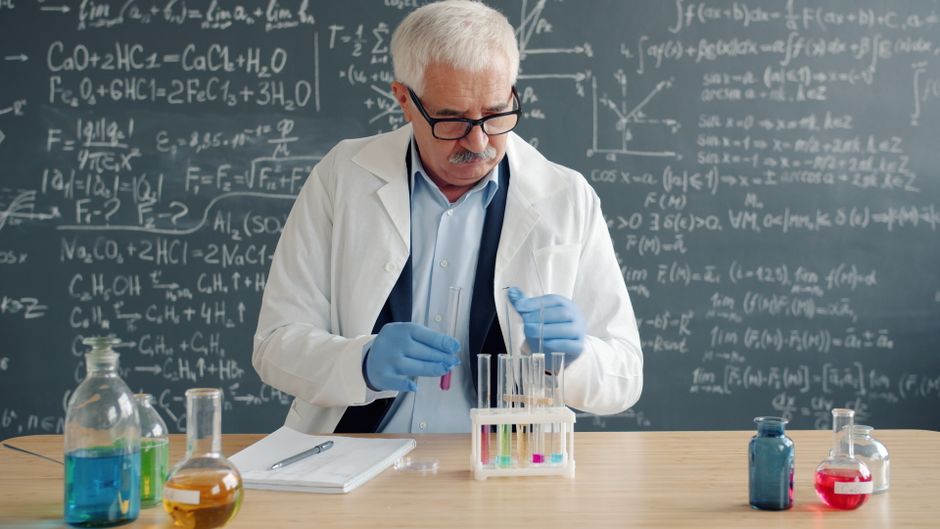
Photo by Vitaly Gariev on Pexels
Reaction rate is how quickly reactants are consumed or products are formed. It's often expressed as the change in concentration over time.
* Factors affecting rate:
* Concentration: Higher concentration generally means more collisions, thus faster reactions.
* Temperature: Higher temperature increases kinetic energy, leading to more frequent and energetic collisions, so reactions speed up.
* Surface area: For solids, more surface area allows more contact points, increasing the rate.
* Catalysts: These substances speed up reactions without being consumed, by providing an alternative reaction pathway with a lower activation energy.
* Nature of reactants: Some substances just react faster than others.
Activation Energy ($E_a$)

Photo by Gustavo Fring on Pexels
Activation energy is the minimum energy required for a reaction to occur. It's like the "hill" that reactants must overcome to turn into products.
Reaction Energy Diagram
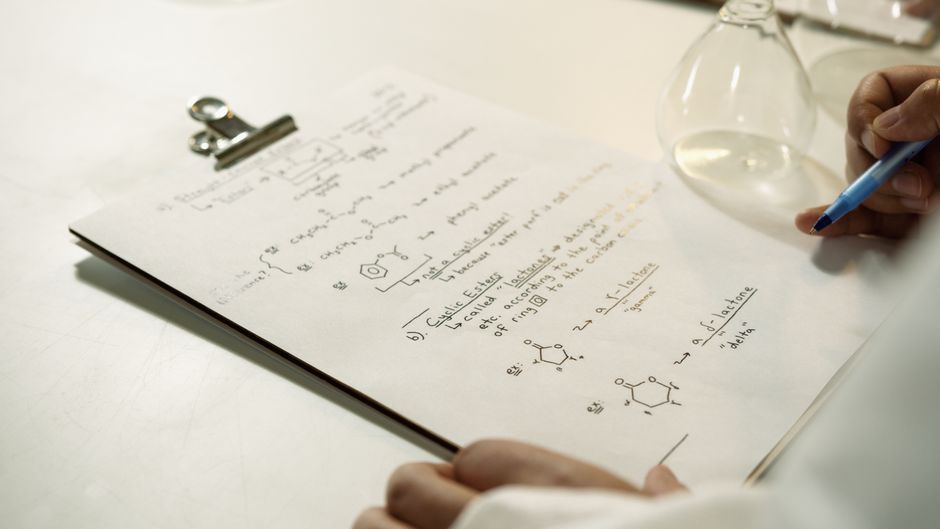
Photo by Artem Podrez on Pexels
This diagram shows the energy changes throughout a reaction, illustrating reactants, products, and the activation energy barrier.
graph TD
    A["Reactants"] --> B{"Transition State (Activated Complex)"}
    B --> C["Products (Exothermic)"]
    B --> D["Products (Endothermic)"]

    style A fill:#cef,stroke:#333,stroke-width:2px
    style C fill:#fce,stroke:#333,stroke-width:2px
    style D fill:#ddf,stroke:#333,stroke-width:2px
    style B fill:#fff,stroke:#333,stroke-dasharray: 5 5

    subgraph Energy Flow
        Exo[("Energy Released")]
        Endo[("Energy Absorbed")]
    end
    C --- Exo
    D --- Endo

    Ea[("Activation Energy")]
    A -- Ea --> B

    DeltaH_exo[("ΔH < 0")]
    A -- DeltaH_exo --> C

    DeltaH_endo[("ΔH > 0")]
    A -- DeltaH_endo --> D
On this diagram, the height from "Reactants" to "Transition State" is the activation energy. The difference in height between "Reactants" and "Products" is the enthalpy change ($\Delta H$).
Rate Laws
A rate law is an equation that relates the rate of a reaction to the concentrations of reactants. For a generic reaction $aA + bB \rightarrow cC$, the rate law is often written as:
Rate = $k[A]^x[B]^y$
Where:
* $k$ is the rate constant (temperature-dependent).
* $[A]$ and $[B]$ are reactant concentrations.
* $x$ and $y$ are the reaction orders with respect to A and B (determined experimentally, not necessarily related to $a$ and $b$).
* The overall reaction order is $x + y$.
3. Worked Example
Let's consider the reaction: $2N_2O_5(g) \rightarrow 4NO_2(g) + O_2(g)$
-
Thermochemistry: If you're told that $\Delta H = +109.6 \text{ kJ/mol}$, this tells you the reaction is endothermic. It absorbs 109.6 kJ of energy for every mole of $N_2O_5$ that reacts. This means the products ($NO_2$ and $O_2$) have higher energy than the reactant ($N_2O_5$). You'd need to supply this energy to make the reaction happen.
-
Kinetics: Experimental data at a certain temperature shows the rate law for this reaction is:
Rate = $k[N_2O_5]$
This means the reaction is first order with respect to $N_2O_5$ (and overall first order). If you double the concentration of $N_2O_5$, the reaction rate will double. If the rate constant ($k$) at $25^\circ C$ is $1.7 \times 10^{-5} \text{ s}^{-1}$ and $[N_2O_5]$ is $0.10 \text{ M}$:
Rate = $(1.7 \times 10^{-5} \text{ s}^{-1})(0.10 \text{ M}) = 1.7 \times 10^{-6} \text{ M/s}$
This tells you how fast $N_2O_5$ is consumed (or $NO_2$ and $O_2$ are formed) at that specific moment. If you increase the temperature, $k$ would increase, and the reaction would go faster.
4. Key Takeaways
- Thermochemistry deals with heat changes (enthalpy) in reactions: exothermic releases heat ($\Delta H < 0$), endothermic absorbs heat ($\Delta H > 0$).
- Kinetics focuses on the speed of reactions (rate) and the factors influencing it.
- Activation energy ($E_a$) is the energy barrier reactants must overcome to form products.
- Catalysts speed up reactions by lowering the activation energy without changing the overall $\Delta H$.
- Reaction rates are affected by concentration, temperature, surface area, and catalysts.
- Rate laws mathematically describe how reactant concentrations influence the reaction rate.
Common mistakes you should avoid:
- Confusing a negative $\Delta H$ with a slow reaction; speed (kinetics) and energy change (thermochemistry) are separate concepts.
- Assuming reaction order ($x, y$ in the rate law) is always the same as the stoichiometric coefficients ($a, b$) from the balanced equation – it's often not!
- Thinking a spontaneous reaction (negative $\Delta G$) means it's also a fast reaction.
- Not understanding that catalysts only affect the reaction rate, not the equilibrium position or the overall energy change.
5. Now Try It
Think about a common chemical process you encounter (e.g., burning wood, cooking an egg, a glow stick). For that process, try to describe whether it's exothermic or endothermic, and then list at least two ways you could influence its reaction rate based on the factors we discussed.
What success looks like: You can correctly identify the energy change type and suggest plausible methods to speed up or slow down the process.
Frequently asked about Thermochemistry and Kinetics
Study this next
Get the full chemistry curriculum
Clone the complete plan to your dashboard for unlimited AI-generated notes, practice quizzes, and a personalised revision schedule.
Save this course free