Structural Determination and Review
From the Grade 12 organic chemistry naming the families how to name them and how to know if the strauct8re diagram is one curriculum
TL;DR
You'll learn to identify common organic functional groups, name them using IUPAC rules, and recognize what a family's structure looks like just from its name. Understanding the basic building blocks and naming conventions is key to making sense of organic chemistry.
1. The Mental Model
Think of organic chemistry like building with LEGOs. Each functional group is a specific type of brick, and the naming rules are how you describe the completed model. Knowing the brick types and naming rules helps you build and understand any organic structure.
2. The Core Material
In organic chemistry, functional groups are specific arrangements of atoms that give molecules their characteristic chemical properties. Knowing these groups is crucial for naming and predicting reactions.
2.1 Common Functional Groups and Their Structures

Photo by Maria Tyutina on Pexels
Here's a quick rundown of some key functional groups you'll encounter in Grade 12, along with their general formulas:
- Alkanes: Contain only single C-C and C-H bonds. They're saturated hydrocarbons.
- General Formula: C$_n$H$_{2n+2}$
- Example: Methane (CH$_4$), Ethane (CH$_3$CH$_3$)
- Alkenes: Contain at least one C=C double bond. They're unsaturated.
- General Formula: C$_n$H$_{2n}$ (for one double bond)
- Example: Ethene (CH$_2$=CH$_2$), Propene (CH$_3$CH=CH$_2$)
- Alkynes: Contain at least one C≡C triple bond. They're also unsaturated.
- General Formula: C$_n$H$_{2n-2}$ (for one triple bond)
- Example: Ethyne (HC≡CH), Propyne (CH$_3$C≡CH)
- Alcohols: Contain a hydroxyl (-OH) group attached to an alkyl group.
- General Formula: R-OH (where R is an alkyl group)
- Suffix: -ol
- Example: Ethanol (CH$_3$CH$_2$OH), Propan-1-ol
- Ethers: Contain an oxygen atom bonded to two alkyl or aryl groups (R-O-R').
- Naming: "alkyl alkyl ether" or using "alkoxyalkane"
- Example: Diethyl ether (CH$_3$CH$_2$OCH$_2$CH$_3$), Methoxyethane
- Aldehydes: Contain a carbonyl group (C=O) at the end of a carbon chain, with at least one hydrogen attached to the carbonyl carbon.
- General Formula: R-CHO
- Suffix: -al
- Example: Ethanal (CH$_3$CHO), Propanal
- Ketones: Contain a carbonyl group (C=O) within a carbon chain, bonded to two other carbon atoms.
- General Formula: R-CO-R'
- Suffix: -one
- Example: Propanone (CH$_3$COCH$_3$), Butan-2-one
- Carboxylic Acids: Contain a carboxyl group (-COOH), which is a carbonyl and a hydroxyl group on the same carbon.
- General Formula: R-COOH
- Suffix: -oic acid
- Example: Ethanoic acid (CH$_3$COOH), Propanoic acid
- Esters: Derived from a carboxylic acid and an alcohol, they have a -COO- linkage.
- General Formula: R-COO-R'
- Naming: "alkyl alkanoate"
- Example: Ethyl ethanoate (CH$_3$COOCH$_2$CH$_3$)
- Amines: Derivatives of ammonia (NH$_3$) where one or more hydrogens are replaced by alkyl or aryl groups. Can be primary (R-NH$_2$), secondary (R$_2$NH), or tertiary (R$_3$N).
- Suffix: -amine
- Example: Methylamine (CH$_3$NH$_2$), Dimethylamine
- Amides: Contain a carbonyl group bonded to a nitrogen atom (-CONH$_2$).
- General Formula: R-CONH$_2$
- Suffix: -amide
- Example: Ethanamide (CH$_3$CONH$_2$)
2.2 Naming Organic Compounds (IUPAC Rules)
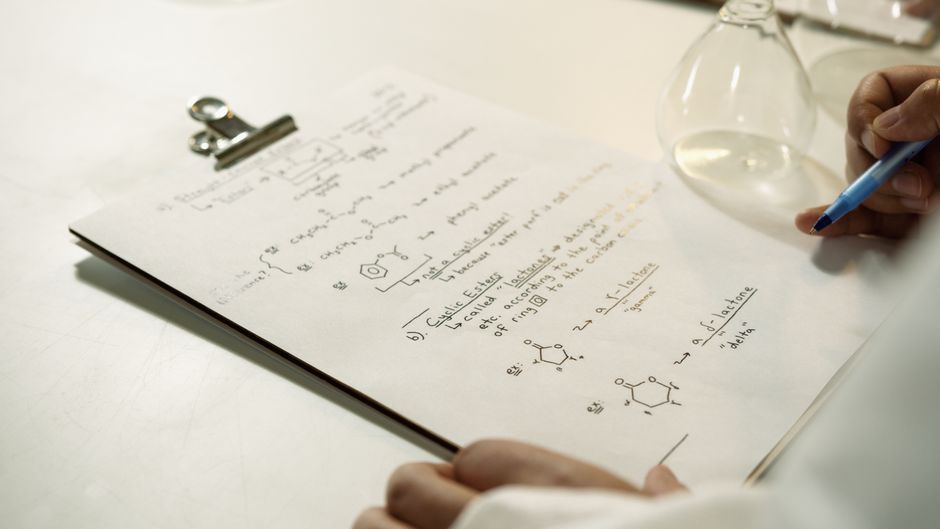
Photo by Artem Podrez on Pexels
The International Union of Pure and Applied Chemistry (IUPAC) provides a systematic way to name compounds. Here's a general approach:
- Identify the longest continuous carbon chain containing the principal functional group. This is your parent chain.
- Number the parent chain to give the lowest possible number to the principal functional group. If there's a tie, give the lowest number to the first substituent.
- Identify and name all substituents (alkyl groups, halogens, etc.).
- Assign a number (locant) to each substituent to indicate its position on the parent chain.
- If there are multiple identical substituents, use prefixes like
di-,tri-,tetra-. - Alphabetize substituents (ignoring di-, tri-, etc.) before placing them in the name.
- Combine everything: (locant)-(substituent)-(parent chain prefix)-(functional group suffix).
The diagram below shows a basic decision process for determining the parent chain and functional group priority.
graph TD
    A["Find Longest Carbon Chain"] --> B{"Contains C=C or C≡C?"}
    B -- Yes --> C{"Contains C≡C?"}
    B -- No --> D{"Contains a functional group (e.g., -OH, -COOH, C=O, -NH2)?"}

    C -- Yes --> "Parent Chain: Alk_yne"
    C -- No --> "Parent Chain: Alk_ene"

    D -- Yes --> E{"Multiple functional groups?"}
    D -- No --> "Parent Chain: Alk_ane"

    E -- Yes --> F["Identify Highest Priority Functional Group"]
    F --> G["Parent Chain includes highest priority group, numbered to give it lowest possible locant."]
    G --> "Suffix for Highest Priority Group, Prefixes for others"
    E -- No --> "Suffix for that functional group"
2.3 How to Know if a Structure Diagram is "One"

Photo by Ivan S on Pexels
This refers to identifying the family (functional group) from a given structure. It's about pattern recognition:
- Look for characteristic atoms: Oxygen (O), Nitrogen (N), Sulfur (S), Halogens (F, Cl, Br, I).
- Look for characteristic bonds: Double bonds (C=C, C=O), Triple bonds (C≡C).
- Look for characteristic groupings:
- -OH group = Alcohol
- C=O group with H on one side = Aldehyde
- C=O group with two carbons attached = Ketone
- -COOH group = Carboxylic Acid
- -COO- group = Ester
- -NH$_2$, -NHR, -NR$_2$ group = Amine
- -CONH$_2$ group = Amide
3. Worked Example
Let's name this compound: CH$_3$CH$_2$CH(OH)CH$_2$CH$_3$
- Identify the longest carbon chain containing the -OH group: This is a 5-carbon chain. So, it's a "pentan-".
- Identify the principal functional group: It's an alcohol (-OH), so the suffix will be "-ol".
- Number the chain: If we number from left, -OH is on C3. If we number from right, -OH is on C3. So, the -OH is at position 3.
- Combine: Pentan-3-ol.
Now, let's go from name to structure: 3-methylbutan-2-one
- Parent chain: "Butan-2-one" means a 4-carbon chain with a ketone (C=O) at the second carbon.
C-C(=O)-C-C - Substituents: "3-methyl" means a methyl group (CH$_3$) on the third carbon.
C-C(=O)-C(CH3)-C - Fill in hydrogens: Ensure each carbon has 4 bonds.
CH3-C(=O)-CH(CH3)-CH3
This is the structural formula.
4. Key Takeaways
- Functional groups dictate a molecule's chemical properties and its family name.
- The IUPAC naming system provides clear, consistent names based on structure.
- Always identify the parent chain first, then the principal functional group, then substituents.
- Number the carbon chain to give the principal functional group the lowest possible number.
- Recognizing common bond patterns (e.g., C=O, -OH) is how you identify a functional group from a diagram.
- Practice going from name to structure and structure to name to solidify your understanding.
Common mistakes to avoid:
* Miscounting the longest carbon chain.
* Incorrectly identifying the principal functional group when multiple are present.
* Not numbering the chain to give the lowest locant to the principal functional group.
* Forgetting to alphabetize substituents or misusing prefixes (di-, tri-).
5. Now Try It
Draw the structural formula for 2,2-dimethylhexanal and then name the following compound:
CH$_3$CH$_2$CH(CH$_3$)COOCH$_3$
Success looks like: You have a correct Lewis structure for 2,2-dimethylhexanal and you've accurately named the given ester using IUPAC rules.
Frequently asked about Structural Determination and Review
More from Grade 12 organic chemistry naming the families how to name them and how to know if the strauct8re diagram is one
Get the full Grade 12 organic chemistry naming the families how to name them and how to know if the strauct8re diagram is one curriculum
Clone the complete plan to your dashboard for unlimited AI-generated notes, practice quizzes, and a personalised revision schedule.
Save this course free