Understanding AI Projects
From the AI TERM 1 curriculum
TL;DR
AI projects are different from traditional software projects because they involve data, experimentation, and uncertainty. You'll need to define your problem clearly, gather good data, and be ready to iterate. Success comes from focusing on business value and managing expectations.
1. The Mental Model
Think of an AI project less like building a house with fixed blueprints and more like growing a garden. You prepare the soil (data), plant seeds (models), and then nurture and adapt as things grow (iterate and refine), dealing with unexpected challenges along the way.
2. The Core Material
AI projects blend traditional software development with a heavy dose of data science and machine learning. This means you're not just coding features; you're also exploring data, training models, and evaluating performance, often in an iterative loop.
Project Lifecycle: Discovery to Deployment
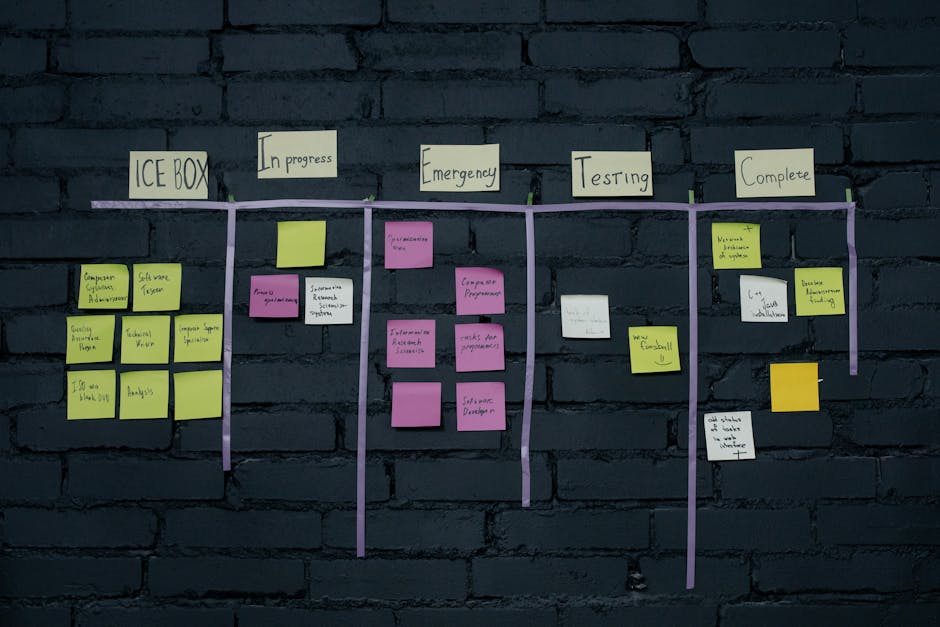
Photo by cottonbro studio on Pexels
AI projects generally follow a lifecycle that emphasizes understanding the problem, preparing data, building and training models, deploying them, and then monitoring their performance. It's rarely a straight line; you'll often go back and forth between steps.
graph TD
    A["Problem Definition & Goal Setting"] --> B["Data Collection & Preparation"]
    B --> C["Model Selection & Training"]
    C --> D["Model Evaluation & Refinement"]
    D --> E["Deployment & Integration"]
    E --> F["Monitoring & Maintenance"]
    F --> A
    C -.-> B["Iterate as needed"]
    D -.-> C["Iterate as needed"]
Key Differences from Traditional Software

Photo by Daniil Komov on Pexels
- Data-centric: Data is king. Its quality, quantity, and relevance directly impact model performance. Bad data = bad AI.
- Experimental: You often don't know if a specific model or approach will work until you try it. This involves lots of experimentation and hypothesis testing.
- Probabilistic Outputs: Unlike traditional software that gives exact results (e.g., a login either succeeds or fails), AI models often provide predictions with a certain probability or confidence.
- Performance Metrics: Success isn't just about bugs; it's about accuracy, precision, recall, F1-score, and other statistical measures.
- Ethical Considerations: AI projects often have significant societal impacts, requiring careful thought about bias, fairness, privacy, and transparency.
Common Roles in an AI Project

Photo by Lisha Dunlap on Pexels
- Product Manager: Defines the problem, business value, and user needs.
- Data Scientist: Explores data, builds models, evaluates performance.
- Machine Learning Engineer: Focuses on deploying models, building robust pipelines, and optimizing performance.
- Data Engineer: Builds and maintains data infrastructure, ensuring data quality and availability.
- Domain Expert: Provides essential knowledge about the specific industry or problem area.
3. Worked Example
Let's say you're tasked with building an AI system to predict customer churn (when a customer stops using a service).
- Problem Definition: The goal is to reduce customer churn by identifying at-risk customers before they leave, allowing the company to intervene. The success metric could be a 10% reduction in churn rate within six months.
- Data Collection: You'd gather historical customer data: demographics, usage patterns (login frequency, features used), support interactions, billing history, and crucially, whether they churned or not.
- Data Preparation: This is messy! You'd clean the data (handle missing values), transform it (e.g., aggregate daily usage into weekly averages), and create features (e.g., "days since last login").
- Model Training: You might try a few different models like Logistic Regression, Random Forest, or a Gradient Boosting Machine (e.g., XGBoost). You'd split your data into training and testing sets, then train the models and tune their parameters.
- Model Evaluation: Using the test set, you'd evaluate each model's performance. For churn, you'd look at metrics like precision (how many predicted churners actually churned) and recall (how many actual churners your model caught). You might find a Random Forest model gives the best balance.
- Deployment: The chosen model is integrated into the company's systems, perhaps predicting churn risk for active customers daily.
- Monitoring: You'd continuously monitor the model's predictions against actual churn, looking for "model drift" (when performance degrades over time due to changing customer behavior) and retraining as needed.
4. Key Takeaways
- AI projects are inherently iterative and require continuous experimentation and refinement.
- High-quality, relevant data is the single most important factor for AI project success.
- Clearly define the business problem and how AI will deliver tangible value before starting.
- Be prepared for uncertainty; AI project outcomes are not always predictable upfront.
- A cross-functional team with diverse skills (data science, engineering, domain expertise) is crucial.
- Ethical considerations and potential biases must be addressed throughout the project lifecycle.
- Monitoring deployed models is critical to ensure continued performance and adapt to changing environments.
Common Mistakes to Avoid

Photo by KATRIN BOLOVTSOVA on Pexels
- Starting without a clear problem: Don't just "do AI" for AI's sake; have a specific goal.
- Ignoring data quality: Assuming your data is clean and ready-to-use will lead to poor results.
- Over-promising and under-delivering: Manage expectations; AI isn't magic and has limitations.
- Skipping deployment planning: A great model is useless if it can't be put into production effectively.
- Neglecting ethical implications: Not considering bias or fairness can lead to harmful or ineffective systems.
5. Now Try It
Think about a repetitive task you encounter in your daily life or work that involves some decision-making or pattern recognition. Spend 15 minutes outlining how you would approach automating or assisting that task using an AI project framework.
What to do:
1. Identify the task: What is it?
2. Define the problem: What specific problem would AI solve, and what would success look like (a measurable goal)?
3. Identify necessary data: What kind of data would you need to gather to train an AI model for this task?
4. Consider challenges: What potential difficulties might you face with data, model building, or deployment?
What success looks like: You've articulated a specific problem, identified relevant data, and thought about the practical challenges, demonstrating an understanding of the initial steps of an AI project.
Frequently asked about Understanding AI Projects
More from AI TERM 1
Get the full AI TERM 1 curriculum
Clone the complete plan to your dashboard for unlimited AI-generated notes, practice quizzes, and a personalised revision schedule.
Create Free Account