Fundamentos de Reacciones Químicas
From the Estequiometria curriculum
Fundamentos de Reacciones Químicas
TL;DR
Chemical reactions rearrange atoms, transforming reactants into products while obeying the law of conservation of mass. We represent these changes with balanced chemical equations, which show the exact ratios of substances involved. Understanding these basics is crucial for predicting reaction outcomes and quantities.
1. The Mental Model
Think of chemical reactions like building with LEGOs. You start with specific sets of bricks (reactants), take them apart, and then reassemble them into new structures (products). No bricks are lost or gained; they just get rearranged.
2. The Core Material
Chemical reactions are fundamental processes where one or more substances, called reactants, are converted into different substances, called products. This transformation involves breaking existing chemical bonds and forming new ones, but importantly, atoms are never created or destroyed—they just change partners. This is known as the Law of Conservation of Mass.
2.1 Representing Reactions: Chemical Equations
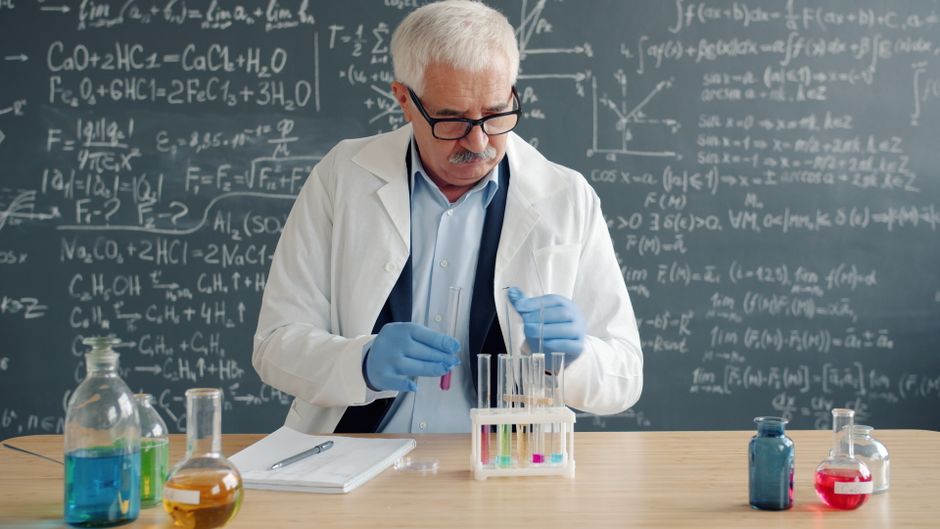
Photo by Vitaly Gariev on Pexels
We use chemical equations to describe these transformations. A chemical equation uses chemical formulas to represent the reactants and products, and an arrow (→) indicates the direction of the reaction. For example, when hydrogen gas (H₂) reacts with oxygen gas (O₂) to form water (H₂O):
H₂ + O₂ → H₂O
This equation tells us what reacts and what is formed.
2.2 Balancing Equations: The Conservation of Mass

Photo by Vitaly Gariev on Pexels
The initial equation above isn't quite right according to the Law of Conservation of Mass. If you count the atoms, you'll see:
- Reactants: 2 Hydrogen atoms, 2 Oxygen atoms
- Products: 2 Hydrogen atoms, 1 Oxygen atom
We have a missing oxygen atom on the product side! To fix this, we balance the equation by placing coefficients (numbers) in front of the chemical formulas. We never change the subscripts in a chemical formula, as that would change the identity of the substance.
To balance H₂ + O₂ → H₂O:
- Start with the most complex molecule or an element that appears in only one reactant and one product. Oxygen is a good choice here.
- There are 2 O atoms on the left, 1 on the right. Put a
2in front of H₂O:
H₂ + O₂ → 2H₂O (Now we have 2 O atoms on both sides) - Now, check Hydrogen. On the left, we have 2 H atoms. On the right, we now have 2 * 2 = 4 H atoms.
- Put a
2in front of H₂ on the left:
2H₂ + O₂ → 2H₂O (Now we have 4 H atoms on both sides) - Check all atoms:
- Left: (2 * 2) = 4 H, (1 * 2) = 2 O
- Right: (2 * 2) = 4 H, (2 * 1) = 2 O
The equation is balanced!
2.3 States of Matter and Reaction Conditions
Photo by Ron Lach on Pexels
Sometimes, you'll see symbols in parentheses next to the formulas:
* (s) for solid
* (l) for liquid
* (g) for gas
* (aq) for aqueous solution (dissolved in water)
You might also see symbols above or below the arrow, indicating conditions like heat (Δ or "heat"), pressure, or catalysts (substances that speed up reactions without being consumed).
Here's how you can think about balancing:
graph TD
    A["Start with Unbalanced Equation"] --> B["Identify Atoms Present (Reactants & Products)"]
    B --> C["Count Atoms of Each Element (Both Sides)"]
    C --> D{"Are Atom Counts Equal?"}
    D -- No --> E["Add Coefficients to Molecules (NEVER change subscripts!)"]
    E --> F{"Does Adding Coefficient Unbalance Other Atoms?"}
    F -- Yes --> E
    F -- No --> C
    D -- Yes --> G["Balanced Equation!"]
3. Worked Example
Let's balance the combustion of propane (C₃H₈) with oxygen (O₂) to produce carbon dioxide (CO₂) and water (H₂O).
Unbalanced: C₃H₈(g) + O₂(g) → CO₂(g) + H₂O(l)
- Balance Carbon (C): 3 C on the left, 1 C on the right. Add a
3in front of CO₂.
C₃H₈ + O₂ → 3CO₂ + H₂O - Balance Hydrogen (H): 8 H on the left, 2 H on the right. Add a
4in front of H₂O (4 * 2 = 8).
C₃H₈ + O₂ → 3CO₂ + 4H₂O - Balance Oxygen (O): Now count O on the product side: (3 * 2 from CO₂) + (4 * 1 from H₂O) = 6 + 4 = 10 O atoms.
On the reactant side, we have O₂. To get 10 O atoms, we need 5 O₂ molecules (5 * 2 = 10). Add a5in front of O₂.
C₃H₈ + 5O₂ → 3CO₂ + 4H₂O - Verify:
- C: Left = 3, Right = 3 (Balanced)
- H: Left = 8, Right = 8 (Balanced)
- O: Left = 10, Right = 10 (Balanced)
The balanced equation is: C₃H₈(g) + 5O₂(g) → 3CO₂(g) + 4H₂O(l)
4. Key Takeaways
- Chemical reactions transform reactants into products by rearranging atoms.
- The Law of Conservation of Mass states that atoms are neither created nor destroyed in a chemical reaction.
- Chemical equations use formulas to represent reactants and products and an arrow for the transformation.
- Balancing chemical equations ensures the number of atoms of each element is equal on both sides.
- Coefficients are used to balance equations, never subscripts.
- State symbols (s, l, g, aq) provide additional information about the substances.
Common Mistakes to Avoid:
- Don't change subscripts in chemical formulas when balancing; that changes the substance.
- Don't forget to count all atoms for an element when it appears in multiple compounds on one side.
- Don't assume an equation is balanced just by a quick glance; always count meticulously.
- Don't stop balancing until all elements are equal on both sides.
5. Now Try It
Balance the following chemical equation for the reaction of aluminum metal with iron(III) oxide to produce iron metal and aluminum oxide: Al(s) + Fe₂O₃(s) → Fe(s) + Al₂O₃(s). Success looks like having the correct smallest whole-number coefficients for each substance, with the atom count for each element matching on both sides of the equation.
Frequently asked about Fundamentos de Reacciones Químicas
Study this next
Get the full Estequiometria curriculum
Clone the complete plan to your dashboard for unlimited AI-generated notes, practice quizzes, and a personalised revision schedule.
Create Free Account