States of Matter and Phase Changes
From the IB Chemistry SL_HL S1.1&S1.2 curriculum
States of Matter and Phase Changes
TL;DR
Matter exists in different physical states like solid, liquid, and gas, determined by particle arrangement and kinetic energy. Phase changes occur when energy is added or removed, changing a substance from one state to another without changing its chemical composition. These changes involve specific temperatures and energy transfers, like melting and boiling points.
1. The Mental Model
Imagine particles like tiny bouncy balls. In a solid, they're tightly packed and just vibrate. In a liquid, they can slide past each other but stay close. In a gas, they fly around freely, far apart.
2. The Core Material
You'll mostly deal with three main states of matter: solids, liquids, and gases. Each state has distinct properties based on how its particles (atoms, ions, or molecules) are arranged and how much energy they have.
Properties of States of Matter
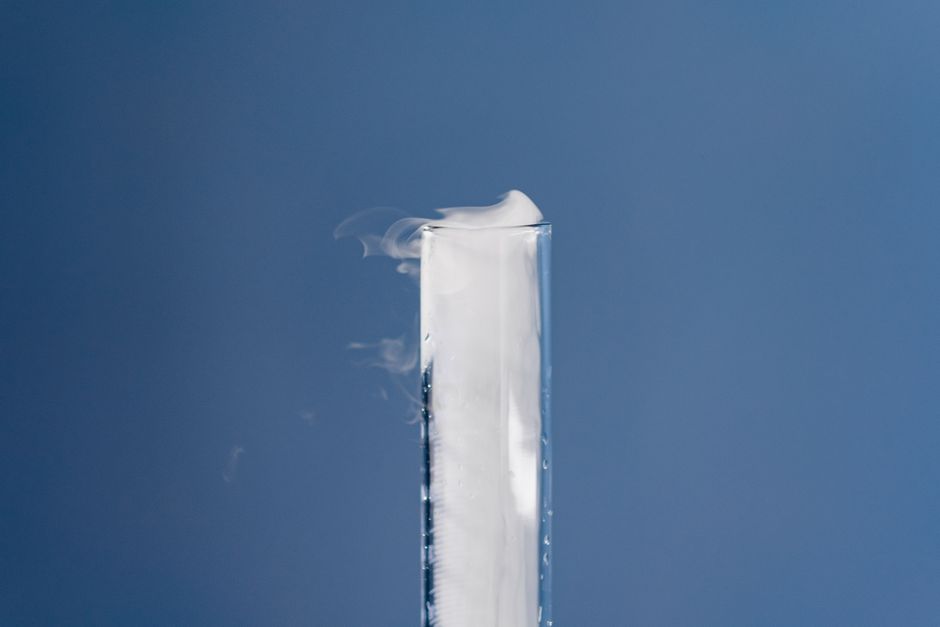
Photo by Ron Lach on Pexels
-
Solids:
- Particles are tightly packed in fixed positions, often in a regular lattice.
- Strong intermolecular forces hold them together.
- Vibrate about fixed positions.
- Have a definite shape and a definite volume.
- Are generally incompressible.
-
Liquids:
- Particles are close together but can move and slide past each other.
- Intermolecular forces are weaker than in solids but still significant.
- Have a definite volume but take the shape of their container.
- Are largely incompressible.
-
Gases:
- Particles are far apart and move randomly and rapidly.
- Very weak or negligible intermolecular forces.
- No definite shape or volume; they expand to fill their container.
- Are easily compressible.
Phase Changes

Photo by Jahra Tasfia Reza on Pexels
A phase change (or state change) is a physical process where a substance changes from one state of matter to another. These changes are typically reversible and occur at specific temperatures and pressures. Energy is either absorbed or released during a phase change, but the chemical identity of the substance doesn't change.
Here are the main phase changes you need to know:
- Melting (Fusion): Solid $\rightarrow$ Liquid. Requires energy input (endothermic). Occurs at the melting point.
- Freezing (Solidification): Liquid $\rightarrow$ Solid. Releases energy (exothermic). Occurs at the freezing point (which is the same temperature as the melting point).
- Boiling (Vaporisation/Evaporation): Liquid $\rightarrow$ Gas. Requires energy input (endothermic). Boiling occurs at the boiling point throughout the liquid; evaporation occurs at the surface at any temperature.
- Condensation: Gas $\rightarrow$ Liquid. Releases energy (exothermic). Occurs at the condensation point (same temperature as the boiling point).
- Sublimation: Solid $\rightarrow$ Gas. Requires energy input (endothermic). (e.g., dry ice).
- Deposition: Gas $\rightarrow$ Solid. Releases energy (exothermic). (e.g., frost formation).
graph LR
    Solid["Solid (Low Kinetic Energy, Fixed Position)"] -->|Melting (Endothermic)| Liquid["Liquid (Medium Kinetic Energy, Slide Past Each Other)"]
    Liquid -->|Freezing (Exothermic)| Solid

    Liquid -->|Boiling/Evaporation (Endothermic)| Gas["Gas (High Kinetic Energy, Random Movement)"]
    Gas -->|Condensation (Exothermic)| Liquid

    Solid -->|Sublimation (Endothermic)| Gas
    Gas -->|Deposition (Exothermic)| Solid
Energy and Phase Changes

Photo by Jan van der Wolf on Pexels
When a substance undergoes a phase change, the energy added or removed doesn't change the temperature immediately. Instead, it's used to overcome or establish intermolecular forces. This energy is called latent heat.
- Latent heat of fusion ($\Delta H_{fus}$): The energy required to melt one mole (or one gram) of a solid at its melting point.
- Latent heat of vaporisation ($\Delta H_{vap}$): The energy required to vaporise one mole (or one gram) of a liquid at its boiling point.
During a phase change, a heating curve (temperature vs. energy added) will show a flat plateau, indicating that temperature remains constant while the state changes.
3. Worked Example
Let's consider heating 100g of ice from -10°C to 110°C.
Here's some data for water:
* Specific heat capacity of ice ($c_{ice}$) = 2.09 J g$^{-1}$ °C$^{-1}$
* Latent heat of fusion ($\Delta H_{fus}$) = 334 J g$^{-1}$
* Specific heat capacity of liquid water ($c_{water}$) = 4.18 J g$^{-1}$ °C$^{-1}$
* Latent heat of vaporisation ($\Delta H_{vap}$) = 2260 J g$^{-1}$
* Specific heat capacity of steam ($c_{steam}$) = 2.01 J g$^{-1}$ °C$^{-1}$
* Melting point = 0°C
* Boiling point = 100°C
To calculate the total energy needed, we break it into five steps:
-
Heat ice from -10°C to 0°C:
$Q_1 = mc_{ice}\Delta T = (100 \text{ g})(2.09 \text{ J g}^{-1} \text{ °C}^{-1})(0 - (-10) \text{ °C}) = 2090 \text{ J}$ -
Melt ice at 0°C:
$Q_2 = m\Delta H_{fus} = (100 \text{ g})(334 \text{ J g}^{-1}) = 33400 \text{ J}$ -
Heat liquid water from 0°C to 100°C:
$Q_3 = mc_{water}\Delta T = (100 \text{ g})(4.18 \text{ J g}^{-1} \text{ °C}^{-1})(100 - 0 \text{ °C}) = 41800 \text{ J}$ -
Boil water at 100°C:
$Q_4 = m\Delta H_{vap} = (100 \text{ g})(2260 \text{ J g}^{-1}) = 226000 \text{ J}$ -
Heat steam from 100°C to 110°C:
$Q_5 = mc_{steam}\Delta T = (100 \text{ g})(2.01 \text{ J g}^{-1} \text{ °C}^{-1})(110 - 100 \text{ °C}) = 2010 \text{ J}$
Total Energy = $Q_1 + Q_2 + Q_3 + Q_4 + Q_5$
Total Energy = $2090 + 33400 + 41800 + 226000 + 2010 = 305300 \text{ J}$ or $305.3 \text{ kJ}$
4. Key Takeaways
- Matter exists primarily as solids, liquids, or gases, each with distinct particle arrangements and energies.
- Phase changes are physical transformations between these states, not chemical reactions.
- Energy is either absorbed (endothermic) or released (exothermic) during phase changes.
- Melting, boiling, and sublimation are endothermic; freezing, condensation, and deposition are exothermic.
- Temperature remains constant during a phase change as energy is used for breaking/forming intermolecular forces (latent heat).
- The amount of energy needed for a phase change depends on the mass and the substance's specific latent heat.
- Heating curves illustrate how temperature changes as energy is added, showing plateaus during phase changes.
Common mistakes to avoid:
- Don't confuse phase changes with chemical reactions; the substance's chemical identity stays the same.
- Remember that temperature doesn't change during a phase transition, even if you're still adding heat.
- Don't forget to use the correct specific heat capacity for each phase (solid, liquid, gas) and the correct latent heat for each transition.
- Be careful with units for energy (Joules vs. kilojoules) and mass (grams vs. moles).
- Don't mix up evaporation (occurs at any temperature at the surface) with boiling (occurs throughout the liquid at a specific temperature).
5. Now Try It
You have 50 grams of ethanol ($C_2H_5OH$) at 50°C. How much energy would you need to convert it entirely into ethanol vapor at 78°C?
(Given: boiling point of ethanol = 78°C, specific heat capacity of liquid ethanol = 2.44 J g$^{-1}$ °C$^{-1}$, latent heat of vaporisation of ethanol = 838 J g$^{-1}$)
What success looks like: You should calculate two energy values: one for heating the liquid ethanol to its boiling point and another for vaporizing all of it, then sum them for the total energy in Joules.
Frequently asked about States of Matter and Phase Changes
Study this next
Get the full IB Chemistry SL_HL S1.1&S1.2 curriculum
Clone the complete plan to your dashboard for unlimited AI-generated notes, practice quizzes, and a personalised revision schedule.
Create Free Account