Introduction to Laboratory Measurements and Terminology
From the lab anatomy and physiology curriculum
Introduction to Laboratory Measurements and Terminology
TL;DR
In lab, you'll measure things using standard units and specific tools, always striving for accuracy and precision. Understanding these terms and how to read instruments correctly is crucial for getting reliable results. You'll learn to choose the right equipment and properly record your data.
1. The Mental Model
Think of lab measurements like baking: you need specific amounts of ingredients, using the right tools (cups, spoons, scales), to get a consistent, tasty result. In lab, we measure biological and chemical quantities, using specific glassware and instruments, to get reliable scientific data.
2. The Core Material
When you're in the lab, you'll be interacting with physical quantities like volume, mass, and temperature. To make sure your results are understood globally and can be reproduced, we use the International System of Units (SI units).
Understanding SI Units
Photo by https://kaboompics.com/ on Pexels
The SI system provides a standardized way to measure things. Here are some you'll encounter often:
- Length: Meter (m)
- Mass: Kilogram (kg) - though you'll often use grams (g) in lab
- Volume: Liter (L) - though milliliters (mL) are very common
- Temperature: Kelvin (K) - but Celsius (°C) is frequently used in biology/chemistry
- Time: Second (s)
You'll also need to understand prefixes that modify these units, like "milli-" (1/1000) or "kilo-" (1000). So, 1 milliliter (mL) is 1/1000 of a liter, and 1 kilogram (kg) is 1000 grams.
Accuracy vs. Precision
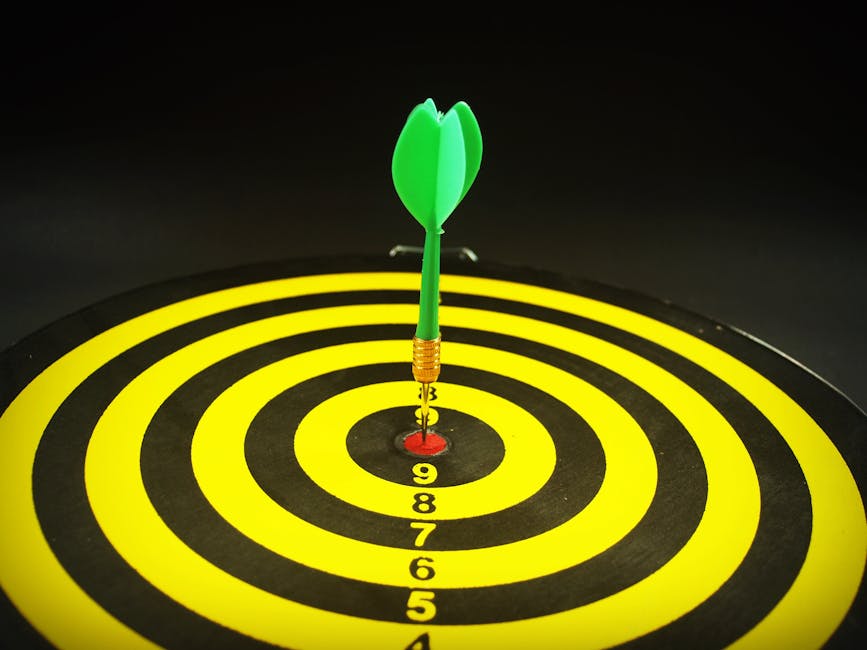
Photo by icon0 com on Pexels
These terms are often used interchangeably, but they have distinct meanings in science:
- Accuracy: How close your measurement is to the true or accepted value. Think of hitting the bullseye on a dartboard.
- Precision: How close repeated measurements are to each other. This is about consistency, even if you're consistently off the bullseye.
You want both! A measurement can be precise but inaccurate (all darts close together, but far from the bullseye), or accurate but imprecise (darts scattered around the bullseye, but their average is the bullseye).
Common Lab Measurement Tools
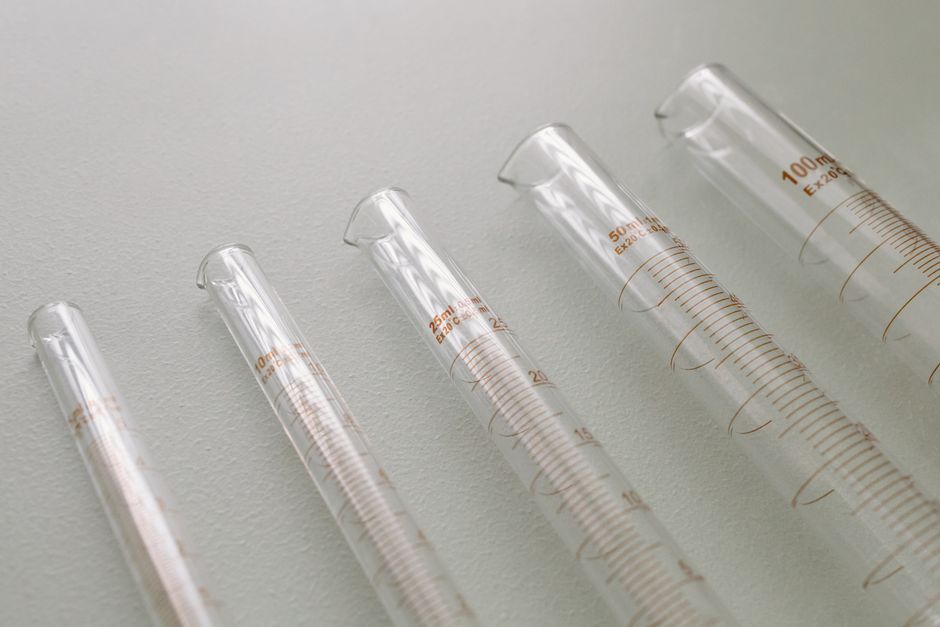
Photo by Tara Winstead on Pexels
You'll use different tools depending on what you're measuring and how much precision you need.
- Volume:
- Beakers and Erlenmeyer Flasks: Good for holding and mixing liquids, but not for precise measurements. They have markings, but these are estimates.
- Graduated Cylinders: More accurate than beakers for measuring liquid volumes. You'll read the bottom of the meniscus (the curve of the liquid surface).
- Pipettes (volumetric and serological): For very accurate and precise dispensing of small volumes. Volumetric pipettes deliver a single, fixed volume, while serological pipettes have graduations for variable volumes.
- Mass:
- Balances (digital scales): Used to measure the mass of substances. You'll need to tare (zero out) the balance before adding your sample.
- Temperature:
- Thermometers: Measure temperature. Ensure you're reading it at eye level.
Here's a simplified view of choosing the right tool for volume:
graph TD
    A["Need to Measure Volume?"] --> B{"How Accurate Must It Be?"}

    B -- "Rough Estimate / Hold Liquid" --> C["Beaker / Erlenmeyer Flask"]
    B -- "Moderately Accurate (e.g., 50 mL)" --> D["Graduated Cylinder"]
    B -- "Highly Accurate (e.g., exactly 10.00 mL)" --> E{"Fixed Volume or Variable?"}

    E -- "Fixed Volume" --> F["Volumetric Pipette"]
    E -- "Variable Volume" --> G["Serological Pipette / Micropipette"]
Reading Measurements and Significant Figures

Photo by MART PRODUCTION on Pexels
When you take a measurement, you record all the certain digits plus one estimated digit. These are your significant figures. The instrument's smallest marking tells you where the certainty ends and estimation begins.
- Example (Graduated Cylinder): If a graduated cylinder has markings for every milliliter (1 mL, 2 mL, etc.) and you see the liquid is between 2.4 mL and 2.5 mL, you'd estimate to the hundredths place, maybe 2.43 mL. The '2', '4' are certain, the '3' is estimated.
3. Worked Example
You need to prepare a 100 mL solution very precisely. You also need to weigh out 2.5 grams of a powder.
Part 1: Measuring 100 mL of liquid
- You wouldn't use a beaker, as it's not accurate enough for a "very precise" 100 mL.
- You'd choose a 100 mL volumetric flask if you're making a solution to 100 mL, or a 100 mL graduated cylinder if you're measuring out 100 mL to transfer. Let's assume you're transferring it.
- Pour your liquid into the graduated cylinder.
- Lower your eye to be level with the top of the liquid.
- Read the bottom of the meniscus. If your 100 mL cylinder has markings every 1 mL, you'll estimate to the tenths place (e.g., 100.0 mL, not just 100 mL).
Part 2: Weighing 2.5 grams of powder
- Place a weighing boat or container on the digital balance.
- Press the "tare" or "zero" button to set the balance to 0.000 g with the container on it. This ensures you're only measuring the powder's mass.
- Carefully add your powder to the container using a spatula.
- Stop when the balance reads 2.50 g (assuming the balance shows two decimal places). If it flickers between 2.49 g and 2.50 g, try to get it to settle on 2.50 g. The significant figures here are three: 2, 5, and 0 (the estimated digit).
4. Key Takeaways
- Always use SI units and their appropriate prefixes for scientific communication.
- Accuracy is about hitting the target; precision is about consistent results.
- Choose your lab equipment based on the required accuracy and volume or mass.
- Read graduated scales at eye level and use the bottom of the meniscus for liquids.
- Tare balances before measuring solids to get only the sample's mass.
- Record measurements with the correct number of significant figures, including one estimated digit.
-
Always double-check your unit conversions, especially between mL and L, or g and kg.
-
Common Mistakes to Avoid:
- Using a beaker for precise volume measurements.
- Not taring the balance, leading to the container's mass being included.
- Reading the meniscus from above or below eye level, causing parallax error.
- Confusing accuracy with precision, or vice-versa.
- Forgetting to include units with your measurements.
5. Now Try It
Go to a lab bench with a 50 mL beaker, a 50 mL graduated cylinder, and a 10 mL serological pipette. Imagine you need to measure out exactly 7.5 mL of water for an experiment. Determine which tool you would use and describe the exact steps you'd take to measure this volume accurately, including how you'd read the instrument.
Success looks like: You correctly identify the most appropriate tool for precise measurement of 7.5 mL and outline the procedure for reading its scale, explaining how to avoid parallax error and read the meniscus.
Frequently asked about Introduction to Laboratory Measurements and Terminology
Study this next
Get the full lab anatomy and physiology curriculum
Clone the complete plan to your dashboard for unlimited AI-generated notes, practice quizzes, and a personalised revision schedule.
Create Free Account