Mixtures: Types and Separation
From the chemistry curriculum
Mixtures: Types and Separation
TL;DR
Mixtures combine substances physically, not chemically, meaning you can separate them. They come in two main types: heterogeneous (unevenly mixed) and homogeneous (evenly mixed, also called solutions). Different properties of the components allow us to select specific physical methods to separate them.
1. The Mental Model
Imagine a salad bowl: you can see the lettuce, tomatoes, and croutons separately. That's a mixture. If you mix sugar in water, you can't see the sugar anymore, but it's still there. Both are mixtures, just mixed differently.
2. The Core Material
When two or more substances combine but don't chemically react to form new substances, you've got a mixture. The key idea is that each substance keeps its original properties.
Types of Mixtures
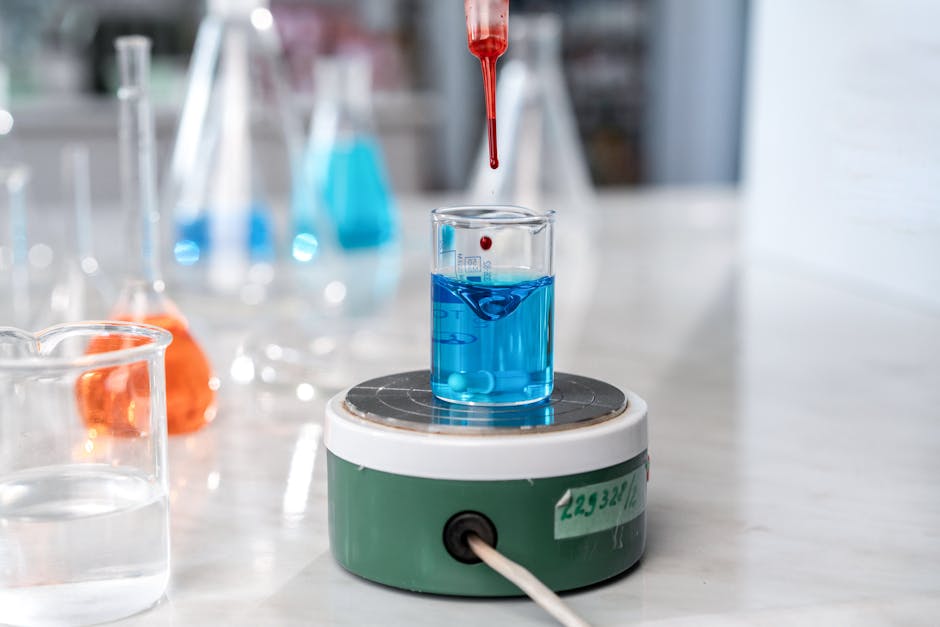
Photo by Ivan S on Pexels
There are two main types of mixtures:
- Heterogeneous Mixtures: Think "different" + "kind." In these mixtures, the components aren't uniformly distributed, meaning you can often see the different parts. Imagine sand and water – you can clearly see the sand grains. Or a bowl of cereal with milk – you can distinguish the flakes from the milk.
- Homogeneous Mixtures: Think "same" + "kind." Here, the components are uniformly distributed throughout, so the mixture looks the same everywhere. You can't easily distinguish the individual components. These are also called solutions. Examples include salt dissolved in water, air (a mixture of gases like nitrogen, oxygen, etc.), or brass (an alloy of copper and zinc).
Separating Mixtures
Photo by Ivan S on Pexels
Because the components in a mixture aren't chemically bonded, you can separate them using physical methods. The method you choose depends on the differences in properties between the components.
graph TD
    A["Mixture"] --> B{"Is it homogeneous or heterogeneous?"}
    B -->|Heterogeneous| C["Physical Separation (e.g., Filtration, Decantation, Magnetism)"]
    B -->|Homogeneous| D["Physical Separation (e.g., Distillation, Evaporation, Chromatography)"]
    C --> E["Separated Components"]
    D --> E
Here are some common separation techniques:
- Decantation: This is used for heterogeneous mixtures where a solid settles at the bottom of a liquid, or for two immiscible liquids (liquids that don't mix, like oil and water). You carefully pour off the liquid, leaving the solid or the denser liquid behind.
- Filtration: Also for heterogeneous mixtures, usually a solid suspended in a liquid. You pass the mixture through a filter (like filter paper) that allows the liquid to pass through (the filtrate) but traps the solid (the residue).
- Evaporation: This is great for separating a soluble solid from a liquid in a homogeneous mixture (a solution). You heat the solution, and the liquid turns into a gas and escapes, leaving the solid behind. You lose the liquid this way.
- Distillation: Used for separating liquids with different boiling points, or a soluble solid from a liquid, where you want to recover the liquid. You heat the mixture, and the substance with the lower boiling point vaporizes first. This vapor is then cooled and condensed back into a liquid (the distillate) in a separate container.
- Magnetism: If one component of a heterogeneous mixture is magnetic (like iron filings) and the others aren't, you can use a magnet to pull out the magnetic substance.
- Chromatography: This technique separates components based on their different affinities for a stationary phase and a mobile phase. For instance, in paper chromatography, different colored pigments in ink will travel up the paper (stationary phase) at different rates when carried by a solvent (mobile phase), separating them.
3. Worked Example
Let's say you have a mixture of sand, salt, and water. How would you separate these three components?
- Add water and stir: The salt will dissolve in the water, forming a homogeneous salt solution. The sand will not dissolve and will remain as a solid, making the overall mixture heterogeneous (sand in saltwater).
- Filter: Pour the mixture through filter paper in a funnel. The sand will be caught by the filter paper (residue), separating it from the saltwater (filtrate).
- Evaporate: Heat the saltwater solution in an evaporating dish. The water will evaporate, leaving the solid salt behind in the dish.
You've now successfully separated the sand, salt, and water!
4. Key Takeaways
- Mixtures are physical combinations of substances where each substance retains its original properties.
- Heterogeneous mixtures have visibly distinct components and are not uniform throughout.
- Homogeneous mixtures (solutions) are uniform throughout and look like a single substance.
- Separation techniques exploit differences in physical properties like solubility, boiling point, density, or magnetism.
- Filtration separates insoluble solids from liquids.
- Evaporation and distillation separate soluble solids from liquids, with distillation allowing you to recover the liquid.
- Decantation is used for settling solids from liquids or separating immiscible liquids.
Common Mistakes to Avoid:
* Confusing mixtures with compounds; compounds involve chemical bonds, mixtures don't.
* Trying to use evaporation if you need to recover the liquid component. Distillation is better for that.
* Assuming all clear liquids are pure substances; many are homogeneous mixtures (solutions).
* Not considering the properties of all components when choosing a separation method.
5. Now Try It
Imagine you have a mixture containing iron filings, sugar, and water. Design a step-by-step process to separate all three components. Clearly state which technique you'd use at each step and what you'd expect to happen. You should end up with separate piles of iron, sugar, and water.
Frequently asked about Mixtures: Types and Separation
More from chemistry
Get the full chemistry curriculum
Clone the complete plan to your dashboard for unlimited AI-generated notes, practice quizzes, and a personalised revision schedule.
Create Free Account