Foundational Chemical Elements
From the introduction curriculum
Foundational Chemical Elements
TL;DR
Everything around us, including you, is made up of fundamental building blocks called chemical elements. Each element is unique because of the number of protons in its atoms, which dictates its identity and how it behaves. Understanding these basic elements helps us grasp how the world works at a chemical level.
1. The Mental Model
Imagine LEGO bricks: each color and shape represents a different element. You can combine these bricks in countless ways to build anything, but a red 2x4 brick is always a red 2x4 brick, no matter what you build with it. Elements are these fundamental, unchangeable building blocks of matter.
2. The Core Material
At its heart, chemistry is about understanding matter – what it's made of and how it changes. The most basic form of matter is an element. You can't break an element down into simpler substances by ordinary chemical means.
What Makes an Element Unique?

Photo by Ann H on Pexels
Every element is defined by the number of protons in the nucleus of its atoms. This number is called the atomic number.
* Protons: Positively charged particles in the atom's center (nucleus).
* Neutrons: Neutral particles also in the nucleus, contributing to mass but not identity.
* Electrons: Negatively charged particles orbiting the nucleus, involved in chemical bonding.
Think of the atomic number as an element's ID card. Hydrogen always has 1 proton (atomic number 1), Helium always has 2 protons (atomic number 2), and so on. Change the number of protons, and you change the element.
The Periodic Table: Your Element Map
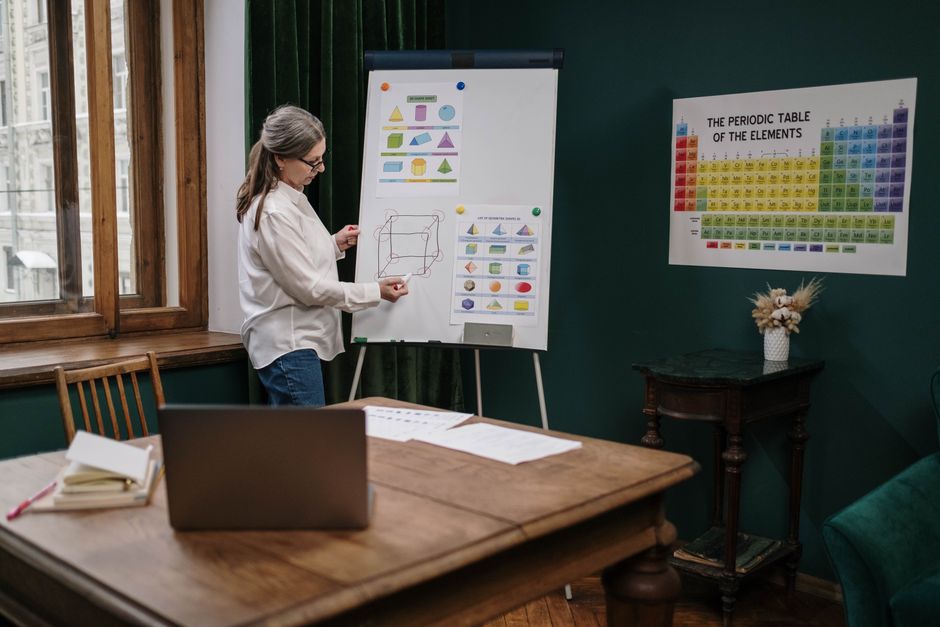
Photo by cottonbro studio on Pexels
The Periodic Table of Elements is an organized chart of all known elements. It's not just a list; it groups elements with similar properties together, making it an incredibly powerful tool.
Here's how elements are generally categorized:
graph TD
    Elements --> Metals
    Elements --> Nonmetals
    Elements --> Metalloids

    Metals --> "Good conductors (heat/electricity)"
    Metals --> "Shiny (lustrous)"
    Metals --> "Malleable (bendable)"
    Metals --> "Ductile (can be drawn into wires)"

    Nonmetals --> "Poor conductors (insulators)"
    Nonmetals --> "Brittle (if solid)"
    Nonmetals --> "Dull"
    Nonmetals --> "Often gases or liquids at room temp"

    Metalloids --> "Semiconductors"
    Metalloids --> "Properties between metals and nonmetals"
- Metals: These are typically shiny, good conductors of heat and electricity, and are usually solid at room temperature (except mercury). Examples: Iron (Fe), Copper (Cu), Gold (Au).
- Nonmetals: These often lack the metallic luster, are poor conductors, and can be solids, liquids, or gases at room temperature. Examples: Oxygen (O), Carbon (C), Nitrogen (N).
- Metalloids: These have properties intermediate between metals and nonmetals (like semiconductors). Examples: Silicon (Si), Germanium (Ge).
Common Foundational Elements

Photo by Brett Jordan on Pexels
You'll encounter these elements constantly in chemistry and everyday life:
- Hydrogen (H): Simplest element (1 proton), most abundant in the universe, key in water (H₂O).
- Oxygen (O): Essential for respiration, makes up a large part of Earth's atmosphere and water.
- Carbon (C): The backbone of all organic molecules and life itself, found in everything from diamonds to DNA.
- Nitrogen (N): Major component of air, crucial for proteins and DNA.
- Iron (Fe): A common metal, essential for blood (hemoglobin) and used widely in construction.
- Sodium (Na) & Chlorine (Cl): Combine to form table salt (NaCl), both vital electrolytes.
3. Worked Example
Let's look at a simple example: Water (H₂O).
You know water is essential for life. But what is it fundamentally made of?
1. You have the element Hydrogen (H). Looking at the periodic table, Hydrogen has an atomic number of 1, meaning each atom has 1 proton.
2. You also have the element Oxygen (O). Oxygen has an atomic number of 8, meaning each atom has 8 protons.
When you see H₂O, it tells you that one molecule of water is made up of two atoms of Hydrogen chemically bonded to one atom of Oxygen. These elements don't lose their identity as H or O within the water molecule; they're just linked together. If you could break water apart chemically, you'd get hydrogen gas and oxygen gas back.
4. Key Takeaways
- Elements are the fundamental building blocks of all matter.
- Each element is uniquely defined by its atomic number, which is the number of protons in its atoms.
- The Periodic Table organizes elements by their atomic number and similar chemical properties.
- Elements are broadly categorized into metals, nonmetals, and metalloids based on their characteristics.
- Common elements like Hydrogen, Oxygen, and Carbon are essential for life and everyday substances.
- You can't break an element down into simpler substances using ordinary chemical reactions.
Common Mistakes to Avoid:
- Don't confuse atoms with elements; an element is a type of atom, defined by its proton count.
- Don't think elements change their identity when they form compounds; they just rearrange and bond.
- Don't assume all elements are solids; many are gases or liquids at room temperature.
- Don't try to memorize the whole periodic table; focus on understanding its structure and the properties of key elements.
5. Now Try It
Find a periodic table (you can easily search for "periodic table online"). Pick any five elements you've never heard of before. For each, write down its name, its chemical symbol, its atomic number, and based on its position on the table, guess if it's likely a metal, nonmetal, or metalloid.
What success looks like: You'll have a list of five new elements with their basic identifying information and a reasonable classification based on their location (e.g., "Element X, Symbol Y, Atomic Number Z, likely a metal because it's on the left side of the table").
Frequently asked about Foundational Chemical Elements
More from introduction
Get the full introduction curriculum
Clone the complete plan to your dashboard for unlimited AI-generated notes, practice quizzes, and a personalised revision schedule.
Create Free Account