Carboxylic Acids: Structure, Properties, and Reactions
From the Chemistry curriculum
Carboxylic Acids: Structure, Properties, and Reactions
TL;DR
Carboxylic acids are organic compounds containing a carboxyl group (-COOH), which gives them acidic properties. Their unique structure allows them to form strong hydrogen bonds, influencing their boiling points and solubility. You'll learn how they react in various ways, like forming esters and amides.
1. The Mental Model
Think of a carboxylic acid as a carbon chain with a special "acidic head." This head, the carboxyl group, is a combination of a carbonyl (C=O) and a hydroxyl (-OH) group, making it quite reactive and able to donate a proton.
2. The Core Material
What is a Carboxylic Acid?

Photo by Pixabay on Pexels
A carboxylic acid is an organic compound that contains a carboxyl group. This group looks like this: -COOH. The 'C' is double-bonded to one oxygen and single-bonded to another oxygen, which is then single-bonded to a hydrogen. It's this -OH part that makes them acidic, as the hydrogen can be donated as a proton (H⁺).
Here's the general formula: R-COOH, where 'R' can be a hydrogen atom, an alkyl group, or an aryl group.
Structure and Nomenclature
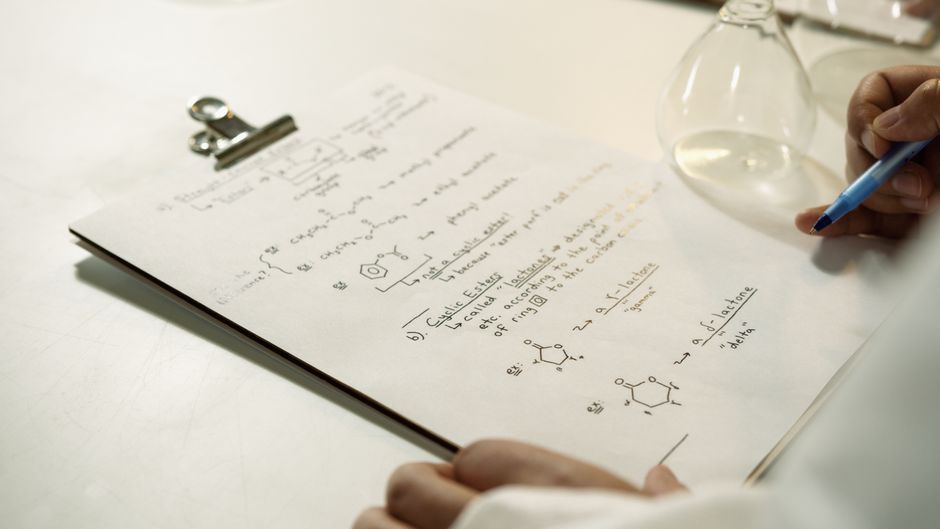
Photo by Artem Podrez on Pexels
You'll name carboxylic acids by taking the longest carbon chain containing the carboxyl group, replacing the '-e' of the corresponding alkane name with '-oic acid'.
For example:
* CH₃COOH is ethanoic acid (from ethane). You might also know it as acetic acid, found in vinegar!
* CH₃CH₂COOH is propanoic acid.
The carbon of the carboxyl group is always carbon #1.
Properties of Carboxylic Acids
Photo by Pixabay on Pexels
Acidity
Carboxylic acids are weak acids, meaning they don't fully dissociate in water. However, they are more acidic than alcohols because the carboxylate ion (RCOO⁻) formed after deprotonation is stabilized by resonance. The negative charge is delocalized over both oxygen atoms, making the conjugate base more stable and thus the acid stronger.
graph TD
    A["Carboxylic Acid (R-COOH)"] --> B["Donates H+"]
    B --> C["Carboxylate Ion (R-COO⁻)"]
    C --> D["Resonance Stabilization (Charge shared between oxygens)"]
    D --> E["More Stable Conjugate Base"]
    E --> A
Boiling Points
Carboxylic acids have significantly higher boiling points than alcohols, aldehydes, and ketones of similar molecular weight. This is because they can form strong dimers through two hydrogen bonds between two acid molecules. This requires more energy to break apart during boiling.
Solubility
Smaller carboxylic acids (up to about four carbons) are soluble in water because the polar carboxyl group can form hydrogen bonds with water molecules. As the nonpolar hydrocarbon chain (R group) gets longer, solubility in water decreases.
Reactions of Carboxylic Acids
Photo by Mikhail Nilov on Pexels
Carboxylic acids undergo several important reactions, mainly involving the -COOH group.
1. Acid-Base Reactions
As acids, they react with strong bases to form a salt and water:
R-COOH + NaOH → R-COONa + H₂O (sodium carboxylate salt)
They also react with carbonates and bicarbonates to produce carbon dioxide gas, which is a good test for their presence:
R-COOH + NaHCO₃ → R-COONa + H₂O + CO₂
2. Esterification
This is a crucial reaction where a carboxylic acid reacts with an alcohol in the presence of an acid catalyst (like H₂SO₄) to form an ester and water. This is a condensation reaction.
R-COOH + R'-OH $\rightleftharpoons$ R-COOR' + H₂O
(Carboxylic acid + Alcohol $\rightleftharpoons$ Ester + Water)
3. Amide Formation
Carboxylic acids can react with amines (compounds containing -NH₂) to form amides. This usually requires heating and sometimes a dehydrating agent to remove water.
R-COOH + R'-NH₂ → R-CONHR' + H₂O
4. Reduction
Carboxylic acids can be reduced to primary alcohols using strong reducing agents like lithium aluminum hydride (LiAlH₄). Milder reducing agents generally don't work.
R-COOH $\xrightarrow{LiAlH_4}$ R-CH₂OH
3. Worked Example
Let's say you have propanoic acid (CH₃CH₂COOH) and you want to react it with ethanol (CH₃CH₂OH) in the presence of sulfuric acid. What would be the product?
This is an esterification reaction.
Propanoic acid: CH₃CH₂COOH
Ethanol: CH₃CH₂OH
When they react, the -OH from the carboxylic acid and the -H from the alcohol's -OH group combine to form water. The remaining parts join together.
CH₃CH₂COOH + CH₃CH₂OH $\xrightarrow{H_2SO_4}$ CH₃CH₂COOCH₂CH₃ + H₂O
The product formed is ethyl propanoate, an ester, along with water. Esters often have fruity smells!
4. Key Takeaways
- Carboxylic acids contain the -COOH (carboxyl) functional group.
- They are weak acids because the carboxylate ion is stabilized by resonance.
- They have high boiling points due to strong hydrogen bonding, often forming dimers.
- Smaller carboxylic acids are water-soluble; solubility decreases as the carbon chain lengthens.
- Carboxylic acids react with bases to form salts, with alcohols to form esters, and with amines to form amides.
- They can be reduced to primary alcohols by strong reducing agents.
Common mistakes to avoid:
* Confusing the acidity of carboxylic acids with inorganic strong acids; they are weak.
* Forgetting that esterification is a reversible reaction and often requires an acid catalyst.
* Underestimating the impact of hydrogen bonding on their physical properties (like boiling point).
* Trying to reduce them with weak reducing agents; LiAlH₄ is usually needed for reduction to alcohols.
5. Now Try It
You have butanoic acid (CH₃CH₂CH₂COOH) and you want to convert it into an ester with methanol (CH₃OH). Write out the balanced chemical equation for this reaction, including the catalyst. What's the name of the ester you would form? You should be able to complete this in about 15 minutes.
Frequently asked about Carboxylic Acids: Structure, Properties, and Reactions
More from Chemistry
Get the full Chemistry curriculum
Clone the complete plan to your dashboard for unlimited AI-generated notes, practice quizzes, and a personalised revision schedule.
Create Free Account