Quiz Question Types and Construction
From the i need a quiz curriculum
TL;DR
When building a quiz, you'll choose from common question types like multiple-choice or true/false, each with pros and cons. Good questions are clear, unambiguous, and directly test what you want to assess. Avoid common pitfalls like trick questions or poorly distributed answers to create effective quizzes.
1. The Mental Model
Think of each quiz question as a tiny test designed to confirm you understand a specific piece of information. The type of question you pick (e.g., matching, essay) dictates how you'll show that understanding, from simply recognizing an answer to explaining it in detail. Your goal is to make sure your question truly asks what you intend to ask.
2. The Core Material
Crafting effective quiz questions is key to accurately assessing knowledge. Different question types are better suited for different learning outcomes. Here’s a breakdown of common types, their strengths, and weaknesses.
Multiple Choice Questions (MCQ)

Photo by Andy Barbour on Pexels
These present a question (the "stem") and several possible answers (the "options" or "alternatives"), only one of which is correct. The incorrect options are called "distractors."
- Pros: Easy to grade (especially automatically), can cover a broad range of topics quickly, good for testing recall and understanding.
- Cons: Can be difficult to write good distractors, susceptible to guessing, doesn't assess higher-order thinking skills well.
- Construction Tips:
- Stem: Should be a complete question or statement, clearly posed. Avoid negatives if possible, or highlight them if necessary (e.g., "Which of the following is NOT...?").
- Options: Make all options grammatically consistent with the stem. Keep them similar in length and complexity. Avoid "all of the above" or "none of the above" unless absolutely necessary, as they can reduce validity. Ensure only one best answer.
True/False Questions
Photo by Pixabay on Pexels
You present a statement, and the test-taker decides if it's true or false.
- Pros: Quick to answer, good for covering many facts, easy to grade.
- Cons: 50% chance of guessing correctly, doesn't assess deep understanding.
- Construction Tips:
- Statements should be unequivocally true or false. Avoid ambiguity.
- Keep statements concise. Avoid double negatives.
- Mix up the number of true and false statements, don't follow a pattern.
Matching Questions

Photo by Leeloo The First on Pexels
These present two columns of related items, and you pair them up.
- Pros: Efficient for assessing knowledge of relationships or associations, reduces guessing compared to T/F.
- Cons: Primarily tests recall of facts, can be less effective for complex topics.
- Construction Tips:
- Provide clear instructions.
- Ensure all items in one column are plausible matches for items in the other.
- Have more options in the response column than in the premise column to reduce guessing.
- Keep the lists relatively short (e.g., 5-10 items).
Short Answer/Fill-in-the-Blank Questions
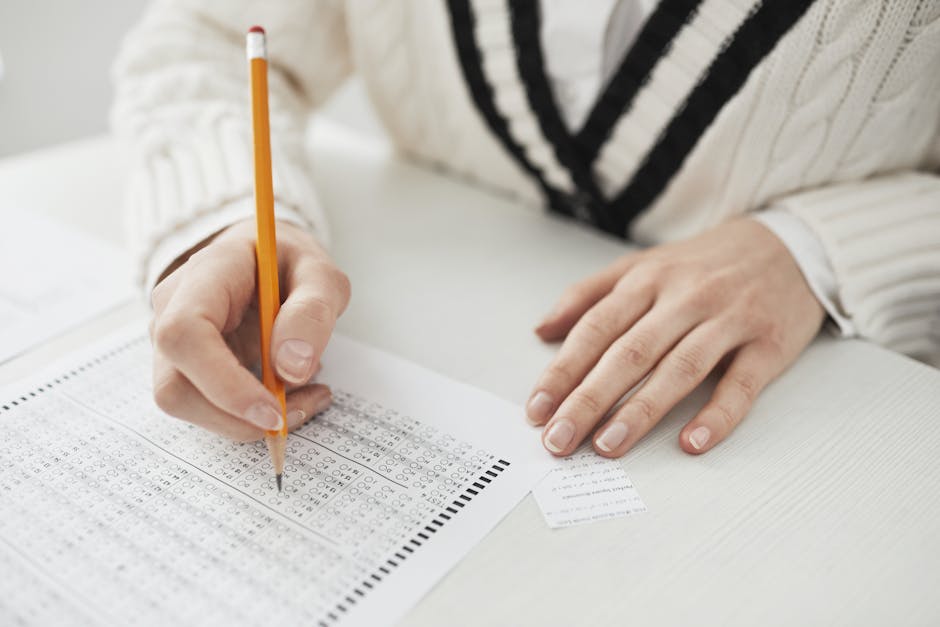
Photo by Andy Barbour on Pexels
You provide a question or an incomplete statement, and the test-taker writes a brief response.
- Pros: Requires recall rather than just recognition, reduces guessing, can assess basic understanding.
- Cons: Can be challenging to grade consistently, especially with minor variations in wording.
- Construction Tips:
- Ask a specific question that has a clear, concise answer.
- For fill-in-the-blank, use only one or two blanks per statement.
- Indicate the expected length of the answer if it helps (e.g., "answer in one word").
Essay Questions
These require a detailed, free-form written response.
- Pros: Assesses higher-order thinking skills (analysis, synthesis, evaluation), reveals depth of understanding, demonstrates writing ability.
- Cons: Time-consuming to answer and grade, subjective grading can be an issue.
- Construction Tips:
- Use clear, specific prompts that define the scope of the answer. Avoid vague terms like "discuss."
- Provide clear criteria for grading (e.g., "Your answer should include two examples and a counter-argument").
- Specify length expectations (e.g., "Write a paragraph," "Write 2-3 pages").
Here’s a diagram showing a general workflow for creating quiz questions:
graph TD
    A["Identify Learning Objective"] --> B{"What knowledge/skill to test?"}
    B --> C["Choose Question Type"]
    C --> D{"Selected Type: \nMCQ, T/F, Matching, Essay, etc."}
    D --> E["Draft Question Stem/Prompt"]
    E --> F{"For MCQs/Matching: \nCreate Correct Answer(s)"}
    F --> G{"For MCQs: \nCreate Plausible Distractors"}
    G --> H["Review for Clarity & Ambiguity"]
    H --> I{"Does it align with \nlearning objective?"}
    I -- No --> A
    I -- Yes --> J["Pilot/Test Question"]
    J --> K{"Is it fair & effective?"}
    K -- No --> H
    K -- Yes --> L["Finalize & Add to Quiz"]
3. Worked Example
Let's say you want to test the understanding of the "Quiz Question Types and Construction" topic.
Learning Objective: You should be able to identify the primary advantage of Multiple Choice Questions.
Initial Idea (Poor): "MCQs are good, right? True/False." (Too vague, mixes types, easily guessable.)
Revision 1 (Better T/F): "Multiple Choice Questions are generally harder to grade than essay questions. True/False." (Still not getting at the advantage.)
Revision 2 (MCQ Attempt - Poor Distractors):
Which of the following is an advantage of Multiple Choice Questions?
a) They always require higher-order thinking.
b) They are very difficult to write.
c) They are easy to grade automatically.
d) They should only be used for math.
(Options a, b, and d are clearly false or extreme, making the answer too obvious even without knowing the content.)
Revision 3 (Stronger MCQ):
What is a primary advantage of using Multiple Choice Questions (MCQs) in a quiz?
a) They effectively assess complex analytical skills.
b) They prevent all forms of guessing.
c) They allow for efficient, objective grading.
d) They require extensive written responses from test-takers.
- Analysis:
- Stem: Clear, concise, asks directly for a primary advantage.
- Correct Answer (c): "They allow for efficient, objective grading" is a well-known advantage.
- Distractor (a): MCQs are generally less effective for complex analytical skills than essays, making this plausible but incorrect.
- Distractor (b): While they reduce some forms of guessing, they don't prevent all forms, making this plausible but incorrect.
- Distractor (d): This describes essay questions, not MCQs, but it's a common characteristic of another question type, making it a reasonable distractor for someone confused about question types.
This final MCQ is much more effective because its distractors are plausible but incorrect, truly testing your knowledge.
4. Key Takeaways
- Understand the strengths and weaknesses of each question type (MCQ, True/False, Matching, Short Answer, Essay).
- Always ensure your question directly tests a specific learning objective, not general knowledge.
- Craft clear, unambiguous question stems or prompts for all question types.
- For multiple-choice, create plausible, well-constructed distractors to avoid giving away the answer.
- Prioritize objective grading for question types where possible, or provide clear rubrics for subjective ones.
Common Mistakes to Avoid
- Vague or ambiguous wording: Questions that can be interpreted in multiple ways.
- Trick questions: Designed to mislead rather than assess understanding.
- Answer patterns: For MCQs, always having 'c' be the correct answer, which lets students guess.
- Overly complex language: Using jargon or convoluted sentences when simpler ones would suffice.
- Mismatched difficulty: Asking very easy questions for advanced topics, or vice-versa.
5. Now Try It
Choose a topic you know well. Construct three different types of quiz questions (e.g., one MCQ, one True/False, one short answer) that test different aspects of that topic. For your MCQ, specifically focus on creating two plausible, but incorrect, distractors. After writing them, read them aloud to yourself to check for clarity and ambiguity.
What success looks like: You'll have three distinct questions, each accurately testing a piece of knowledge about your chosen topic, and your MCQ will have distractors that genuinely challenge someone who isn't sure of the answer.
Frequently asked about Quiz Question Types and Construction
Study this next
Get the full i need a quiz curriculum
Clone the complete plan to your dashboard for unlimited AI-generated notes, practice quizzes, and a personalised revision schedule.
Save this course free