Mechanical Energy: Potential and Kinetic
From the fysik curriculum
Mechanical Energy: Potential and Kinetic
TL;DR
Mechanical energy is the total energy of motion and position for an object, made up of kinetic energy (energy of movement) and potential energy (stored energy due to position). It's a conserved quantity in ideal systems, meaning it just changes forms between kinetic and potential. Understanding this helps you predict how objects will move or how much work they can do.
1. The Mental Model
Imagine a rollercoaster. As it climbs a hill, it stores up energy because of its height (potential energy). As it races down, that stored energy turns into speed (kinetic energy). The total energy (ignoring friction) stays the same, just changing its appearance.
2. The Core Material
Mechanical energy ($E_{mech}$) is simply the sum of an object's kinetic energy ($E_k$) and its potential energy ($E_p$). So, $E_{mech} = E_k + E_p$.
Kinetic Energy ($E_k$)

Photo by Pixabay on Pexels
Kinetic energy is the energy an object possesses due to its motion. The faster an object moves and the more mass it has, the more kinetic energy it has.
The formula for kinetic energy is:
$E_k = \frac{1}{2}mv^2$
Where:
* $m$ is the object's mass (in kilograms, kg)
* $v$ is the object's speed (in meters per second, m/s)
Notice the $v^2$ part: this means that doubling an object's speed quadruples its kinetic energy!
Potential Energy ($E_p$)

Photo by Pixabay on Pexels
Potential energy is stored energy that an object has because of its position or state. In many physics problems, we're talking about gravitational potential energy.
The formula for gravitational potential energy is:
$E_p = mgh$
Where:
* $m$ is the object's mass (in kilograms, kg)
* $g$ is the acceleration due to gravity (approximately $9.8 \text{ m/s}^2$ on Earth)
* $h$ is the object's height above a reference point (in meters, m)
It's important to pick a consistent reference point (where $h=0$). The actual value of potential energy changes with the reference point, but the change in potential energy doesn't.
Conservation of Mechanical Energy
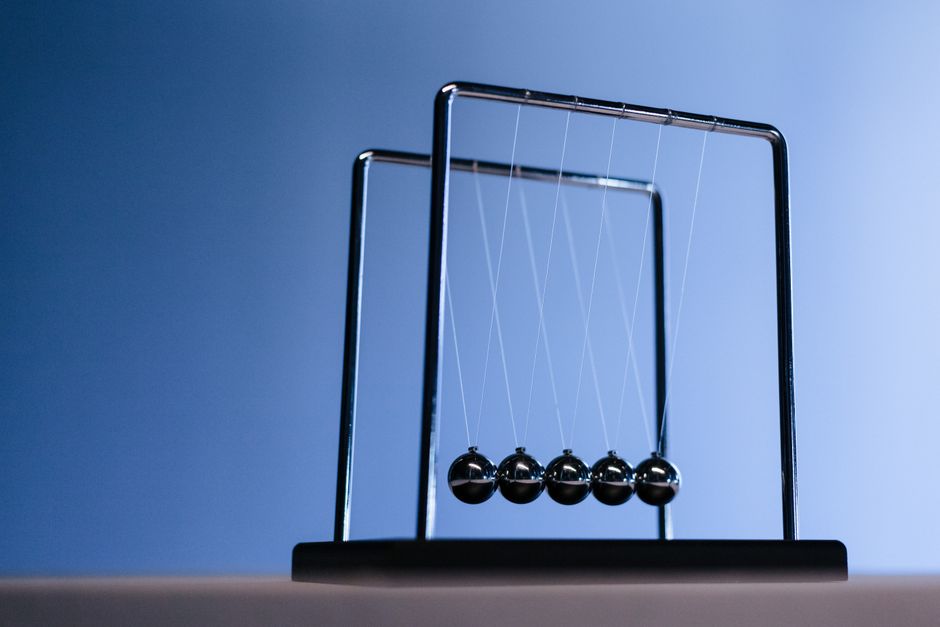
Photo by Ron Lach on Pexels
In an ideal system where there's no friction or air resistance (non-conservative forces), the total mechanical energy remains constant. It just transforms between kinetic and potential forms.
$E_{mech, initial} = E_{mech, final}$
$\frac{1}{2}mv_{initial}^2 + mgh_{initial} = \frac{1}{2}mv_{final}^2 + mgh_{final}$
This is super useful because if you know the energy at one point, you can find it at another!
graph TD
    Start["Object at Rest (High Point)"] --> A["High Potential Energy (mgh)"]
    A --> B["Starts to Fall (Speed increases)"]
    B --> C["Potential Energy decreases"]
    C --> D["Kinetic Energy increases (1/2mv²)"]
    D --> E["Object at Low Point (Max Speed)"]
    E --> F["Low Potential Energy (close to 0)"]
    F --> G["High Kinetic Energy"]
    G --> End["Mechanical Energy Conserved (A + D = F + G)"]
3. Worked Example
Let's say you drop a 2 kg bowling ball from a height of 5 meters. What's its speed just before it hits the ground? (Assume no air resistance and $g=9.8 \text{ m/s}^2$).
1. Define your initial and final states:
* Initial (top of drop): $h_{initial} = 5 \text{ m}$, $v_{initial} = 0 \text{ m/s}$ (since it's dropped from rest)
* Final (just before hitting ground): $h_{final} = 0 \text{ m}$ (our reference point), $v_{final} = ?$
2. Calculate initial mechanical energy:
$E_{k, initial} = \frac{1}{2}mv_{initial}^2 = \frac{1}{2}(2 \text{ kg})(0 \text{ m/s})^2 = 0 \text{ J}$
$E_{p, initial} = mgh_{initial} = (2 \text{ kg})(9.8 \text{ m/s}^2)(5 \text{ m}) = 98 \text{ J}$
$E_{mech, initial} = 0 \text{ J} + 98 \text{ J} = 98 \text{ J}$
3. Set up the conservation of energy equation:
Since mechanical energy is conserved: $E_{mech, initial} = E_{mech, final}$
$98 \text{ J} = E_{k, final} + E_{p, final}$
4. Calculate final potential energy:
$E_{p, final} = mgh_{final} = (2 \text{ kg})(9.8 \text{ m/s}^2)(0 \text{ m}) = 0 \text{ J}$
5. Solve for final kinetic energy and then speed:
$98 \text{ J} = E_{k, final} + 0 \text{ J}$
$E_{k, final} = 98 \text{ J}$
Now use the kinetic energy formula to find speed:
$E_{k, final} = \frac{1}{2}mv_{final}^2$
$98 \text{ J} = \frac{1}{2}(2 \text{ kg})v_{final}^2$
$98 \text{ J} = (1 \text{ kg})v_{final}^2$
$v_{final}^2 = \frac{98 \text{ J}}{1 \text{ kg}}$
$v_{final} = \sqrt{98} \text{ m/s} \approx 9.9 \text{ m/s}$
So, the bowling ball will be moving at about 9.9 m/s just before it hits the ground.
4. Key Takeaways
- Mechanical energy is the sum of kinetic energy (due to motion) and potential energy (due to position).
- Kinetic energy depends on an object's mass and the square of its speed ($E_k = \frac{1}{2}mv^2$).
- Gravitational potential energy depends on mass, gravity, and height ($E_p = mgh$).
- In ideal systems without friction, total mechanical energy is conserved; it just changes form.
- You must choose a consistent reference point for height ($h=0$) when calculating potential energy.
- Mechanical energy is expressed in Joules (J), where $1 \text{ J} = 1 \text{ kg} \cdot \text{m}^2/\text{s}^2$.
Common Mistakes to Avoid:
- Forgetting that speed ($v$) is squared in the kinetic energy formula.
- Not using consistent units (e.g., mixing grams and kilograms).
- Forgetting to include mass ($m$) in either formula.
- Not setting a clear reference point for height when calculating potential energy.
- Assuming mechanical energy is always conserved even when friction or other non-conservative forces are present.
5. Now Try It
Imagine a 0.5 kg toy car starting from rest at the top of a 1.2-meter tall ramp. Calculate its speed when it reaches the bottom of the ramp, assuming no friction. What does success look like? You should arrive at a speed value in m/s, demonstrating that the initial potential energy was fully converted to kinetic energy at the bottom.
Frequently asked about Mechanical Energy: Potential and Kinetic
Study this next
Get the full fysik curriculum
Clone the complete plan to your dashboard for unlimited AI-generated notes, practice quizzes, and a personalised revision schedule.
Create Free Account