The Road to Stalemate: Early War and the Schlieffen Plan's Failure
From the WW1 curriculum
The Road to Stalemate: Early War and the Schlieffen Plan's Failure
TL;DR
The early stages of WWI saw swift movements and grand strategic plans, most notably Germany's Schlieffen Plan. This plan aimed for a quick victory over France before turning to Russia, but it failed due to several critical miscalculations and strong Allied resistance, leading to a prolonged and bloody stalemate.
1. The Mental Model
Imagine a carefully choreographed chess match that goes horribly wrong almost immediately. One side tries a bold, risky opening, but unexpected resistance and logistical nightmares turn the swift victory into a grinding, static deadlock.
2. The Core Material
When WWI began in August 1914, most European powers expected a short, decisive war. Germany, in particular, had a detailed strategy for a quick victory: the Schlieffen Plan. Devised by Field Marshal Alfred von Schlieffen, and later modified by Helmuth von Moltke the Younger, this plan was based on the premise that Germany would likely face a two-front war against France in the west and Russia in the east.
The Schlieffen Plan's Core Idea
Photo by Felicity Tai on Pexels
The plan's central idea was to defeat France quickly before Russia could fully mobilize its vast army. It assumed Russia's mobilization would be slow due to its size and less developed infrastructure. So, Germany would launch a massive, lightning-fast offensive through neutral Belgium to bypass heavily fortified French defenses along the Franco-German border. The goal was to encircle Paris and force France to surrender within weeks. Once France was out of the war, German forces could then be redeployed east to fight Russia.
Execution and Early Successes

Photo by RDNE Stock project on Pexels
Germany invaded Belgium on August 4, 1914. This act immediately brought Britain, committed to defending Belgian neutrality, into the war. The German advance was initially successful, pushing deep into Belgium and northern France. French and British forces struggled to contain the rapid German advance, and it seemed, for a brief period, that the plan might actually work.
Why the Schlieffen Plan Failed

Photo by Ann H on Pexels
Several factors conspired against the Schlieffen Plan:
- Belgian Resistance: The Belgians, despite being a small nation, offered unexpectedly fierce resistance, slowing the German advance and allowing the Allies crucial time to prepare.
- British Expeditionary Force (BEF): Britain's rapid deployment of the BEF to France, though small, provided vital support to the French lines and helped slow the German push.
- Russian Mobilization: Russia mobilized much faster than German intelligence had anticipated. This forced Germany to divert troops from the Western Front to the East earlier than planned, weakening the critical right wing of the Schlieffen Plan.
- Overextension and Supply Lines: The rapid German advance stretched their supply lines to the breaking point. Troops were exhausted, and essential supplies couldn't keep up.
- Modification by Moltke: Moltke, fearing a Russian breakthrough, weakened the crucial right wing (the invading force) by diverting troops to Alsace-Lorraine and the Eastern Front. This reduced the numerical superiority needed for the sweeping encirclement.
- French Counter-Attack (Battle of the Marne): The weakened German right wing, approaching Paris, met a determined Franco-British counter-attack at the Battle of the Marne (September 5-12, 1914). French troops were even ferried to the front in Parisian taxis. This battle halted the German advance, saving Paris and pushing German forces back to the Aisne River.
Here's a diagram illustrating the intended vs. actual outcomes:
graph TD
    A["German High Command (1905)"] --> B{Schlieffen Plan Devised};

    B --> C["Hypothesis: Quick defeat of France"];
    B --> D["Hypothesis: Slow Russian mobilization"];

    C --> E["Massive right wing through Belgium"];
    D --> F["Delay troop transfers to East"];

    E --> G["Encircle Paris"];
    F --> H["Focus on Western Front"];

    G --> I{"Expected Outcome: French Surrender"};
    H --> J{"Expected Outcome: Two-front war avoided"};

    I -.-> K["Actual: Strong Belgian Resistance"];
    J -.-> L["Actual: Faster Russian Mobilization"];
    E -.-> M["Actual: Weakened German Right Wing (Moltke's changes)"];
    G -.-> N["Actual: Battle of the Marne (Sept 1914)"];

    K & L & M & N --> O["Result: German Advance Halted"];
    O --> P["Result: Race to the Sea"];
    P --> Q["Result: Trench Warfare / Stalemate"];
The "Race to the Sea" and Trench Warfare
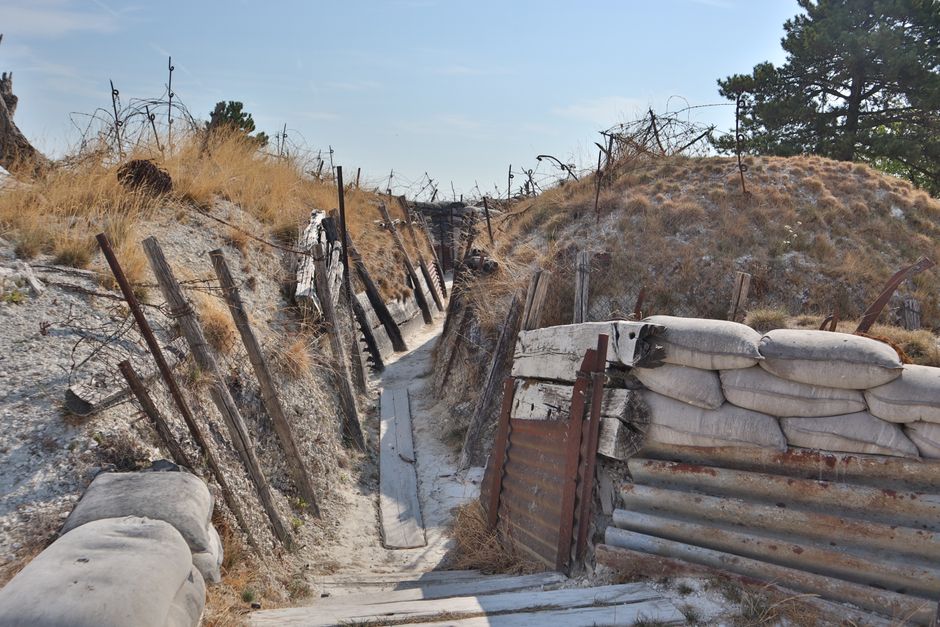
Photo by El Capra on Pexels
After the Battle of the Marne, both sides attempted to outflank each other, moving north towards the coast in what became known as the "Race to the Sea." Neither side could achieve a decisive breakthrough, and as winter approached, they began to dig in for protection. These hastily dug trenches soon evolved into complex systems of fortifications, stretching from the Swiss border to the English Channel. This marked the beginning of the brutal, static trench warfare that would define the Western Front for the next four years.
3. Worked Example
Let's look at a key aspect of the plan's failure: the divergence of the German right wing.
Schlieffen's Original Intent: The original plan called for the right wing (the forces sweeping through Belgium and Northern France) to be significantly stronger than the left wing, acting like a huge swinging door. He specified that the right wing should have seven times the strength of the left wing. This was to ensure overwhelming force for the rapid encirclement of Paris.
Moltke's Modification: When Moltke implemented the plan in 1914, he was concerned about potential French attacks in Alsace-Lorraine and the rapid Russian mobilization. He consequently diverted troops from the critical right wing to reinforce the left wing and send forces to the Eastern Front.
- Original Plan (ideal): Right Wing (attacking through Belgium) : Left Wing (holding Alsace-Lorraine) = 7:1
- Actual Deployment (Moltke): Right Wing : Left Wing = closer to 3:1
This reduction in strength meant the German right wing, while still powerful, lacked the overwhelming force needed for a swift, decisive encirclement. It became overstretched, exhausted, and more vulnerable to the Allied counter-attack at the Marne, directly contributing to the plan's ultimate failure.
4. Key Takeaways
- The Schlieffen Plan was Germany's strategy to avoid a two-front war by quickly defeating France before Russia could fully mobilize.
- It involved a massive, sweeping invasion through neutral Belgium to bypass French defenses.
- Key factors in its failure included unexpected Belgian resistance, faster Russian mobilization, British intervention, logistical problems, and modifications by Moltke.
- The decisive Battle of the Marne halted the German advance and saved Paris.
-
The failure of the Schlieffen Plan directly led to the "Race to the Sea" and the establishment of static trench warfare on the Western Front.
-
Common Mistakes to Avoid:
- Don't confuse the idea of the Schlieffen Plan with its execution and modifications.
- Avoid oversimplifying the reasons for failure; it wasn't just one thing.
- Don't forget the immediate impact of Belgian neutrality and British involvement.
- Don't assume trench warfare was immediately the plan; it was a consequence of early failures.
5. Now Try It
Imagine you are a German General Staff officer reviewing the failed Schlieffen Plan in late 1914. Write a brief memo (about 150 words) to Moltke explaining 2-3 specific reasons why the plan failed and what lessons you'd suggest for future operations. Focus on concrete military or logistical issues rather than political ones. Success means you've clearly identified how specific elements of the plan or its execution led to its failure and proposed a practical, if hypothetical, adjustment.
Frequently asked about The Road to Stalemate: Early War and the Schlieffen Plan's Failure
More from WW1
Get the full WW1 curriculum
Clone the complete plan to your dashboard for unlimited AI-generated notes, practice quizzes, and a personalised revision schedule.
Create Free Account