Measurement of Volume: Measuring Cylinders
From the physics curriculum
TL;DR
Measuring cylinders are essential tools for accurately determining the volume of liquids in a lab. You need to read the measurement at the bottom of the meniscus at eye level to avoid parallax errors. Always choose the smallest cylinder that can hold your liquid for better precision.
1. The Mental Model
Imagine you're trying to figure out how much water is in a glass. A measuring cylinder is just a super-accurate glass with markings that tell you the exact amount. Your job is to read those markings correctly.
2. The Core Material
Measuring cylinders are tall, cylindrical containers with graduated markings along the side, indicating specific volumes. They're designed to measure liquid volumes with reasonable precision, though they aren't as precise as burettes or pipettes.
Choosing the Right Measuring Cylinder
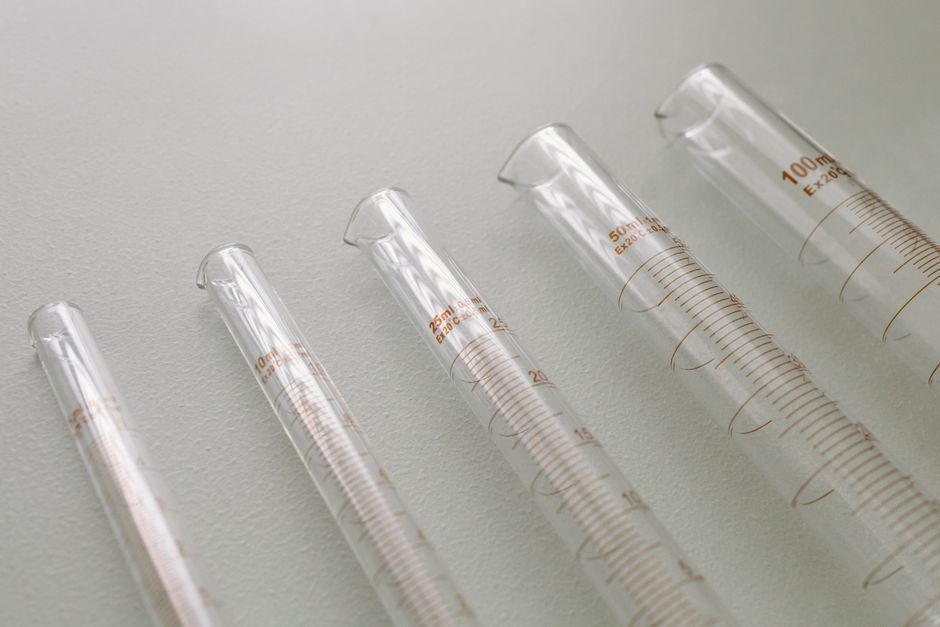
Photo by Tara Winstead on Pexels
Measuring cylinders come in various sizes (e.g., 10 mL, 50 mL, 100 mL, 250 mL, 1000 mL). The smaller the cylinder's total volume, the finer its graduations, which means it can give you a more precise reading. For example, a 10 mL cylinder might have graduations every 0.1 mL, while a 100 mL cylinder might have them every 1 mL.
Rule of thumb: Always use the smallest measuring cylinder that can comfortably hold the volume you need to measure. Don't use a 100 mL cylinder to measure 5 mL of liquid if a 10 mL or 25 mL cylinder is available.
Reading the Meniscus
When a liquid is in a narrow container like a measuring cylinder, its surface isn't perfectly flat. For most liquids (like water), the surface curves downwards at the edges, forming a "U" shape. This curve is called the meniscus.
To get an accurate reading, you must read the volume at the bottom of the meniscus.
Avoiding Parallax Error
Parallax error occurs when your eye isn't level with the meniscus, causing the reading to appear higher or lower than it actually is.
How to avoid it:
1. Place the measuring cylinder on a flat surface.
2. Bend down so your eye is exactly level with the bottom of the meniscus.
3. Read the volume directly from the scale.
Here's a visual guide:
graph TD
    A["Pour liquid into cylinder"] --> B["Place cylinder on flat surface"]
    B --> C["Wait for liquid to settle"]
    C --> D["Lower eye to be level with meniscus"]
    D --> E["Read volume at the bottom of the meniscus"]
    E --> F{"Is reading accurate?"}
    F -- Yes --> G["Record the measurement"]
    F -- No (due to parallax) --> D
Recording the Measurement
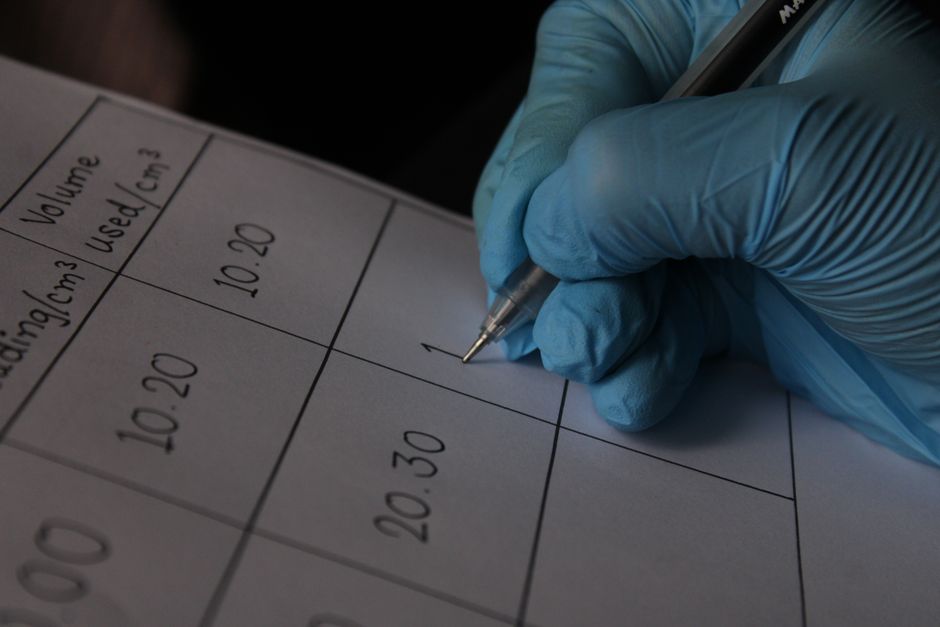
Photo by Jahra Tasfia Reza on Pexels
Always record the measurement to the smallest division marked on the cylinder, plus one estimated digit. For example, if a 100 mL cylinder has markings every 1 mL, and the meniscus is between 50 mL and 51 mL, you might estimate it as 50.5 mL.
3. Worked Example
Let's say you're measuring a liquid using a 50 mL measuring cylinder. The cylinder has major markings every 10 mL and minor markings every 1 mL.
- You pour the liquid into the cylinder.
- You place the cylinder on the lab bench.
- You lower your head so your eyes are perfectly level with the liquid's surface.
- You observe that the bottom of the meniscus is above the 20 mL mark but below the 21 mL mark. It looks like it's about halfway between 20 mL and 21 mL.
Based on this observation, you would record the volume as 20.5 mL. You read the certain digits (20 mL) and estimated the uncertain digit (0.5 mL).
4. Key Takeaways
- Always read the volume at the bottom of the meniscus for most liquids (like water).
- Position your eye level with the meniscus to prevent parallax errors.
- Choose the smallest measuring cylinder that can hold your liquid for maximum precision.
- Ensure the cylinder is on a flat, stable surface before taking a reading.
- Record the volume to the appropriate number of significant figures, including one estimated digit.
- Understand that measuring cylinders are for approximate measurements; use pipettes or burettes for higher accuracy.
Common Mistakes to Avoid:
- Reading the top of the meniscus instead of the bottom.
- Reading from above or below eye level (parallax error).
- Using a much larger cylinder than necessary, reducing precision.
- Not waiting for the liquid to settle before taking a reading.
5. Now Try It
Find a measuring cylinder (or even a clear glass with some markings if a cylinder isn't available). Pour about a quarter full of water into it. Now, practice reading the volume. First, try reading it from above, then from below, and finally, bring your eye exactly level with the bottom of the meniscus. Observe how your perceived reading changes. Repeat this a few times until you're confident you can consistently get an accurate, level reading. What do you notice about the perceived volume when you read from different angles?
Try it yourself: Volume, surface area and nets of 3D shapes
Frequently asked about Measurement of Volume: Measuring Cylinders
More from physics
Get the full physics curriculum
Clone the complete plan to your dashboard for unlimited AI-generated notes, practice quizzes, and a personalised revision schedule.
Save this course free