Electrolysis of Aqueous Solutions and Molten Electrolytes
From the electrolysis curriculum
TL;DR
Electrolysis uses electricity to drive non-spontaneous chemical reactions in molten salts or aqueous solutions. The key difference lies in what ions are present: only ions from the salt in molten electrolytes, versus water and salt ions in aqueous solutions. The products formed depend on the reactivity of the ions and the electrode material.
1. The Mental Model
Think of electrolysis as forcing reluctant dance partners (ions) to go to specific sides of a dance floor (electrodes) by using a powerful electric current, resulting in new pairs (products) being formed.
2. The Core Material
Electrolysis is the process of using electrical energy to break down compounds. You're forcing a non-spontaneous redox reaction to occur. This happens in an electrolytic cell, which consists of two electrodes (anode and cathode) immersed in an electrolyte, connected to a power supply.
Molten Electrolytes
When you melt an ionic compound, like sodium chloride (NaCl), it separates into its constituent ions (Na⁺ and Cl⁻). There's nothing else present to compete for reaction at the electrodes.
- At the Cathode (negative electrode): Cations (positive ions) are attracted. They gain electrons and are reduced.
- Example: Na⁺(l) + e⁻ → Na(l)
- At the Anode (positive electrode): Anions (negative ions) are attracted. They lose electrons and are oxidized.
- Example: 2Cl⁻(l) → Cl₂(g) + 2e⁻
The products are always the pure elements making up the molten ionic compound.
Aqueous Solutions
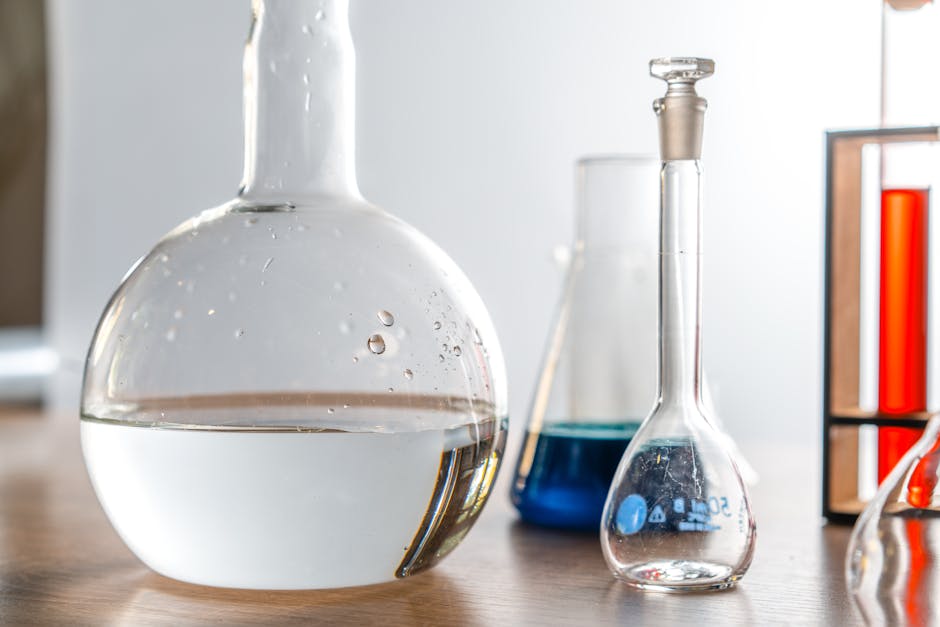
Photo by Ivan S on Pexels
This is where things get more interesting because water (H₂O) is present along with the dissolved ionic compound. Water itself can ionize slightly into H⁺ and OH⁻ ions, and it can also be oxidized or reduced. This means there's competition at both electrodes.
At the Cathode (Reduction):
You'll have the cation from the dissolved salt and water molecules present. The species that is more easily reduced will react.
* Metal cations: If the metal is more reactive than hydrogen (e.g., K⁺, Na⁺, Ca²⁺, Mg²⁺, Al³⁺), water will be reduced instead.
* 2H₂O(l) + 2e⁻ → H₂(g) + 2OH⁻(aq)
* If the metal is less reactive than hydrogen (e.g., Cu²⁺, Ag⁺, Pb²⁺), the metal ion will be reduced.
* Cu²⁺(aq) + 2e⁻ → Cu(s)
* If the solution is acidic, H⁺ ions will be reduced:
* 2H⁺(aq) + 2e⁻ → H₂(g)
At the Anode (Oxidation):
You'll have the anion from the dissolved salt and water molecules present. The species that is more easily oxidized will react.
* Halide anions (Cl⁻, Br⁻, I⁻): These are usually oxidized to their elemental form unless they are very dilute or another species is much easier to oxidize.
* 2Cl⁻(aq) → Cl₂(g) + 2e⁻
* Other anions (SO₄²⁻, NO₃⁻, CO₃²⁻, F⁻): These are difficult to oxidize. In their presence, water will be oxidized instead.
* 2H₂O(l) → O₂(g) + 4H⁺(aq) + 4e⁻
* Hydroxide ions (OH⁻) in alkaline solutions:
* 4OH⁻(aq) → O₂(g) + 2H₂O(l) + 4e⁻
Summary of Competition at Electrodes (Aqueous):
graph TD
    A["Electrolysis of Aqueous Solution"] --> B{Cathode (Reduction)};
    A --> C{Anode (Oxidation)};

    B --> B1["If cation is reactive (e.g., Na+, K+)"];
    B1 --> B2["Water reduced to H2 gas and OH-"];

    B --> B3["If cation is unreactive (e.g., Cu2+, Ag+)"];
    B3 --> B4["Metal deposited"];

    B --> B5["If solution is acidic"];
    B5 --> B6["H+ reduced to H2 gas"];

    C --> C1["If anion is halide (e.g., Cl-)"];
    C1 --> C2["Halogen gas produced"];

    C --> C3["If anion is non-halide (e.g., SO42-, NO3-)"];
    C3 --> C4["Water oxidized to O2 gas and H+"];

    C --> C5["If solution is alkaline"];
    C5 --> C6["OH- oxidized to O2 gas and H2O"];
Factors affecting products:
1. Reactivity of ions: More reactive metals stay in solution; less reactive metals deposit. Halide ions oxidize; others usually don't.
2. Concentration: In some cases, a very concentrated halide solution might favor halide oxidation over water, even if water is slightly easier to oxidize.
3. Electrode material: Inert electrodes (like graphite or platinum) just provide a surface. Reactive electrodes (like copper) can participate in the reaction, dissolving from the anode or forming an alloy. We usually assume inert electrodes unless stated otherwise.
3. Worked Example
Let's predict the products of electrolysis of:
1. Molten potassium iodide (KI) using inert electrodes.
2. Aqueous copper(II) sulfate (CuSO₄) solution using inert electrodes.
Example 1: Molten KI
- Ions present: K⁺(l), I⁻(l)
- At Cathode (Reduction): K⁺ ions are attracted.
- K⁺(l) + e⁻ → K(l)
- Product: Molten potassium metal.
- At Anode (Oxidation): I⁻ ions are attracted.
- 2I⁻(l) → I₂(g) + 2e⁻
- Product: Iodine gas (or vapor).
Example 2: Aqueous CuSO₄
- Ions present: Cu²⁺(aq), SO₄²⁻(aq), H₂O(l) (which can produce H⁺ and OH⁻)
- At Cathode (Reduction): Competing species are Cu²⁺ and H₂O.
- Copper is less reactive than hydrogen, so Cu²⁺ is more easily reduced than water.
- Cu²⁺(aq) + 2e⁻ → Cu(s)
- Product: Copper metal (a reddish-brown solid) deposits.
- At Anode (Oxidation): Competing species are SO₄²⁻ and H₂O.
- Sulfate ions (SO₄²⁻) are very difficult to oxidize. Water is more easily oxidized.
- 2H₂O(l) → O₂(g) + 4H⁺(aq) + 4e⁻
- Product: Oxygen gas (colorless bubbles) is produced, and the solution becomes more acidic due to the H⁺ ions.
4. Key Takeaways
- Electrolysis uses electrical energy to force non-spontaneous chemical changes.
- In molten electrolytes, only the compound's ions are present, simplifying product prediction.
- In aqueous solutions, water competes with the dissolved salt ions at both electrodes.
- At the cathode, the less reactive cation or H₂O (if the cation is very reactive) gets reduced.
- At the anode, halide ions get oxidized, otherwise H₂O gets oxidized (unless OH⁻ is present).
- Anode products in aqueous solutions are often oxygen gas or halogens, while cathode products are usually hydrogen gas or metals.
- Concentration and electrode material can influence the products, especially in aqueous solutions.
Common Mistakes to Avoid:
- Forgetting about water's role in aqueous electrolysis and just considering the salt ions.
- Incorrectly determining which species is more easily reduced or oxidized at a given electrode.
- Confusing oxidation (loss of electrons, anode) with reduction (gain of electrons, cathode).
- Not balancing the half-equations correctly or combining them to get the overall reaction.
5. Now Try It
For a 15-minute exercise, predict the products formed at the anode and cathode when a concentrated aqueous solution of sodium chloride (brine) is electrolysed using inert electrodes. Write down the half-reactions for each electrode and the overall reaction. Success looks like correctly identifying the products and writing balanced half-equations for both the cathode and anode, and a balanced overall equation.
Try it yourself: Electrolysis in 3D
Frequently asked about Electrolysis of Aqueous Solutions and Molten Electrolytes
Study this next
Get the full electrolysis curriculum
Clone the complete plan to your dashboard for unlimited AI-generated notes, practice quizzes, and a personalised revision schedule.
Save this course free