intermediate

Algebra — Foundations of Equations + 5 more topics

Comprehensive AI-generated study curriculum with 7 detailed note modules.

8 views 7 notes

Course Syllabus

  1. Foundations of Equations
  2. Ratios, Proportions, and Percentages
  3. Rearranging and Applying Formulas
  4. Problem Solving with Financial Contexts
  5. Advanced Equation Solving Techniques
  6. Review and Integrated Application

Study Notes

Foundations of Equations

An equation is a mathematical statement that shows two expressions are equal. It always has an equals sign (=).

For example: $x + 5 = 10$

Here, $x+5$ is one expression and $10$ is another. The = sign says they're the same value. Our job is to find what $x$ has to be for that statement to be true.

Read full note →

Ratios, Proportions, and Percentages

Ratios should always be simplified, just like fractions.

Example: If you have 3 apples and 6 oranges, the ratio of apples to oranges is 3 : 6, which simplifies to 1 : 2. This means for every 1 apple, you have 2 oranges.

The key to solving proportions is cross-multiplication: If a/b = c/d, then a * d = b * c.

Example: If 1 cup of flour makes 12 cookies, how many cookies can you make with 3 cups of flour?
Set up the proportion: 1 cup / 12 cookies = 3 cups / x cookies
Cross-multiply: 1 * x = 12 * 3
x = 36 cookies.

Read full note →

Rearranging and Applying Formulas

Formulas are just equations that show how different quantities relate. Rearranging them means changing which variable is "alone" on one side of the equals sign. This is super useful because sometimes you know the result and want to find one of the inputs, or you might need a formula in a specific form for another calculation.

Read full note →

Advanced Equation Solving Techniques

When equations get more complicated, just isolating the variable won't always work directly. You need strategies to transform the equation into a more familiar, solvable form, often resembling linear or quadratic equations.

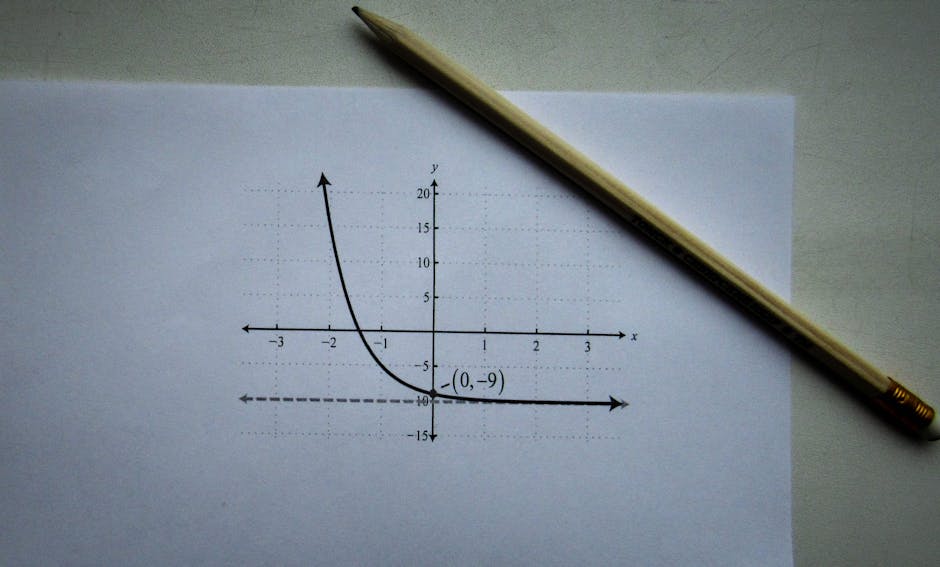
Close-up of a parabola graph on paper with pencil, perfect for math or education themes.
Photo by Sergey Meshkov on Pexels

Read full note →

Ratios, Proportions, and Percentages

Ratios can compare parts to parts (e.g., girls to boys) or parts to a whole (e.g., girls to total students). Always simplify ratios to their lowest terms, just like fractions.

Example: If there are 3 red balls and 6 blue balls, the ratio of red to blue is 3 : 6, which simplifies to 1 : 2. The ratio of red balls to total balls is 3 : 9, which simplifies to 1 : 3.

Example: If you can bake 2 cakes with 4 cups of flour, how many cakes can you bake with 8 cups of flour?
You can set up a proportion: 2 cakes / 4 cups = x cakes / 8 cups
Cross-multiply: 2 * 8 = 4 * x
16 = 4x
x = 4 cakes.

Read full note →