Introduction to the Periodic Table and Atomic Structure
From the https://drive.google.com/file/d/1DWxdvYSo-FdnMkO0lK48yBVV1bcZ88Uf/view?usp=drivesdk curriculum
Introduction to the Periodic Table and Atomic Structure
TL;DR
The periodic table organizes all known elements based on their atomic structure, particularly the number of protons. Understanding atomic structure—protons, neutrons, and electrons—explains how elements behave and interact. This foundation is crucial for comprehending all chemical reactions.
1. The Mental Model
Think of elements like unique LEGO bricks: each type of brick has a specific number of studs (protons) that define it. How these bricks connect (electrons) depends on their outermost layer, and they also have a 'weight' (neutrons) that can vary slightly without changing the brick type.
2. The Core Material
You're diving into the fundamental building blocks of everything around you: atoms and how they're organized in the periodic table.
What's an Atom?

Photo by Steve A Johnson on Pexels
An atom is the smallest unit of an element that still retains that element's properties. It's made of three main types of subatomic particles:
- Protons: Positively charged particles found in the atom's center (the nucleus). The number of protons determines which element an atom is; this is called the atomic number (Z).
- Neutrons: Neutral (no charge) particles also found in the nucleus. They add mass to the atom but don't change its identity. Atoms of the same element can have different numbers of neutrons; these are called isotopes.
- Electrons: Negatively charged particles that orbit the nucleus in specific energy levels or "shells." In a neutral atom, the number of electrons equals the number of protons. Electrons are key to how atoms interact and form bonds.
The mass number (A) of an atom is the total number of protons and neutrons in its nucleus.
The Periodic Table: An Organized System
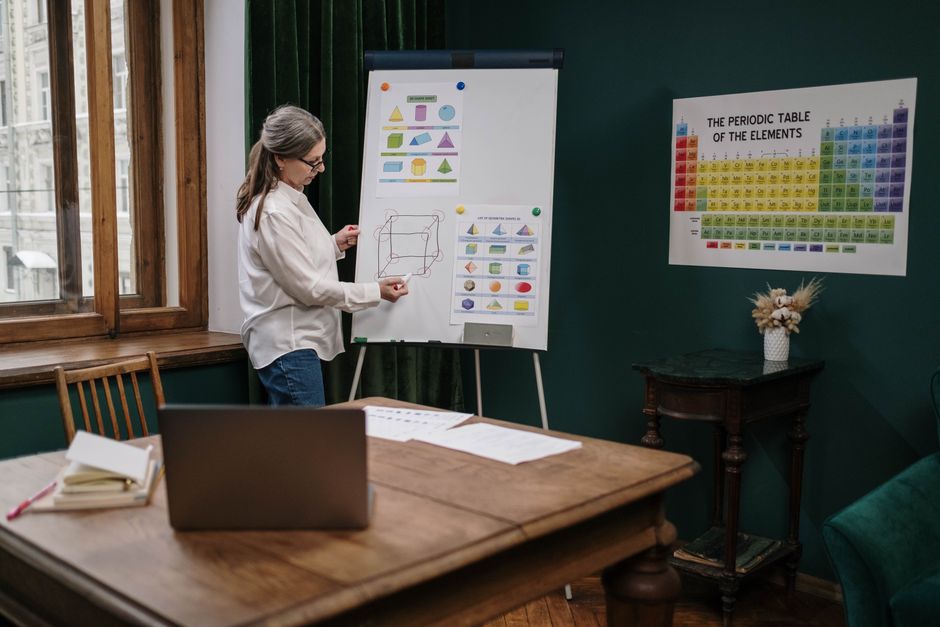
Photo by cottonbro studio on Pexels
The periodic table is a master list of all known elements, arranged in a way that reveals patterns in their properties. It's organized by increasing atomic number (number of protons).
- Periods (Rows): These run horizontally. As you move across a period, atomic number increases by one, and elements generally have the same number of electron shells.
- Groups/Families (Columns): These run vertically. Elements in the same group have similar chemical properties because they have the same number of valence (outermost shell) electrons.
Here's a breakdown of the key information you'll find for an element on the periodic table:
graph TD
    A["Element Information"] --> B["Element Symbol"];
    A --> C["Element Name"];
    A --> D["Atomic Number (Z)"];
    A --> E["Atomic Mass"];
    D -- "Number of Protons" --> ZP["Positive Charge"];
    D -- "Number of Electrons (in neutral atom)" --> NE["Negative Charge"];
    E -- "Average mass of isotopes" --> AM["Weighted average of proton + neutron count"];
Key Regions and Families:

Photo by Alena Darmel on Pexels
- Metals: Generally shiny, good conductors of heat and electricity, malleable (can be hammered into sheets), and ductile (can be drawn into wires). They tend to lose electrons. Found on the left and center.
- Nonmetals: Often dull, poor conductors, brittle. They tend to gain or share electrons. Found on the right.
- Metalloids: Have properties between metals and nonmetals (e.g., semiconductors). Found along the "staircase" line separating metals and nonmetals.
- Alkali Metals (Group 1): Highly reactive metals.
- Alkaline Earth Metals (Group 2): Reactive metals.
- Transition Metals (Groups 3-12): Diverse metals, often forming colorful compounds.
- Halogens (Group 17): Highly reactive nonmetals, often forming salts.
- Noble Gases (Group 18): Very unreactive, stable gases.
Understanding the atomic number (protons) tells you what element it is, and its position in the periodic table hints at how it will behave chemically.
3. Worked Example
Let's look at an element from the periodic table: Oxygen (O).
- Find Oxygen on the periodic table. You'll see its element symbol is 'O'.
- Identify its atomic number (Z). For Oxygen, Z = 8.
- This means a neutral oxygen atom has 8 protons.
- It also means a neutral oxygen atom has 8 electrons.
- Identify its atomic mass. For Oxygen, the atomic mass is approximately 15.999 amu (atomic mass units). This is an average of its isotopes.
- Determine the number of neutrons for a common isotope, Oxygen-16.
- The "16" in Oxygen-16 is the mass number (A).
- Number of neutrons = Mass Number (A) - Atomic Number (Z)
- Number of neutrons = 16 - 8 = 8 neutrons.
So, a common Oxygen-16 atom has 8 protons, 8 electrons, and 8 neutrons. If you encountered Oxygen-17, it would still have 8 protons and 8 electrons (defining it as Oxygen), but 9 neutrons (17 - 8 = 9).
4. Key Takeaways
- The atomic number (Z), which is the number of protons, uniquely identifies an element.
- Atoms consist of a nucleus (protons and neutrons) and orbiting electrons.
- The periodic table organizes elements by increasing atomic number, revealing patterns in chemical properties.
- Elements in the same group (column) have similar chemical behaviors due to having the same number of outermost electrons.
- Isotopes are atoms of the same element with different numbers of neutrons, leading to different mass numbers.
Common Mistakes to Avoid

Photo by KATRIN BOLOVTSOVA on Pexels
- Confusing atomic number (protons) with mass number (protons + neutrons).
- Thinking that changing the number of neutrons changes the element's identity. It only creates an isotope.
- Assuming all atoms of an element have the exact same mass; atomic mass is usually an average of isotopes.
- Forgetting that in a neutral atom, protons = electrons.
5. Now Try It
Choose any three elements from the periodic table (e.g., Sodium, Carbon, Helium). For each, identify its atomic number, element symbol, and whether it's a metal, nonmetal, or metalloid. Then, for one of your chosen elements (pick one with an atomic mass that isn't a whole number, like Chlorine ~35.45), determine the number of protons, electrons, and the most common number of neutrons for its primary isotope (you might need to google the most common isotope's mass number).
Success looks like you correctly identifying these properties and confidently explaining why an element belongs to a certain category (metal/nonmetal/metalloid) based on its position.
Frequently asked about Introduction to the Periodic Table and Atomic Structure
Study this next
Get the full https://drive.google.com/file/d/1DWxdvYSo-FdnMkO0lK48yBVV1bcZ88Uf/view?usp=drivesdk curriculum
Clone the complete plan to your dashboard for unlimited AI-generated notes, practice quizzes, and a personalised revision schedule.
Create Free Account