Foundations of Radicals and Exponents
From the math curriculum
Foundations of Radicals and Exponents
TL;DR
Exponents tell you to multiply a number by itself a certain number of times, making numbers grow or shrink quickly. Radicals (like square roots) are the inverse, figuring out what number was multiplied by itself. Mastering these foundational concepts simplifies complex math expressions and is essential for algebra and beyond.
1. The Mental Model
Think of exponents as repeated multiplication, a shortcut for writing $2 \times 2 \times 2$ as $2^3$. Radicals undo this; if you know $x^2 = 9$, then the square root of 9 tells you $x$ is 3. They're opposite operations, like addition and subtraction.
2. The Core Material
Understanding Exponents
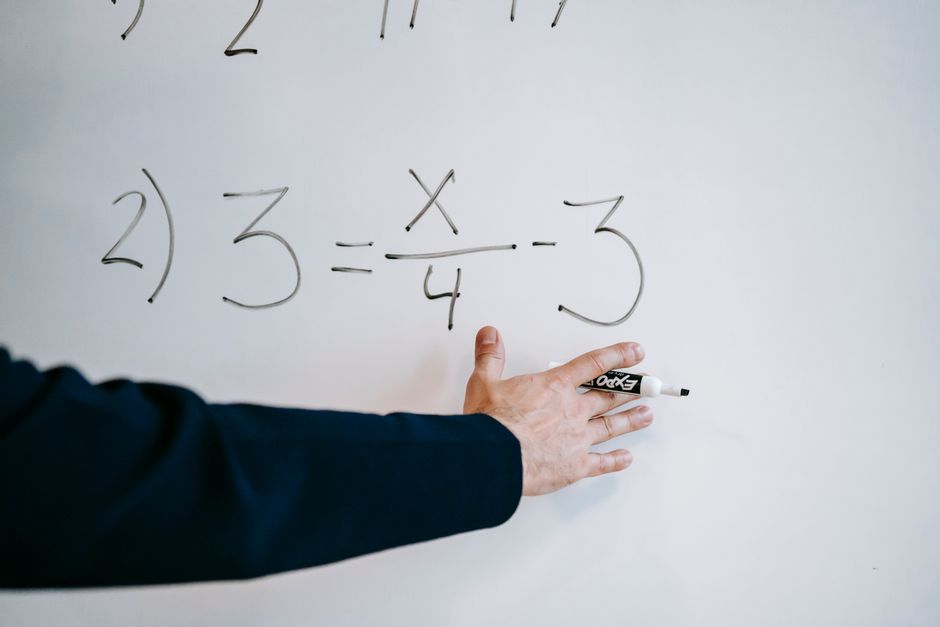
Photo by Vanessa Garcia on Pexels
An exponent tells you how many times to use the "base" number in a multiplication. We write it as $b^n$, where $b$ is the base and $n$ is the exponent (or power).
- Example: $2^3$ means $2 \times 2 \times 2 = 8$. Here, 2 is the base, and 3 is the exponent.
- Special Cases:
- Any number to the power of 1 is itself: $b^1 = b$ (e.g., $5^1 = 5$).
- Any non-zero number to the power of 0 is 1: $b^0 = 1$ (e.g., $7^0 = 1$).
- Negative exponents mean take the reciprocal: $b^{-n} = 1/b^n$ (e.g., $2^{-3} = 1/2^3 = 1/8$).
Rules of Exponents

Photo by Joshua Miranda on Pexels
These rules help simplify expressions with exponents:
- Product Rule: When multiplying powers with the same base, add the exponents.
$b^m \times b^n = b^{m+n}$ (e.g., $2^3 \times 2^4 = 2^{3+4} = 2^7$) - Quotient Rule: When dividing powers with the same base, subtract the exponents.
$b^m / b^n = b^{m-n}$ (e.g., $5^6 / 5^2 = 5^{6-2} = 5^4$) - Power Rule: When raising a power to another power, multiply the exponents.
$(b^m)^n = b^{m \times n}$ (e.g., $(3^2)^3 = 3^{2 \times 3} = 3^6$) - Power of a Product: $(ab)^n = a^n b^n$ (e.g., $(2x)^3 = 2^3 x^3 = 8x^3$)
- Power of a Quotient: $(a/b)^n = a^n / b^n$ (e.g., $(x/y)^2 = x^2 / y^2$)
Understanding Radicals
Photo by Vanessa Garcia on Pexels
A radical (like a square root or cube root) is the opposite of an exponent. It asks, "What number, when multiplied by itself 'n' times, gives this value?" The symbol $\sqrt{}$ is called the radical sign.
- The number under the radical sign is the radicand.
-
The small number indicating which root to take (e.g., 2 for square root, 3 for cube root) is the index. If no index is shown, it's assumed to be 2 (square root).
-
Example: $\sqrt{9}$ means "what number multiplied by itself equals 9?" The answer is 3 (since $3 \times 3 = 9$).
- Example: $\sqrt[3]{8}$ means "what number multiplied by itself three times equals 8?" The answer is 2 (since $2 \times 2 \times 2 = 8$).
Connecting Radicals and Exponents (Fractional Exponents)
Photo by Vanessa Garcia on Pexels
Radicals can be written as fractional exponents. This is super useful because it allows us to use all the exponent rules for radicals too!
- $\sqrt[n]{b}$ can be written as $b^{1/n}$.
- Example: $\sqrt{9} = 9^{1/2}$
- Example: $\sqrt[3]{8} = 8^{1/3}$
- When you have a power inside the radical, $\sqrt[n]{b^m}$, it can be written as $b^{m/n}$.
- Example: $\sqrt[3]{x^2} = x^{2/3}$
Here's how these concepts link:
graph TD
    A["Number (Base)"] --> B["Exponent (Power)"]
    B --> C["Result of Exponentiation"]
    C --> D["Radical (Root)"]
    D --> A;

    subgraph Operations
        B -- "Repeated Multiplication" --> C;
        D -- "Find Base from Result" --> A;
    end

    E["Integer Exponent"] --> F["Positive/Negative/Zero"];
    F --> G["Applies Exponent Rules"];

    H["Radical (e.g., Square Root)"] --> I["Index (n)"];
    I --> J["Radicand (b)"];
    J --> K["Equivalent to Fractional Exponent b^(1/n)"];
    K --> G;
Simplifying Radicals
You can simplify radicals by finding perfect squares (or cubes, etc.) within the radicand.
- Example: Simplify $\sqrt{12}$.
- Find the largest perfect square factor of 12, which is 4. ($12 = 4 \times 3$)
- $\sqrt{12} = \sqrt{4 \times 3} = \sqrt{4} \times \sqrt{3} = 2\sqrt{3}$.
3. Worked Example
Let's simplify the expression: $(\sqrt[3]{x^6 y^9}) / (x^2 y^{-1})$
-
Convert the radical to a fractional exponent:
$\sqrt[3]{x^6 y^9} = (x^6 y^9)^{1/3}$ -
Apply the Power of a Product rule:
$(x^6 y^9)^{1/3} = x^{6 \times (1/3)} y^{9 \times (1/3)} = x^{6/3} y^{9/3} = x^2 y^3$ -
Substitute this back into the original expression:
$(x^2 y^3) / (x^2 y^{-1})$ -
Apply the Quotient Rule for exponents:
- For $x$: $x^2 / x^2 = x^{2-2} = x^0 = 1$
- For $y$: $y^3 / y^{-1} = y^{3 - (-1)} = y^{3+1} = y^4$
-
Combine the simplified terms:
$1 \times y^4 = y^4$
So, $(\sqrt[3]{x^6 y^9}) / (x^2 y^{-1}) = y^4$.
4. Key Takeaways
- Exponents mean repeated multiplication, $b^n$, where $b$ is the base and $n$ is the power.
- Radicals, like $\sqrt[n]{b}$, are the inverse of exponents, finding the base that produces the radicand.
- Any non-zero number to the power of zero is 1 ($b^0=1$).
- Negative exponents mean taking the reciprocal ($b^{-n} = 1/b^n$).
- You can rewrite radicals as fractional exponents ($ \sqrt[n]{b^m} = b^{m/n}$), which lets you use exponent rules to simplify them.
- When multiplying powers with the same base, add exponents; when dividing, subtract them.
- When raising a power to another power, multiply the exponents.
Common Mistakes to Avoid:
* Confusing $2^3$ ($2 \times 2 \times 2 = 8$) with $2 \times 3 = 6$.
* Forgetting that $b^0 = 1$ (it's not 0 or $b$).
* Applying exponent rules when bases are different (e.g., you can't simplify $2^3 \times 3^2$ using the product rule directly).
* Thinking $\sqrt{a+b}$ is the same as $\sqrt{a} + \sqrt{b}$ (it isn't!).
* Forgetting that a negative exponent moves the base to the other side of the fraction bar (e.g., $2^{-1} = 1/2$, not $-2$).
5. Now Try It
Simplify the following expression as much as possible, showing each step: $( (4x^3 y^{-2})^2 \times \sqrt{x^4 y^{10}} ) / (8x^5 y)$. What success looks like: a single term with $x$ and $y$ raised to their final simplified powers.
Frequently asked about Foundations of Radicals and Exponents
Study this next
Get the full math curriculum
Clone the complete plan to your dashboard for unlimited AI-generated notes, practice quizzes, and a personalised revision schedule.
Create Free Account