Foundational Concepts & Equivalence
From the Fractions high level curriculum
Foundational Concepts & Equivalence
TL;DR
Fractions represent parts of a whole, showing a numerator (how many parts you have) over a denominator (how many equal parts make the whole). Equivalent fractions look different but represent the exact same amount. You create equivalent fractions by multiplying or dividing both the numerator and denominator by the same non-zero number.
1. The Mental Model
Think of a fraction like a slice of pizza. The bottom number tells you how many equal slices the whole pizza was cut into. The top number tells you how many of those slices you're getting.
2. The Core Material
Fractions are all about sharing or dividing a whole into equal parts. You'll always see two numbers separated by a line:
$$\frac{\text{Numerator}}{\text{Denominator}}$$
- The numerator (top number) tells you how many parts you have or are considering.
- The denominator (bottom number) tells you how many equal parts the whole is divided into. It cannot be zero because you can't divide something into zero parts.
Understanding the Denominator
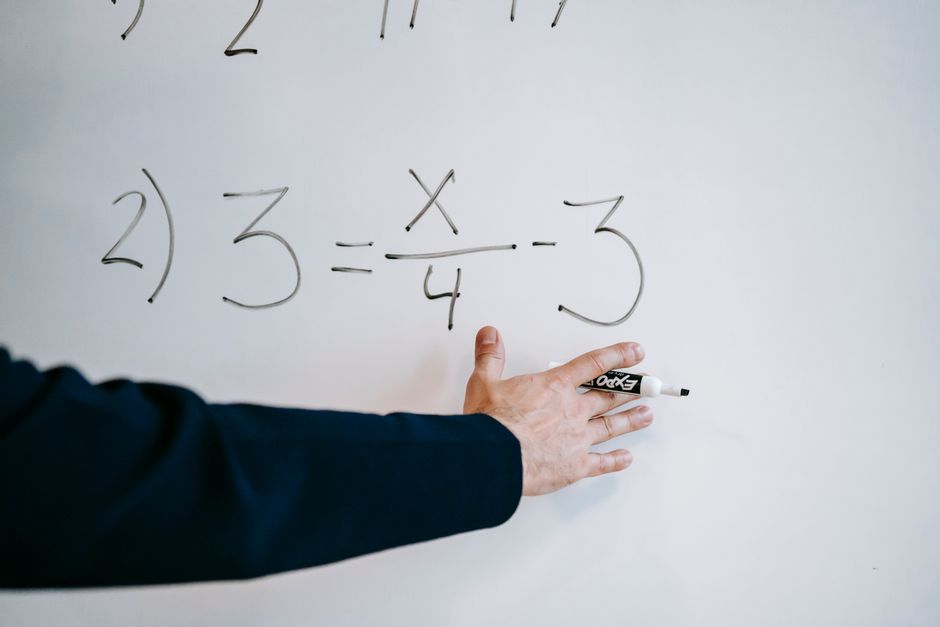
Photo by Vanessa Garcia on Pexels
The denominator defines the "size" of the parts. For example, in $\frac{1}{2}$, the whole is split into 2 parts. In $\frac{1}{4}$, the whole is split into 4 parts. The more parts a whole is split into (larger denominator), the smaller each individual part becomes.
Visualizing Fractions

Photo by Steve A Johnson on Pexels
Imagine a chocolate bar.
* $\frac{1}{3}$ means you have 1 piece out of 3 equal pieces.
* $\frac{2}{3}$ means you have 2 pieces out of 3 equal pieces.
What are Equivalent Fractions?

Photo by Ann H on Pexels
Equivalent fractions are different ways to write the same amount. They look different but represent the exact same portion of a whole. For example, $\frac{1}{2}$ is the same amount as $\frac{2}{4}$ and $\frac{3}{6}$.
Creating Equivalent Fractions

Photo by Ann H on Pexels
The key to equivalent fractions is that you can multiply or divide both the numerator and the denominator by the same non-zero number. This doesn't change the fraction's value, only how it looks. It's like cutting each slice of pizza in half – you have more pieces, but you still have the same total amount of pizza.
graph TD
    Start["Start with a fraction"] --> MultiplyOrDivide["Multiply or Divide Numerator AND Denominator"]
    MultiplyOrDivide --> SameNumber["By the SAME non-zero number"]
    SameNumber --> Result["Result is an equivalent fraction"]
    Result --> Example1["Example: 1/2 --> (1*2)/(2*2) --> 2/4"]
    Result --> Example2["Example: 6/8 --> (6/2)/(8/2) --> 3/4"]
Multiplication Example:
Let's take $\frac{1}{3}$. If you multiply both the numerator and denominator by 2:
$\frac{1 \times 2}{3 \times 2} = \frac{2}{6}$.
So, $\frac{1}{3}$ is equivalent to $\frac{2}{6}$.
Division Example (Simplifying):
Let's take $\frac{4}{8}$. If you divide both the numerator and denominator by 4:
$\frac{4 \div 4}{8 \div 4} = \frac{1}{2}$.
So, $\frac{4}{8}$ is equivalent to $\frac{1}{2}$. This process is called simplifying or reducing a fraction to its lowest terms. You keep dividing until the only common factor between the numerator and denominator is 1.
3. Worked Example
Let's find three equivalent fractions for $\frac{3}{5}$.
-
Multiply by 2:
$\frac{3 \times 2}{5 \times 2} = \frac{6}{10}$ -
Multiply by 3:
$\frac{3 \times 3}{5 \times 3} = \frac{9}{15}$ -
Multiply by 10:
$\frac{3 \times 10}{5 \times 10} = \frac{30}{50}$
So, $\frac{3}{5}$, $\frac{6}{10}$, $\frac{9}{15}$, and $\frac{30}{50}$ all represent the same amount.
4. Key Takeaways
- A fraction shows a part of a whole, with the numerator as the part and the denominator as the whole's total equal pieces.
- The denominator tells you how many equal parts the whole is divided into; a larger denominator means smaller individual parts.
- Equivalent fractions represent the same quantity even though their numerators and denominators are different.
- You create equivalent fractions by multiplying or dividing both the numerator and denominator by the exact same non-zero number.
- Simplifying a fraction means dividing both parts by their greatest common factor until it can't be reduced further.
Common Mistakes to Avoid:
* Changing only one part: Don't multiply/divide just the numerator or just the denominator.
* Using different numbers: Always use the same number for both parts when making equivalent fractions.
* Dividing by zero: You can never have a denominator of zero, and you can't multiply/divide by zero to get an equivalent fraction.
* Ignoring the "equal parts" rule: The denominator always means the whole is split into truly equal segments.
5. Now Try It
Take the fraction $\frac{12}{18}$. Your task is to:
1. Find two different equivalent fractions by multiplying.
2. Simplify the fraction to its lowest terms.
What success looks like: You should have two new fractions that are equivalent to $\frac{12}{18}$ (e.g., $\frac{24}{36}$, $\frac{36}{54}$) and one simplified fraction that cannot be reduced further (e.g., $\frac{2}{3}$).
Frequently asked about Foundational Concepts & Equivalence
Study this next
Get the full Fractions high level curriculum
Clone the complete plan to your dashboard for unlimited AI-generated notes, practice quizzes, and a personalised revision schedule.
Create Free Account