Number Systems and Basic Algebra
From the Math curriculum
Number Systems and Basic Algebra
TL;DR
You'll learn about different types of numbers, how to perform basic math operations, and how to solve simple equations. This is the foundation for almost everything else in math, so understanding it well is super important. We'll cover everything from counting numbers to variables and their manipulation.
1. The Mental Model
Think of numbers as tools: some are for counting whole things, some for parts, and others for more complex ideas like debt or direction. Algebra is like learning to use those tools to solve puzzles where some pieces are unknown.
2. The Core Material
2.1 Number Systems
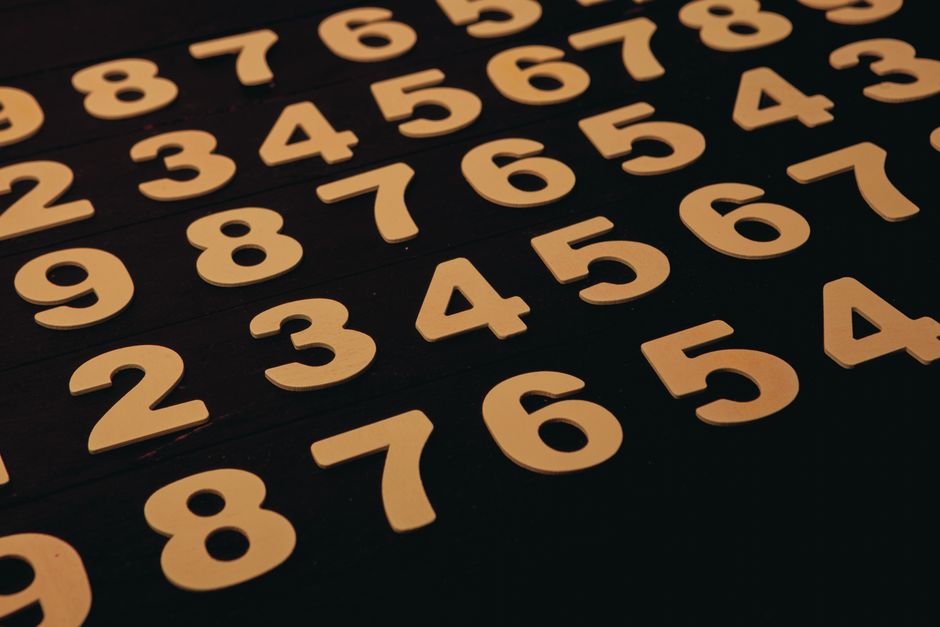
Photo by Roman Friptuleac on Pexels
You're probably used to counting: 1, 2, 3... These are natural numbers (or counting numbers). If you add zero, you get whole numbers (0, 1, 2, 3...).
When you start dealing with things like temperature below zero or owing money, you need integers. These include whole numbers plus their negative counterparts: ..., -3, -2, -1, 0, 1, 2, 3, ...
What about parts of things? That's where rational numbers come in. These are numbers that can be expressed as a fraction a/b, where 'a' and 'b' are integers and 'b' isn't zero. Examples include 1/2, -3/4, 5 (because 5 can be 5/1), and even repeating decimals like 0.333... (which is 1/3).
Some numbers can't be written as simple fractions; these are irrational numbers. Think of pi ($\pi \approx 3.14159...$) or the square root of 2 ($\sqrt{2} \approx 1.414...$). They have infinite non-repeating decimal expansions.
All these numbers together form the set of real numbers. For most basic math, you'll be working with real numbers.
graph TD
    A["Real Numbers"] --> B["Rational Numbers (a/b)"];
    A --> C["Irrational Numbers (e.g., pi, sqrt(2))"];
    B --> D["Integers (...-2, -1, 0, 1, 2...)"];
    D --> E["Whole Numbers (0, 1, 2...)"];
    E --> F["Natural Numbers (1, 2, 3...)"];
2.2 Basic Operations

Photo by https://kaboompics.com/ on Pexels
You know these well:
* Addition (+): Combining quantities. Example: 3 + 5 = 8.
* Subtraction (-): Finding the difference. Example: 8 - 3 = 5.
* Multiplication (* or x): Repeated addition. Example: 3 * 5 = 15 (3 groups of 5).
* Division (/ or ÷): Splitting into equal parts. Example: 15 / 3 = 5. Remember, you can't divide by zero!
2.3 Order of Operations (PEMDAS/BODMAS)

Photo by setengah lima sore on Pexels
This is crucial for getting the right answer when you have multiple operations. It tells you which order to do things in:
1. Parentheses (or Brackets)
2. Exponents (or Orders/Powers)
3. Multiplication and Division (from left to right)
4. Addition and Subtraction (from left to right)
Example: $5 + 2 \times 3 - 1$
1. No Parentheses or Exponents.
2. Multiplication: $2 \times 3 = 6$. So, $5 + 6 - 1$.
3. Addition/Subtraction from left to right: $5 + 6 = 11$. Then $11 - 1 = 10$.
2.4 Introduction to Variables and Expressions
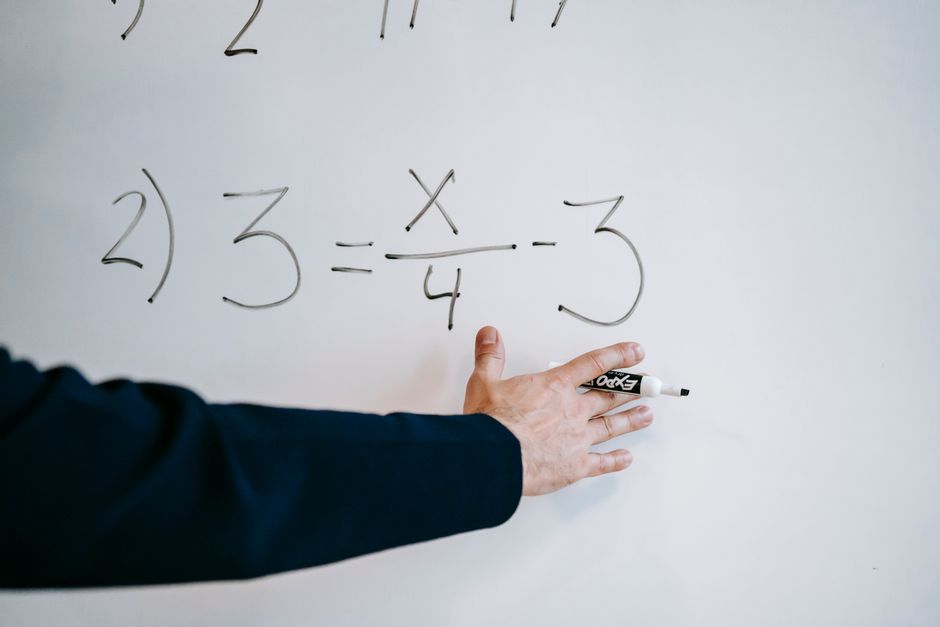
Photo by Vanessa Garcia on Pexels
In algebra, letters (like x, y, a, b) are used as variables to represent unknown numbers.
An expression is a combination of numbers, variables, and operation signs. It doesn't have an equals sign.
Examples: $3x + 5$, $y - 7$, $2ab$.
You can evaluate an expression by substituting numbers for variables.
If $x = 4$, then $3x + 5$ becomes $3(4) + 5 = 12 + 5 = 17$.
2.5 Solving Basic Equations
An equation is a statement that two expressions are equal (it has an equals sign). Your goal is usually to find the value of the variable that makes the equation true.
The key rule: Whatever you do to one side of the equation, you must do to the other side to keep it balanced.
-
Addition/Subtraction:
$x + 5 = 12$
To get x alone, subtract 5 from both sides:
$x + 5 - 5 = 12 - 5$
$x = 7$ -
Multiplication/Division:
$3x = 18$
To get x alone, divide by 3 on both sides:
$3x / 3 = 18 / 3$
$x = 6$ -
Two-Step Equations: Combine the above.
$2x - 4 = 10$- Add 4 to both sides: $2x - 4 + 4 = 10 + 4 \implies 2x = 14$
- Divide by 2 on both sides: $2x / 2 = 14 / 2 \implies x = 7$
3. Worked Example
Let's solve the equation $4(x - 2) + 3x = 20 - x$.
-
Distribute the 4 on the left side:
$4x - 8 + 3x = 20 - x$ -
Combine like terms on the left side ($4x$ and $3x$):
$(4x + 3x) - 8 = 20 - x$
$7x - 8 = 20 - x$ -
Get all variable terms on one side (let's add 'x' to both sides):
$7x - 8 + x = 20 - x + x$
$8x - 8 = 20$ -
Get all constant terms on the other side (add 8 to both sides):
$8x - 8 + 8 = 20 + 8$
$8x = 28$ -
Isolate the variable (divide by 8):
$8x / 8 = 28 / 8$
$x = 28/8$ -
Simplify the fraction:
$x = 7/2$ or $x = 3.5$
4. Key Takeaways
- Numbers come in different types: natural, whole, integers, rational, irrational, and real, each building on the last.
- PEMDAS/BODMAS dictates the correct order for performing operations to ensure you get the right answer every time.
- Variables are placeholders for unknown numbers, and expressions combine numbers and variables without an equals sign.
- Equations state that two expressions are equal; solving them means finding the variable's value.
- To solve an equation, whatever operation you perform on one side, you must perform on the other to maintain balance.
- Always simplify your answers, especially fractions, to their lowest terms.
Common Mistakes to Avoid:
- Dividing by zero: This is undefined; never do it.
- Ignoring order of operations: Always follow PEMDAS/BODMAS to avoid incorrect results.
- Forgetting to do the same thing to both sides of an equation: This unbalances the equation and leads to a wrong answer.
- Sign errors: Be very careful with positive and negative numbers during addition, subtraction, and multiplication/division.
5. Now Try It
Solve the following equation for $y$: $5(y + 3) - 2y = 21$.
What success looks like: You should be able to show each step you take to isolate 'y', combining like terms and applying inverse operations correctly, and arrive at the correct numerical value for 'y'.
Frequently asked about Number Systems and Basic Algebra
More from Math
Get the full Math curriculum
Clone the complete plan to your dashboard for unlimited AI-generated notes, practice quizzes, and a personalised revision schedule.
Create Free Account