Proteins: Structure, Function, and Chemical Testing
From the Biology Lab curriculum
Proteins: Structure, Function, and Chemical Testing
TL;DR
Proteins are essential molecules built from amino acids, and their specific 3D shapes determine their many functions. We'll explore how these structures form and how we can use chemical tests to identify proteins and their components. Understanding protein structure is key to understanding why they do what they do.
1. The Mental Model
Think of proteins like tiny, incredibly specialized molecular machines: their shape dictates their job. If the shape is wrong, the machine doesn't work. These machines are built from smaller Lego-like blocks called amino acids.
2. The Core Material
Proteins are large, complex macromolecules vital for virtually every process in living organisms. They do everything from catalyzing reactions (enzymes) to providing structural support (collagen) to transporting molecules (hemoglobin) and fighting infections (antibodies).
Building Blocks: Amino Acids

Photo by ibrahim hafedh on Pexels
The fundamental units of proteins are amino acids. There are 20 common types of amino acids, each with a central carbon atom (alpha-carbon) bonded to:
1. An amino group (–NH2)
2. A carboxyl group (–COOH)
3. A hydrogen atom (–H)
4. A unique side chain (–R group)
The R-group is what makes each amino acid different, giving it unique chemical properties (e.g., polar, nonpolar, acidic, basic).
Protein Structure: The Four Levels

Photo by Steve A Johnson on Pexels
Proteins achieve their specific 3D shapes through a hierarchy of folding. Each level is crucial:
Primary Structure
This is simply the linear sequence of amino acids linked together by peptide bonds. Imagine a string of beads, where each bead is an amino acid. The order of these amino acids is determined by the genetic code (DNA).
Secondary Structure
Local folding patterns within the polypeptide chain, formed by hydrogen bonds between the amino and carboxyl groups of nearby amino acids. The two most common forms are:
* Alpha-helix (α-helix): A coiled, spring-like structure.
* Beta-pleated sheet (β-sheet): A folded, zig-zagging structure, like pleats in fabric.
Tertiary Structure
The overall 3D shape of a single polypeptide chain, including all its secondary structures and random coils. This level is stabilized by interactions between the R-groups of amino acids, such as:
* Hydrogen bonds
* Ionic bonds
* Hydrophobic interactions (nonpolar R-groups cluster away from water)
* Disulfide bridges (covalent bonds between two cysteine amino acids)
This is the first level where a protein becomes truly functional.
Quaternary Structure
This level exists only for proteins made of more than one polypeptide chain (subunits). It describes how these multiple polypeptide chains assemble and interact to form a functional complex. For example, hemoglobin has four subunits.
graph TD
    A["Amino Acid Sequence (Primary Structure)"] --> B["Local Folding (Secondary Structure)"]
    B --> C["Overall 3D Shape (Tertiary Structure)"]
    C --> D{"Multiple Chains Together (Quaternary Structure)"}
    D --> E["Functional Protein"]

    style A fill:#f9f,stroke:#333,stroke-width:2px
    style B fill:#f9f,stroke:#333,stroke-width:2px
    style C fill:#f9f,stroke:#333,stroke-width:2px
    style D fill:#f9f,stroke:#333,stroke-width:2px
    style E fill:#9cf,stroke:#333,stroke-width:2px
Denaturation
Protein shape is very sensitive to its environment. Denaturation is the process where a protein loses its specific 3D shape (tertiary and secondary structures) due to external stresses like heat, extreme pH, or strong chemicals. When denatured, a protein usually loses its function because its active site or binding region is altered. Think of an egg white cooking – the clear liquid protein turns solid white as it denatures.
Chemical Testing for Proteins
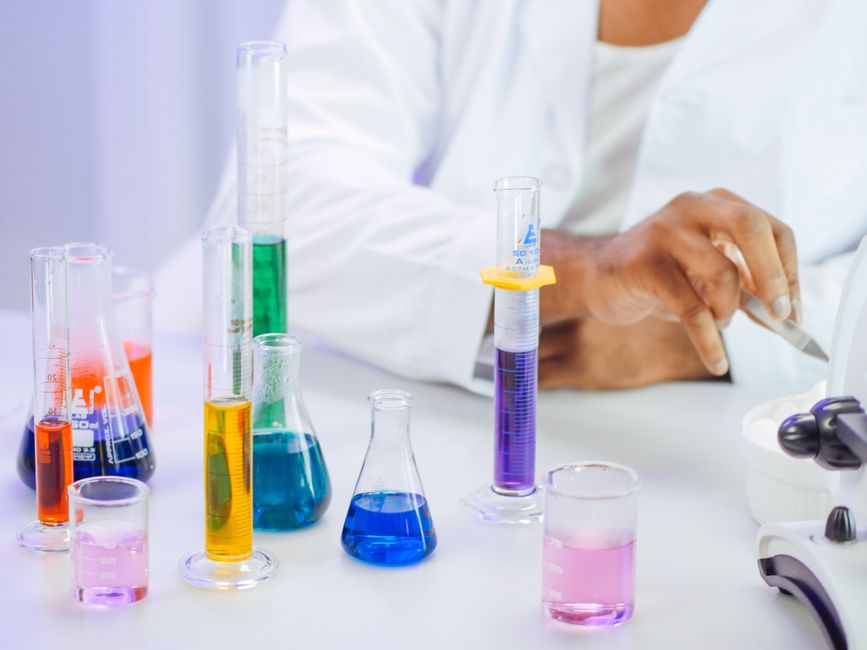
Photo by Kindel Media on Pexels
We can use specific chemical tests to detect the presence of proteins or amino acids:
Biuret Test
- What it detects: The presence of peptide bonds. Since all proteins have peptide bonds, this is a general test for proteins.
- How it works: In an alkaline solution, copper(II) ions (Cu2+) from Biuret reagent react with peptide bonds to form a violet-colored complex.
- Positive result: Color change from blue (reagent color) to violet or pink-purple. The intensity of the color indicates the concentration of protein.
- Negative result: Remains blue.
Ninhydrin Test
- What it detects: The presence of free amino acids (and proteins with free N-terminal amino groups).
- How it works: Ninhydrin reacts with the amino group of free amino acids (and also ammonia and primary amines) to produce a deep blue or purple color. Proline (an amino acid with a secondary amine) gives a yellow color.
- Positive result: Color change to purple-blue (most amino acids) or yellow (proline).
- Negative result: Remains colorless.
3. Worked Example
Let's say you have three unknown solutions (A, B, C) and you want to know which one contains protein. You perform both a Biuret test and a Ninhydrin test on each.
Procedure:
1. Biuret Test:
* Add 1 mL of solution A, B, or C to separate test tubes.
* Add 1 mL of Biuret reagent to each tube.
* Mix gently and observe color change after 5-10 minutes.
2. Ninhydrin Test:
* Add 1 mL of solution A, B, or C to separate test tubes.
* Add 0.5 mL of Ninhydrin reagent to each tube.
* Heat gently in a boiling water bath for 5 minutes.
* Observe color change.
Results:
| Solution | Biuret Test Result | Ninhydrin Test Result | Interpretation |
|---|---|---|---|
| A | Purple | Purple-blue | Contains protein (due to peptide bonds) AND free amino acids. This could be a protein solution that's partially broken down. |
| B | Blue (no change) | Purple-blue | No significant protein (no peptide bonds detected), but contains free amino acids. This might be a solution of individual amino acids. |
| C | Purple | Yellow | Contains protein (peptide bonds). The yellow Ninhydrin result might indicate the presence of Proline, or simply that the protein has an N-terminal Proline. Since it's purple with Biuret, protein is definitely present. |
4. Key Takeaways
- Proteins are crucial macromolecules built from amino acid monomers linked by peptide bonds.
- Protein function is absolutely dependent on its precise 3D structure, which unfolds in four hierarchical levels: primary, secondary, tertiary, and quaternary.
- The primary structure (amino acid sequence) dictates how the protein folds into its higher-order structures.
- Denaturation is the loss of a protein's 3D shape, usually leading to a loss of function, caused by factors like heat or extreme pH.
- The Biuret test detects peptide bonds (general protein presence), turning blue to violet.
- The Ninhydrin test detects free amino acids (or N-terminal amino groups), turning colorless to purple-blue.
Common Mistakes to Avoid:
- Don't confuse the Biuret test (detects peptide bonds) with the Ninhydrin test (detects free amino acids).
- Remember that not all proteins have quaternary structure; only those with multiple polypeptide chains do.
- Assuming a protein is still functional just because it's present; denaturation can make it useless.
- Heating Biuret test samples; this is usually not required and can cause precipitation.
- Misinterpreting the blue color in Biuret as a positive result; blue is the reagent color, you need to see violet.
5. Now Try It
Imagine you've been given an unknown food sample. Your task is to determine if it contains significant amounts of protein or just free amino acids.
What to do: Design an experiment using both the Biuret and Ninhydrin tests. Write down the steps you would take, what reagents you'd use, and what observations you'd look for to draw a conclusion.
What success looks like: You should have a clear, step-by-step procedure for both tests, and for each possible outcome (e.g., Biuret positive/Ninhydrin negative), a clear interpretation of what it means for your unknown food sample.
Frequently asked about Proteins: Structure, Function, and Chemical Testing
More from Biology Lab
Get the full Biology Lab curriculum
Clone the complete plan to your dashboard for unlimited AI-generated notes, practice quizzes, and a personalised revision schedule.
Create Free Account