Exponents and Roots
From the practice curriculum
TL;DR
Exponents tell you how many times to multiply a number by itself, while roots undo that operation, finding the base number. You'll learn how to calculate and simplify expressions involving both, making tough-looking math much easier to handle. Understanding these concepts is fundamental for algebra and many real-world applications.
1. The Mental Model
Think of exponents as shorthand for repeated multiplication. Roots are like asking, "What number, multiplied by itself a certain number of times, gives me this result?" They're inverse operations, balancing each other out.
2. The Core Material
2.1 What are Exponents?

Photo by Ann H on Pexels
An exponent (also called a power or index) tells you how many times to use a number (the base) in multiplication. For example, in $2^3$, 2 is the base and 3 is the exponent. This means $2 \times 2 \times 2 = 8$.
- $x^1 = x$: Any number to the power of 1 is just itself.
- $x^0 = 1$: Any non-zero number to the power of 0 is 1. (e.g., $5^0 = 1$)
- Negative Exponents: $x^{-n} = \frac{1}{x^n}$. A negative exponent means you take the reciprocal. (e.g., $2^{-3} = \frac{1}{2^3} = \frac{1}{8}$)
2.2 Exponent Rules

Photo by Markus Winkler on Pexels
These rules help you simplify expressions with exponents:
graph TD
    A["Exponent Rules: Simplifying Operations"] --> B["Multiplication (Same Base): x^a * x^b = x^(a+b)"]
    A --> C["Division (Same Base): x^a / x^b = x^(a-b)"]
    A --> D["Power of a Power: (x^a)^b = x^(a*b)"]
    A --> E["Power of a Product: (xy)^a = x^a * y^a"]
    A --> F["Power of a Quotient: (x/y)^a = x^a / y^a"]
Example:
- $3^2 \times 3^4 = 3^{(2+4)} = 3^6 = 729$
- $\frac{5^7}{5^3} = 5^{(7-3)} = 5^4 = 625$
- $(2^3)^2 = 2^{(3 \times 2)} = 2^6 = 64$
- $(2x)^3 = 2^3 x^3 = 8x^3$
- $(\frac{a}{b})^2 = \frac{a^2}{b^2}$
2.3 What are Roots?

Photo by Liudmyla Shalimova on Pexels
A root is the inverse operation of an exponent.
- The square root ($\sqrt{x}$) asks, "What number multiplied by itself gives x?" (e.g., $\sqrt{9} = 3$ because $3 \times 3 = 9$).
- The cube root ($\sqrt[3]{x}$) asks, "What number multiplied by itself three times gives x?" (e.g., $\sqrt[3]{8} = 2$ because $2 \times 2 \times 2 = 8$).
- In general, the n-th root ($\sqrt[n]{x}$) asks, "What number multiplied by itself 'n' times gives x?"
2.4 Fractional Exponents
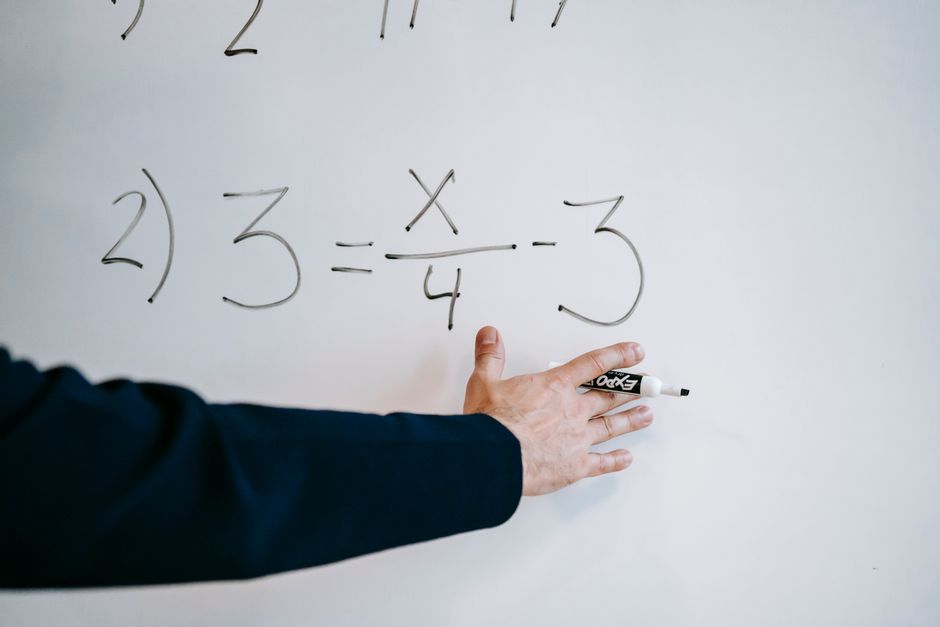
Photo by Vanessa Garcia on Pexels
Fractional exponents connect exponents and roots directly.
- $x^{\frac{1}{n}} = \sqrt[n]{x}$ (e.g., $9^{\frac{1}{2}} = \sqrt{9} = 3$)
- $x^{\frac{m}{n}} = (\sqrt[n]{x})^m = \sqrt[n]{x^m}$ (e.g., $8^{\frac{2}{3}} = (\sqrt[3]{8})^2 = 2^2 = 4$)
This means you can rewrite roots as exponents and apply the exponent rules to them!
3. Worked Example
Let's simplify the expression: $\frac{(2x^3)^2 \cdot \sqrt{x^4}}{x^{-1}}$
- Apply power of a product rule: $(2x^3)^2 = 2^2 \cdot (x^3)^2 = 4x^6$
- Apply power of a power rule: $(x^3)^2 = x^{(3 \times 2)} = x^6$
- Rewrite root as a fractional exponent: $\sqrt{x^4} = x^{\frac{4}{2}} = x^2$
- Rewrite negative exponent: $x^{-1} = \frac{1}{x^1} = \frac{1}{x}$
Now, substitute these back into the expression:
$\frac{4x^6 \cdot x^2}{\frac{1}{x}}$
-
Multiply terms with the same base in the numerator: $x^6 \cdot x^2 = x^{(6+2)} = x^8$
So, the numerator is $4x^8$.
The expression becomes: $\frac{4x^8}{\frac{1}{x}}$ -
Divide by a fraction (multiply by the reciprocal): $\frac{4x^8}{1} \times x = 4x^8 \cdot x^1$
-
Multiply terms with the same base: $4x^{(8+1)} = 4x^9$
The simplified expression is $4x^9$.
4. Key Takeaways
- Exponents are a shortcut for repeated multiplication, and roots are their inverse.
- Any non-zero number to the power of zero is one.
- A negative exponent means you take the reciprocal of the base raised to the positive exponent.
- Fractional exponents represent roots; the denominator is the root, and the numerator is the power.
- All exponent rules (multiplication, division, power of a power) apply to fractional and negative exponents too.
Common Mistakes to Avoid:
- Don't confuse $2^3$ with $2 \times 3$.
- Remember that $(x+y)^n$ is NOT equal to $x^n + y^n$.
- Forgetting that $x^0 = 1$ (for $x \neq 0$).
- Incorrectly handling negative signs with exponents, e.g., $-2^2 = -4$ but $(-2)^2 = 4$.
5. Now Try It
Simplify the following expression as much as you can: $\frac{(3a^2b^{-1})^3 \cdot \sqrt[3]{a^6}}{9a^4b^{-2}}$.
What success looks like: Your final answer should be a single term with $a$ and $b$ raised to positive integer exponents, and a simplified numerical coefficient. You'll apply power rules, fractional exponents, and rules for multiplying and dividing terms with the same base.
Frequently asked about Exponents and Roots
Study this next
Get the full practice curriculum
Clone the complete plan to your dashboard for unlimited AI-generated notes, practice quizzes, and a personalised revision schedule.
Save this course free