Foundational Algebra: Linear Equations
From the practice curriculum
TL;DR
Linear equations are like balanced scales; whatever you do to one side, you must do to the other to keep it equal. Your goal is usually to isolate a variable, typically 'x', to find its unknown value. We use inverse operations to "undo" things and move terms around until the variable is by itself.
1. The Mental Model
Think of an equation as a perfectly balanced seesaw. If you add weight to one side, you must add the exact same weight to the other side to keep it level. Your mission is to get the "mystery box" (the variable) on one side by itself, and the total weight (the number) on the other.
2. The Core Material
Linear equations involve variables (like 'x') raised to the power of 1 (you don't see the '1', it's just 'x'), numbers, and an equals sign. They create a straight line when graphed, hence "linear." The most common form you'll see is ax + b = c, where 'a', 'b', and 'c' are just numbers.
Solving for a Variable
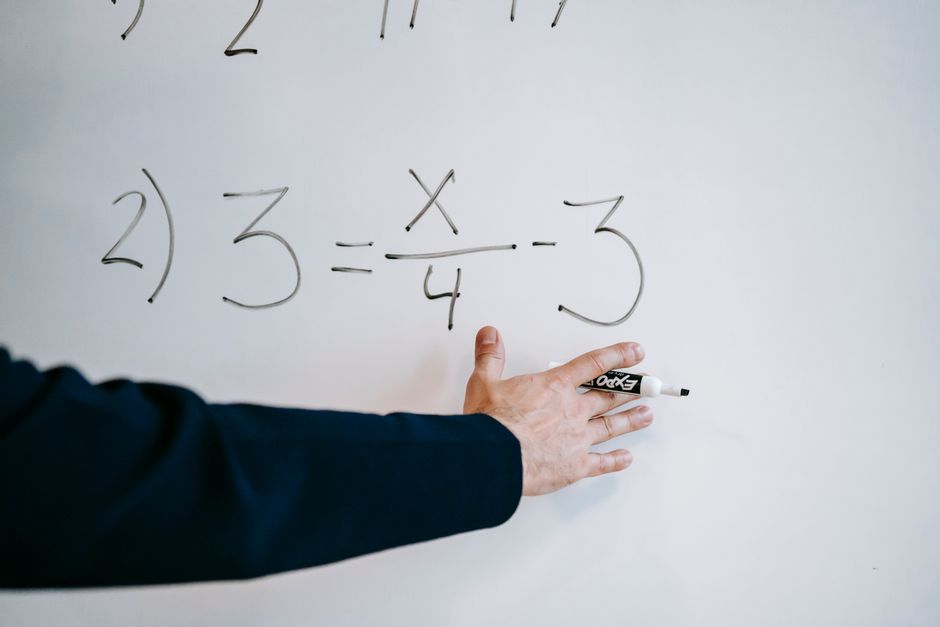
Photo by Vanessa Garcia on Pexels
Your main goal is to get the variable (e.g., x) by itself on one side of the equation. You do this by performing inverse operations.
- Addition and Subtraction are inverse operations: If you have
x + 5, subtract 5 to getx. If you havex - 3, add 3 to getx. - Multiplication and Division are inverse operations: If you have
3x, divide by 3 to getx. If you havex / 4, multiply by 4 to getx.
The Golden Rule: Whatever you do to one side of the equation, you must do the exact same thing to the other side. This keeps the equation balanced.
Let's break down the typical steps:
graph TD
    A["Start: Equation with Variable"] --> B["Simplify Both Sides (Distribute, Combine Like Terms)"]
    B --> C{"Is Variable on Both Sides?"}
    C -- Yes --> D["Move All Variable Terms to One Side"]
    C -- No --> E["Move All Constant Terms to the Other Side"]
    D --> E
    E --> F["Isolate Variable (Divide/Multiply by Coefficient)"]
    F --> G["Check Your Answer (Substitute back into original equation)"]
    G --> H["End: Solution Found"]
Simple Cases

Photo by Katerina Holmes on Pexels
-
x + 7 = 10
To get 'x' alone, you need to "undo" the+ 7. The inverse operation is- 7.
x + 7 - 7 = 10 - 7
x = 3 -
y - 4 = 5
To get 'y' alone, you need to "undo" the- 4. The inverse operation is+ 4.
y - 4 + 4 = 5 + 4
y = 9 -
3z = 12
To get 'z' alone, you need to "undo" the* 3. The inverse operation is/ 3.
3z / 3 = 12 / 3
z = 4 -
w / 2 = 6
To get 'w' alone, you need to "undo" the/ 2. The inverse operation is* 2.
(w / 2) * 2 = 6 * 2
w = 12
Multi-Step Equations

Photo by Monstera Production on Pexels
These combine the simple cases. You generally want to deal with addition/subtraction first, then multiplication/division.
Example: 2x + 5 = 11
- Undo the addition/subtraction: Subtract 5 from both sides.
2x + 5 - 5 = 11 - 5
2x = 6 - Undo the multiplication/division: Divide by 2 on both sides.
2x / 2 = 6 / 2
x = 3
3. Worked Example
Let's solve the equation 5x - 7 = 3x + 9.
-
Move variable terms to one side: I'll choose to move
3xto the left side by subtracting3xfrom both sides.
5x - 7 - 3x = 3x + 9 - 3x
2x - 7 = 9 -
Move constant terms to the other side: Now, I'll move
- 7to the right side by adding7to both sides.
2x - 7 + 7 = 9 + 7
2x = 16 -
Isolate the variable: Divide both sides by
2.
2x / 2 = 16 / 2
x = 8 -
Check your answer (optional but recommended): Substitute
x = 8back into the original equation.
5(8) - 7 = 3(8) + 9
40 - 7 = 24 + 9
33 = 33
Since both sides are equal, our solutionx = 8is correct!
4. Key Takeaways
- Linear equations represent a balanced relationship between numbers and variables.
- The goal is always to isolate the variable, usually 'x'.
- Use inverse operations (addition/subtraction, multiplication/division) to move terms.
- Remember the Golden Rule: whatever you do to one side, you must do to the other.
- Simplify each side by combining like terms before moving terms across the equals sign.
- You can always check your solution by plugging the value back into the original equation.
- Practice is key to becoming fast and accurate.
Common Mistakes to Avoid:
- Forgetting the Golden Rule: Only doing an operation to one side of the equation.
- Sign Errors: Incorrectly adding or subtracting negative numbers, or flipping signs when moving terms.
- Incorrect Order of Operations: Trying to divide before dealing with addition/subtraction on the same side.
- Math Errors: Simple arithmetic mistakes that cascade through the problem.
5. Now Try It
Spend 15 minutes solving the following linear equations. For each, try to check your answer by plugging it back into the original equation.
4x + 10 = 263y - 5 = 7y + 112(z + 3) = 14(Hint: distribute the 2 first)
Success means you've correctly found the value for each variable and confirmed it by checking your work.
Frequently asked about Foundational Algebra: Linear Equations
Study this next
Get the full practice curriculum
Clone the complete plan to your dashboard for unlimited AI-generated notes, practice quizzes, and a personalised revision schedule.
Save this course free