Fonctions Usuelles: Carrée et Inverse
From the https://www.youtube.com/watch?v=BiihO1M8SAY&pp=ygUqZ2VuZXJhbGl0ZSBzdXIgbGVzIGZvbmN0aW9uIDNlbWUgdGVjaG5pcXVl curriculum
TL;DR
You'll learn about two fundamental functions: the squaring function ($x^2$) and the inverse function ($1/x$). Understanding their graphs and properties will help you analyze more complex mathematical expressions. These functions have distinct characteristics like symmetry and how they behave at different input values.
1. The Mental Model
Think of these functions as basic building blocks. The squaring function takes any number and makes it non-negative, curving upwards from zero. The inverse function flips numbers, making small numbers big and big numbers small, with a break at zero.
2. The Core Material
La Fonction Carrée (The Squaring Function)

Photo by DS stories on Pexels
The squaring function is defined as $f(x) = x^2$. This means for any input $x$, the output is that number multiplied by itself.
- Graph: Its graph is a parabola, a U-shaped curve that opens upwards.
- Domain: You can square any real number, so the domain is $\mathbb{R}$ (all real numbers), written as $(-\infty, +\infty)$.
- Range: When you square a number, the result is always greater than or equal to zero. So the range is $[0, +\infty)$.
- Symmetry: The parabola is symmetric with respect to the y-axis. This means $f(-x) = (-x)^2 = x^2 = f(x)$, making it an even function.
- Variations (Monotonicity):
- It's decreasing on $(-\infty, 0]$.
- It's increasing on $[0, +\infty)$.
- It has a minimum value of 0 at $x=0$.
graph TD
    A["Input x"] --> B["Square it (x*x)"]
    B --> C["Result is always >= 0"]
    C --> D{"Is x positive or negative?"}
    D -- "x < 0" --> E["Graph goes down to 0"]
    D -- "x > 0" --> F["Graph goes up from 0"]
    D -- "x = 0" --> G["Minimum value (0)"]
La Fonction Inverse (The Inverse Function)
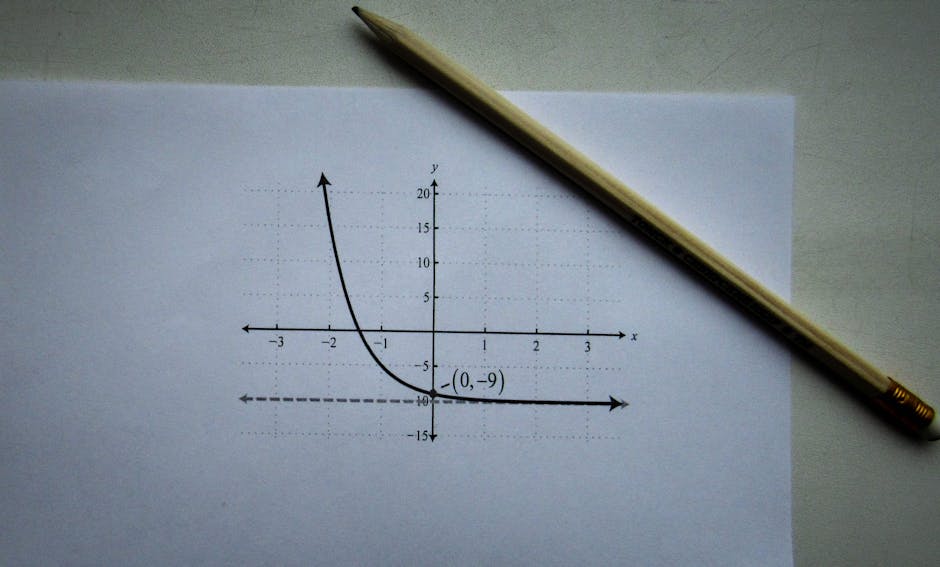
Photo by Sergey Meshkov on Pexels
The inverse function is defined as $f(x) = 1/x$. This function gives the reciprocal of its input.
- Graph: Its graph is a hyperbola, consisting of two separate branches.
- Domain: You can't divide by zero, so $x$ cannot be 0. The domain is $\mathbb{R} \setminus \{0\}$, written as $(-\infty, 0) \cup (0, +\infty)$.
- Range: The output $1/x$ can never be zero. Also, for positive inputs, the output is positive; for negative inputs, the output is negative. The range is $\mathbb{R} \setminus \{0\}$, written as $(-\infty, 0) \cup (0, +\infty)$.
- Symmetry: The hyperbola is symmetric with respect to the origin. This means $f(-x) = 1/(-x) = -1/x = -f(x)$, making it an odd function.
- Variations (Monotonicity):
- It's decreasing on $(-\infty, 0)$.
- It's decreasing on $(0, +\infty)$.
- Notice it decreases on both intervals, but there's a discontinuity at $x=0$.
3. Worked Example
Let's compare $f(x) = x^2$ and $g(x) = 1/x$ for a few specific values.
For $f(x) = x^2$:
* If $x = -2$, $f(-2) = (-2)^2 = 4$.
* If $x = -1$, $f(-1) = (-1)^2 = 1$.
* If $x = 0$, $f(0) = (0)^2 = 0$.
* If $x = 1$, $f(1) = (1)^2 = 1$.
* If $x = 2$, $f(2) = (2)^2 = 4$.
Notice how negative inputs give positive outputs, and it's symmetric around $x=0$.
For $g(x) = 1/x$:
* If $x = -2$, $g(-2) = 1/(-2) = -0.5$.
* If $x = -1$, $g(-1) = 1/(-1) = -1$.
* If $x = -0.5$, $g(-0.5) = 1/(-0.5) = -2$. (Small negative input, large negative output)
* If $x = 0.5$, $g(0.5) = 1/(0.5) = 2$. (Small positive input, large positive output)
* If $x = 1$, $g(1) = 1/(1) = 1$.
* If $x = 2$, $g(2) = 1/(2) = 0.5$. (Large positive input, small positive output)
Notice the behavior approaching zero (outputs get very large positive or very large negative) and the discontinuity at $x=0$.
4. Key Takeaways
- The squaring function $f(x) = x^2$ always yields non-negative results and has a U-shaped graph (parabola).
- The squaring function is an even function, meaning its graph is symmetric about the y-axis.
- The inverse function $f(x) = 1/x$ cannot accept $x=0$ as an input, creating a discontinuity in its graph.
- The inverse function's graph has two distinct branches and is symmetric about the origin, making it an odd function.
- $x^2$ decreases then increases, with a minimum at $x=0$; $1/x$ decreases on both sides of $x=0$.
- For $x^2$, large inputs give large outputs; for $1/x$, large inputs give outputs close to zero.
- For $x^2$, inputs close to zero give outputs close to zero; for $1/x$, inputs close to zero give very large (positive or negative) outputs.
Common Mistakes to Avoid:
- Don't assume $1/x$ is defined at $x=0$; it's undefined there.
- Don't confuse the symmetry of $x^2$ (y-axis) with $1/x$ (origin).
- Don't think $1/x$ is increasing just because it goes from a large negative to a large positive value across the discontinuity. It's decreasing on both intervals.
- For $x^2$, remember that negative numbers squared become positive.
5. Now Try It
Sketch the graphs of $y = x^2$ and $y = 1/x$ on the same coordinate plane without looking at notes or online examples. Pay close attention to their shapes, intercepts (if any), and how they behave as $x$ gets very large positive or very large negative, and especially around $x=0$. Then, check your sketches against common representations of these graphs. Your success will be seeing that your sketches accurately reflect the key features like symmetry, domain, and range.
Frequently asked about Fonctions Usuelles: Carrée et Inverse
Study this next
Get the full https://www.youtube.com/watch?v=BiihO1M8SAY&pp=ygUqZ2VuZXJhbGl0ZSBzdXIgbGVzIGZvbmN0aW9uIDNlbWUgdGVjaG5pcXVl curriculum
Clone the complete plan to your dashboard for unlimited AI-generated notes, practice quizzes, and a personalised revision schedule.
Save this course free