Fonctions de Référence : Linéaires et Affines
From the https://www.youtube.com/watch?v=BiihO1M8SAY&pp=ygUqZ2VuZXJhbGl0ZSBzdXIgbGVzIGZvbmN0aW9uIDNlbWUgdGVjaG5pcXVl curriculum
TL;DR
You'll learn about two fundamental types of functions: linear and affine functions. Linear functions pass through the origin and have a constant slope, while affine functions are a more general form that can intersect the y-axis at any point. Understanding these functions helps you model relationships where one quantity changes proportionally or consistently with another.
1. The Mental Model
Imagine a straight line on a graph. If that line always goes through the point (0,0), that's a linear function. If it's a straight line but can start anywhere on the vertical axis, that's an affine function.
2. The Core Material
In math, functions describe how one quantity changes in relation to another. For example, how much you earn ($y$) might depend on how many hours you work ($x$). Linear and affine functions are the simplest, yet most powerful, ways to describe these relationships when they form a straight line.
What's a Function?

Photo by Efrem Efre on Pexels
A function takes an input, processes it, and gives you a single output. We often write this as $f(x) = \text{something}$, where $x$ is your input and $f(x)$ is your output.
Affine Functions: The General Case

Photo by Rashed Paykary on Pexels
An affine function is described by the equation $f(x) = ax + b$.
- $x$ is your input (often on the horizontal axis).
- $f(x)$ or $y$ is your output (often on the vertical axis).
- $a$ is the slope (or coefficient directeur). It tells you how steep the line is. If $a$ is positive, the line goes up as $x$ increases; if $a$ is negative, it goes down.
- $b$ is the y-intercept (or ordonnée à l'origine). This is the value of $f(x)$ when $x=0$. It's where the line crosses the vertical axis.
Here's how these parts fit together:
graph TD
    InputX["Input (x)"] --> MultiplyA["Multiply by 'a' (slope)"]
    MultiplyA --> AddB["Add 'b' (y-intercept)"]
    AddB --> OutputFX["Output (f(x) or y)"]
Linear Functions: A Special Type of Affine Function

Photo by Hert Niks on Pexels
A linear function is a specific type of affine function where $b=0$. So, its equation is $f(x) = ax$.
- It still has a slope $a$.
- Because $b=0$, the line always passes through the origin (0,0).
Think of it like this: if you work 0 hours, you earn 0 dollars. There's no starting pay or fixed fee.
Graphing These Functions
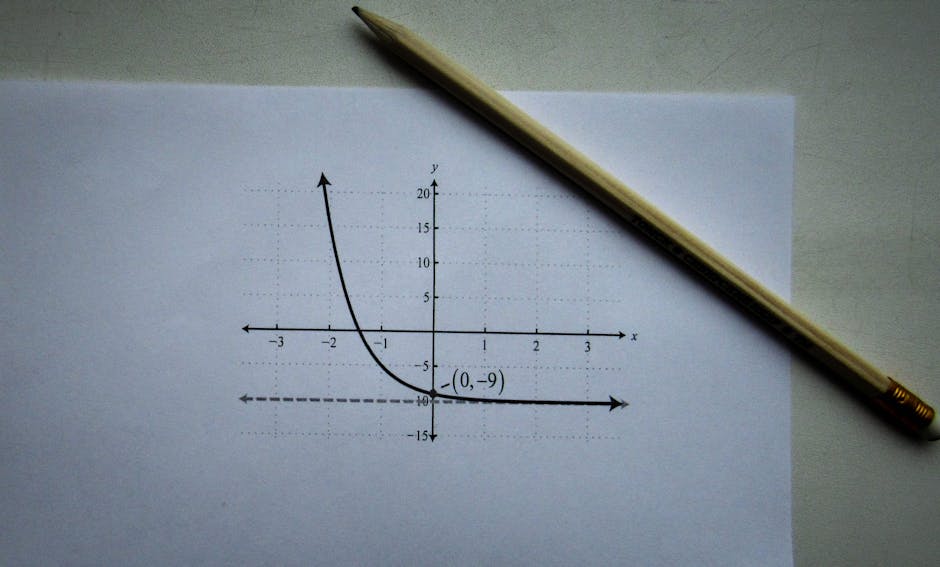
Photo by Sergey Meshkov on Pexels
To graph an affine or linear function, you only need two points:
1. For an affine function ($f(x) = ax + b$):
* One easy point is the y-intercept: $(0, b)$.
* Pick another value for $x$ (e.g., $x=1$), calculate $f(1) = a(1) + b$, and you have your second point $(1, a+b)$.
2. For a linear function ($f(x) = ax$):
* One point is always the origin: $(0,0)$.
* Pick another value for $x$ (e.g., $x=1$), calculate $f(1) = a(1)$, and you have your second point $(1, a)$.
How to Determine the Equation
From two points:
If you're given two points $(x_1, y_1)$ and $(x_2, y_2)$ that an affine (or linear) function passes through:
1. Calculate the slope $a$: $a = \frac{y_2 - y_1}{x_2 - x_1}$.
2. Calculate the y-intercept $b$: Use one of the points (e.g., $x_1, y_1$) and the calculated $a$ in the equation $y_1 = ax_1 + b$. Then solve for $b$: $b = y_1 - ax_1$.
From a graph:
- Find $b$: Look for where the line crosses the y-axis. That's your $b$.
- Find $a$: Pick two easy-to-read points on the line. Count "rise over run" – how many units the line goes up or down (rise) for every unit it goes right (run). If it goes down, the rise is negative.
3. Worked Example
Let's find the equation of the affine function that passes through the points $(1, 5)$ and $(3, 11)$.
-
Calculate the slope $a$:
$a = \frac{y_2 - y_1}{x_2 - x_1} = \frac{11 - 5}{3 - 1} = \frac{6}{2} = 3$. -
Calculate the y-intercept $b$:
Use one of the points, say $(1, 5)$, and the slope $a=3$ in the equation $y = ax + b$.
$5 = 3(1) + b$
$5 = 3 + b$
$b = 5 - 3 = 2$.
So, the equation of the affine function is $f(x) = 3x + 2$.
Let's check with the other point $(3, 11)$:
$f(3) = 3(3) + 2 = 9 + 2 = 11$. It works!
4. Key Takeaways
- An affine function is a straight line represented by $f(x) = ax + b$.
- A linear function is a special affine function where $b=0$, so it's $f(x) = ax$.
- The 'a' value is the slope, indicating the steepness and direction of the line.
- The 'b' value is the y-intercept, where the line crosses the y-axis.
- All linear functions pass through the origin $(0,0)$.
- You only need two points to define and graph a unique linear or affine function.
Common Mistakes to Avoid
- Confusing linear with affine: remember, linear is always through the origin, affine can be anywhere.
- Incorrectly calculating the slope: ensure you subtract $y$ values in the same order as $x$ values ($y_2 - y_1$ over $x_2 - x_1$, not $y_2 - y_1$ over $x_1 - x_2$).
- Forgetting the negative sign for a downward-sloping line when calculating 'a'.
- Assuming $b$ is always zero; only linear functions have $b=0$.
5. Now Try It
Find the equation of the affine function that passes through the points $(-2, 7)$ and $(4, -5)$. Then, state whether this function is also a linear function and why. Sketch a quick graph based on the two points and your y-intercept to check your answer.
Frequently asked about Fonctions de Référence : Linéaires et Affines
Study this next
Get the full https://www.youtube.com/watch?v=BiihO1M8SAY&pp=ygUqZ2VuZXJhbGl0ZSBzdXIgbGVzIGZvbmN0aW9uIDNlbWUgdGVjaG5pcXVl curriculum
Clone the complete plan to your dashboard for unlimited AI-generated notes, practice quizzes, and a personalised revision schedule.
Save this course free