Solving Linear Inequalities in One Variable
From the Solving equations and inequalities Algebra 1 curriculum
TL;DR
Solving linear inequalities is a lot like solving linear equations, but with one key difference: when you multiply or divide by a negative number, you flip the inequality sign. Your goal is still to isolate the variable, and the solution will be a range of values, not just a single number. You can represent these solutions on a number line.
1. The Mental Model
Think of an inequality as a balanced scale, but one side might be heavier than the other. Whatever you do to one side, you must do to the other to keep the "balance" (or imbalance) true. The special rule for negatives is like flipping the scale over; what was heavier is now lighter.
2. The Core Material
When you're solving a linear inequality, you're looking for all the values of the variable that make the statement true. It's very similar to solving equations, with just one crucial rule to remember.
2.1 Basic Operations

Photo by https://kaboompics.com/ on Pexels
You can add or subtract the same number from both sides of an inequality, and the inequality sign stays the same.
- If $x - 3 < 5$, then $x - 3 + 3 < 5 + 3$, which means $x < 8$.
- If $y + 7 \ge 10$, then $y + 7 - 7 \ge 10 - 7$, which means $y \ge 3$.
You can multiply or divide both sides by the same positive number, and the inequality sign stays the same.
- If $2x \le 10$, then $\frac{2x}{2} \le \frac{10}{2}$, which means $x \le 5$.
- If $\frac{x}{4} > 2$, then $\frac{x}{4} \times 4 > 2 \times 4$, which means $x > 8$.
2.2 The Flipped Sign Rule

Photo by DS stories on Pexels
This is the most important rule: When you multiply or divide both sides of an inequality by a negative number, you must reverse the direction of the inequality sign.
-
If $-3x < 12$, and you divide by $-3$:
$\frac{-3x}{-3} > \frac{12}{-3}$ (notice the sign flipped!)
$x > -4$ -
If $-\frac{x}{5} \ge 2$, and you multiply by $-5$:
$-\frac{x}{5} \times (-5) \le 2 \times (-5)$ (notice the sign flipped!)
$x \le -10$
2.3 Solving Multi-Step Inequalities

Photo by Wolfgang Weiser on Pexels
Just like equations, you'll often need to combine steps. The general strategy is:
1. Simplify both sides of the inequality (distribute, combine like terms).
2. Move all terms with the variable to one side and constant terms to the other.
3. Isolate the variable using multiplication or division, remembering to flip the sign if you use a negative number.
graph TD
    A["Start: Inequality like 3x - 5 < 10"] --> B{"Any parentheses or like terms?"}
    B -- Yes --> C["Simplify: Distribute, combine like terms"]
    B -- No --> D["Move variable terms to one side, constants to other"]
    C --> D
    D --> E{"Isolate variable: Multiply or divide"}
    E --> F{"Multiply/Divide by negative number?"}
    F -- Yes --> G["Flip inequality sign"]
    F -- No --> H["Keep inequality sign"]
    G --> I["Solution: x < 5 or x >= -2 etc."]
    H --> I
    I --> J["End: Solution set"]
2.4 Graphing Solutions on a Number Line
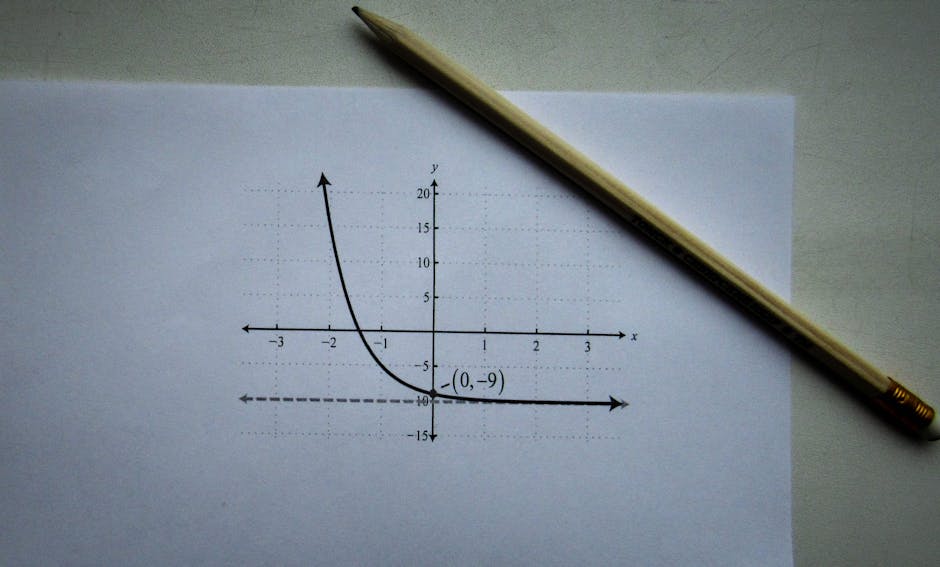
Photo by Sergey Meshkov on Pexels
The solution to an inequality is a range of numbers. We can visualize this on a number line:
- Open Circle ( o ): Used for $<$ or $>$ (the number itself is not included in the solution).
- Closed Circle ( ● ): Used for $\le$ or $\ge$ (the number itself is included in the solution).
- Arrow: Points in the direction of the numbers that satisfy the inequality.
For example:
* $x < 3$: Open circle at 3, arrow pointing left.
* $x \ge -1$: Closed circle at -1, arrow pointing right.
3. Worked Example
Let's solve the inequality $4 - 2(x + 1) \le 10$ and graph its solution.
-
Distribute: First, distribute the $-2$ into the parentheses.
$4 - 2x - 2 \le 10$ -
Combine like terms: Combine the constant terms on the left side ($4 - 2$).
$2 - 2x \le 10$ -
Move constants: Subtract 2 from both sides to get the variable term alone.
$2 - 2x - 2 \le 10 - 2$
$-2x \le 8$ -
Isolate variable: Divide both sides by $-2$. Remember to flip the inequality sign because we're dividing by a negative number.
$\frac{-2x}{-2} \ge \frac{8}{-2}$
$x \ge -4$
So, the solution is $x \ge -4$.
To graph this:
* Place a closed circle at $-4$ (because it's $\ge$, meaning $-4$ is included).
* Draw an arrow pointing to the right from $-4$, indicating all numbers greater than or equal to $-4$.
4. Key Takeaways
- Solving inequalities generally follows the same steps as solving equations.
- The crucial difference is flipping the inequality sign when multiplying or dividing by a negative number.
- Always simplify each side of the inequality before moving terms around.
- Solutions to inequalities are ranges of numbers, not single values.
- Use open circles for $<$ or $>$ and closed circles for $\le$ or $\ge$ when graphing on a number line.
- An inequality like $x < 5$ means all numbers less than 5, not including 5.
- An inequality like $x \ge -2$ means all numbers greater than or equal to -2, including -2.
Common Mistakes to Avoid:
* Forgetting to flip the inequality sign when multiplying or dividing by a negative number. This is the biggest one!
* Mixing up open and closed circles when graphing.
* Not distributing correctly when parentheses are involved.
* Making arithmetic errors, especially with negative numbers.
5. Now Try It
Solve the inequality $7 - 3(2x - 5) > 40$. Once you have your solution, draw a number line and graph the solution.
Success looks like:
* You've correctly distributed the $-3$.
* You've combined like terms.
* You've moved terms to isolate $x$.
* You've remembered to flip the inequality sign if you multiplied or divided by a negative.
* Your final graph has the correct type of circle (open or closed) and the arrow pointing in the correct direction.
Frequently asked about Solving Linear Inequalities in One Variable
Study this next
Get the full Solving equations and inequalities Algebra 1 curriculum
Clone the complete plan to your dashboard for unlimited AI-generated notes, practice quizzes, and a personalised revision schedule.
Save this course free