A-Level Mathematics: Pure — Algebra, Functions, Coordinate Geometry, Sequences
From the A-Level Prep curriculum
A-Level Pure Maths Fundamentals
TL;DR
This note covers essential A-Level Pure Maths topics: algebra for manipulating expressions, functions for defining relationships, coordinate geometry for visualising these relationships, and sequences for understanding patterns. You'll learn the core skills needed to tackle more complex problems in these areas.
1. The Mental Model
Think of these topics as your foundational toolkit. Algebra helps you simplify and solve, functions describe how things change, coordinate geometry lets you draw and see those changes, and sequences help you predict patterns. Mastering these interconnected ideas builds a strong base for all of A-Level Maths.
2. The Core Material
Algebra: Simplifying and Solving

Photo by https://kaboompics.com/ on Pexels
Algebra is all about manipulating mathematical expressions and equations. You'll need to be super comfortable with:
- Expanding brackets: Multiplying terms to remove brackets, e.g., $ (x+2)(x-3) = x^2 - 3x + 2x - 6 = x^2 - x - 6 $.
- Factorising: The reverse of expanding – putting expressions back into brackets. This includes common factors, difference of two squares ($a^2 - b^2 = (a-b)(a+b)$), and quadratic factorisation ($x^2 + bx + c = (x+p)(x+q)$ where $p+q=b$ and $pq=c$).
- Solving equations: Finding the value(s) of the unknown variable(s). This covers linear, quadratic (by factorising, completing the square, or formula), and simultaneous equations.
- Indices and Surds: Rules for powers (e.g., $x^a \times x^b = x^{a+b}$, $x^0 = 1$, $x^{-n} = \frac{1}{x^n}$) and simplifying square roots (e.g., $\sqrt{12} = \sqrt{4 \times 3} = 2\sqrt{3}$). Rationalising denominators means removing surds from the bottom of a fraction.
Functions: Input, Process, Output

Photo by Alexey Demidov on Pexels
A function, $f(x)$, describes a unique output for every input.
graph TD
    A["Input (x)"] --> B{"Function (f)"};
    B --> C["Output (f(x))"];
- Notation: $f(x) = 2x+1$ means 'the function $f$ takes $x$ and gives $2x+1$'. If you see $f(3)$, you substitute $x=3$ into the function.
- Domain & Range: The domain is the set of all possible input values ($x$). The range is the set of all possible output values ($f(x)$ or $y$).
- Composite Functions: When one function's output becomes another's input, e.g., $fg(x) = f(g(x))$. You calculate $g(x)$ first, then substitute that result into $f(x)$.
- Inverse Functions: If $f(x)$ maps $A$ to $B$, its inverse $f^{-1}(x)$ maps $B$ back to $A$. To find $f^{-1}(x)$, swap $x$ and $y$ (where $y=f(x)$) and rearrange to make $y$ the subject again.
Coordinate Geometry: Points, Lines, and Curves
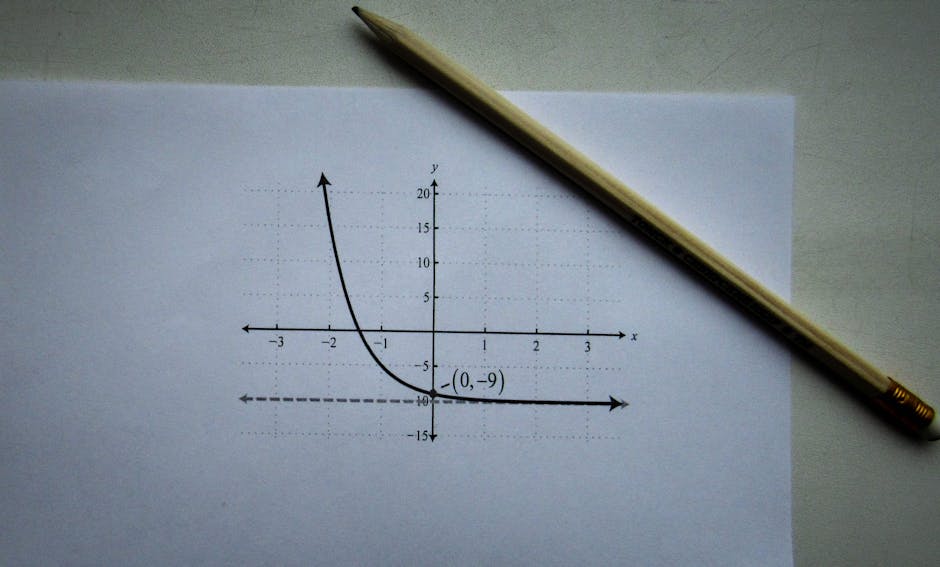
Photo by Sergey Meshkov on Pexels
This is about connecting algebra to graphs. You'll use:
- Distance between two points: $\sqrt{(x_2-x_1)^2 + (y_2-y_1)^2}$.
- Midpoint of a line segment: $(\frac{x_1+x_2}{2}, \frac{y_1+y_2}{2})$.
- Gradient of a straight line: $m = \frac{y_2-y_1}{x_2-x_1}$.
- Equation of a straight line: $y - y_1 = m(x - x_1)$ or $y = mx + c$.
- Parallel lines: Have the same gradient ($m_1 = m_2$).
- Perpendicular lines: Their gradients multiply to -1 ($m_1 m_2 = -1$).
- Circles: The general equation is $(x-a)^2 + (y-b)^2 = r^2$, where $(a,b)$ is the centre and $r$ is the radius. You'll need to complete the square to find the centre and radius from an expanded equation.
Sequences and Series: Patterns and Sums

Photo by Atlantic Ambience on Pexels
A sequence is an ordered list of numbers. A series is the sum of the terms in a sequence.
- Arithmetic Sequences: Each term is found by adding a constant "common difference" ($d$) to the previous term. The $n$-th term is $a_n = a + (n-1)d$, where $a$ is the first term.
- Geometric Sequences: Each term is found by multiplying by a constant "common ratio" ($r$) to the previous term. The $n$-th term is $a_n = ar^{n-1}$.
- Sum of an Arithmetic Series: $S_n = \frac{n}{2}(2a + (n-1)d)$ or $S_n = \frac{n}{2}(a + l)$, where $l$ is the last term.
- Sum of a Geometric Series: $S_n = \frac{a(1-r^n)}{1-r}$ for $r
eq 1$. - Sum to Infinity of a Geometric Series: $S_\infty = \frac{a}{1-r}$ when $|r| < 1$. If $|r| \ge 1$, the sum doesn't converge.
3. Worked Example
Let's find the centre and radius of the circle given by the equation $x^2 + y^2 - 6x + 4y - 3 = 0$.
-
Group $x$ terms and $y$ terms:
$(x^2 - 6x) + (y^2 + 4y) - 3 = 0$ -
Complete the square for $x$ terms: Take half of the coefficient of $x$ (which is $-6/2 = -3$) and square it ($(-3)^2 = 9$). Add and subtract this inside the bracket:
$(x^2 - 6x + 9 - 9) + (y^2 + 4y) - 3 = 0$
$( (x-3)^2 - 9 ) + (y^2 + 4y) - 3 = 0$ -
Complete the square for $y$ terms: Take half of the coefficient of $y$ (which is $4/2 = 2$) and square it ($2^2 = 4$). Add and subtract this inside the bracket:
$(x-3)^2 - 9 + (y^2 + 4y + 4 - 4) - 3 = 0$
$(x-3)^2 - 9 + ( (y+2)^2 - 4 ) - 3 = 0$ -
Rearrange into the standard circle equation form $(x-a)^2 + (y-b)^2 = r^2$:
$(x-3)^2 + (y+2)^2 - 9 - 4 - 3 = 0$
$(x-3)^2 + (y+2)^2 - 16 = 0$
$(x-3)^2 + (y+2)^2 = 16$ -
Identify the centre and radius:
Comparing to $(x-a)^2 + (y-b)^2 = r^2$:
The centre $(a,b)$ is $(3, -2)$.
The radius squared $r^2$ is $16$, so the radius $r = \sqrt{16} = 4$.
4. Key Takeaways
- Always simplify algebraic expressions before attempting to solve or substitute values.
- Understand the relationship between a function's domain (inputs) and range (outputs).
- Remember that perpendicular lines have gradients that multiply to -1.
- For circles, completing the square is crucial for finding the centre and radius.
- Distinguish carefully between sequences (lists) and series (sums of lists).
Common Mistakes to Avoid:
- Forgetting to change signs when moving terms across the equals sign in algebra.
- Incorrectly applying indices rules, especially with negative or fractional powers.
- Mixing up arithmetic and geometric sequence/series formulas.
- Assuming an inverse function always exists (it only does if the original function is one-to-one).
5. Now Try It
Consider the function $f(x) = \frac{2x+1}{x-3}$ for $x
eq 3$.
1. Find $f(5)$.
2. Find the inverse function, $f^{-1}(x)$.
3. State the domain and range of $f(x)$.
4. State the domain and range of $f^{-1}(x)$.
What success looks like: You'll correctly substitute $x=5$ into $f(x)$, successfully rearrange $y = \frac{2x+1}{x-3}$ to make $x$ the subject, and accurately identify the values $x$ cannot be (for the domain) and the values $f(x)$ cannot be (for the range), understanding how these relate to the inverse function.
Frequently asked about A-Level Mathematics: Pure — Algebra, Functions, Coordinate Geometry, Sequences
Study this next
Get the full A-Level Prep curriculum
Clone the complete plan to your dashboard for unlimited AI-generated notes, practice quizzes, and a personalised revision schedule.
Create Free Account