Foundational Algebra & Equations
From the I have a math test on Wednesday. I used to know how to do it but I completely forgot. i feel so stupid. curriculum
Foundational Algebra & Equations
TL;DR
You're not stupid, you just need a quick refresh on the basics of algebra to solve for unknowns. We'll focus on balancing equations to isolate the variable you want to find. Practice is key, and you'll get it back in no time.
1. The Mental Model
Think of an equation like a balanced seesaw. Whatever you do to one side, you must do to the other side to keep it perfectly balanced. Your goal is to get the "thing you don't know" (the variable) all by itself on one side of that seesaw.
2. The Core Material
Algebra is all about figuring out unknown values. We use letters, usually x, y, or z, to represent these unknowns. The main idea is to manipulate equations so you can isolate that unknown variable.
What's an Equation?
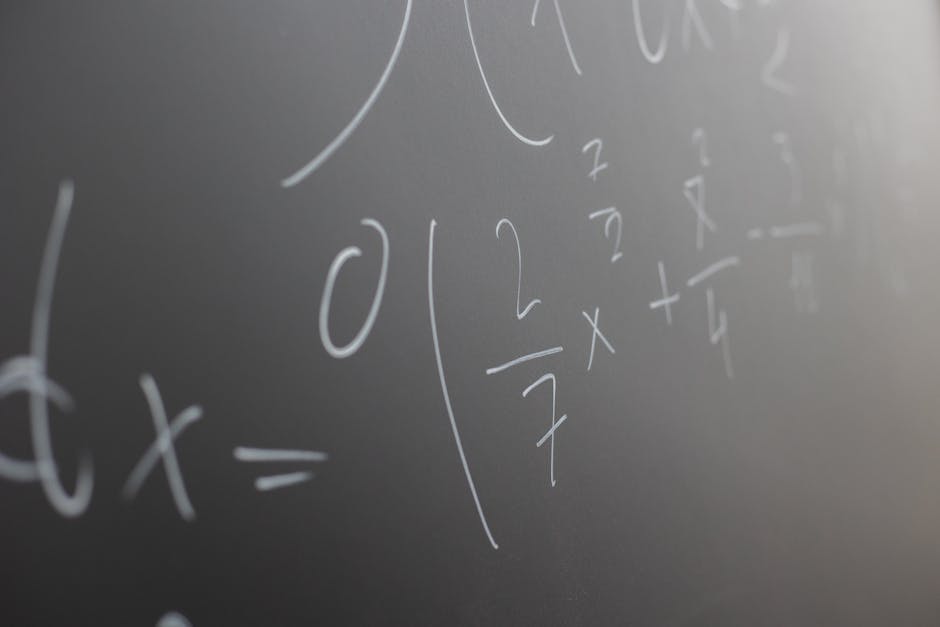
Photo by Monstera Production on Pexels
An equation is a statement that two mathematical expressions are equal. It always has an "equals" sign (=). For example, 2 + 3 = 5 is an equation. So is x + 3 = 5.
Basic Operations: The Inverse

Photo by https://kaboompics.com/ on Pexels
To get a variable alone, you need to "undo" whatever's being done to it. This means using the opposite (inverse) operation:
- Addition is undone by subtraction.
- Subtraction is undone by addition.
- Multiplication is undone by division.
- Division is undone by multiplication.
Solving One-Step Equations

Photo by Vanessa Garcia on Pexels
This is where you just need one inverse operation.
Example: x + 7 = 10
Here, 7 is added to x. To get x alone, you subtract 7 from both sides:
x + 7 - 7 = 10 - 7
x = 3
Example: y - 5 = 8
Here, 5 is subtracted from y. To get y alone, you add 5 to both sides:
y - 5 + 5 = 8 + 5
y = 13
Example: 3z = 12 (This means 3 multiplied by z)
Here, 3 is multiplied by z. To get z alone, you divide both sides by 3:
3z / 3 = 12 / 3
z = 4
Example: p / 4 = 5 (This means p divided by 4)
Here, p is divided by 4. To get p alone, you multiply both sides by 4:
(p / 4) * 4 = 5 * 4
p = 20
Solving Two-Step Equations
Photo by Vanessa Garcia on Pexels
Often, you'll need to do two operations to get the variable by itself. The general rule is to undo addition/subtraction first, then undo multiplication/division.
Example: 2x + 3 = 11
1. Undo the addition: Subtract 3 from both sides.
2x + 3 - 3 = 11 - 3
2x = 8
2. Undo the multiplication: Divide both sides by 2.
2x / 2 = 8 / 2
x = 4
This process follows a clear order to isolate the variable:
graph TD
    A["Equation with variable (e.g., 2x + 3 = 11)"] --> B{"Is there addition or subtraction with the variable?"}
    B -- Yes --> C["Undo addition/subtraction (e.g., subtract 3) on BOTH sides"]
    B -- No --> D
    C --> D{"Is there multiplication or division with the variable?"}
    D -- Yes --> E["Undo multiplication/division (e.g., divide by 2) on BOTH sides"]
    D -- No --> F["Variable is isolated! (e.g., x = 4)"]
    E --> F
Variables on Both Sides
Sometimes the unknown variable appears on both sides of the equation. Your first step should be to gather all the variable terms on one side and all the constant numbers on the other.
Example: 5x - 2 = 2x + 10
1. Get x terms together: Subtract 2x from both sides.
5x - 2 - 2x = 2x + 10 - 2x
3x - 2 = 10
2. Get constant terms together: Add 2 to both sides.
3x - 2 + 2 = 10 + 2
3x = 12
3. Isolate x: Divide both sides by 3.
3x / 3 = 12 / 3
x = 4
3. Worked Example
Let's solve the equation: 4m + 7 = 19 - 2m
-
Goal: Get all
mterms on one side and all regular numbers on the other. Let's aim formon the left.- To move
-2mfrom the right to the left, we do the inverse: add2mto both sides.
4m + 7 + 2m = 19 - 2m + 2m
6m + 7 = 19
- To move
-
Next Goal: Get the constant
7off the left side.- To move
+7from the left to the right, we do the inverse: subtract7from both sides.
6m + 7 - 7 = 19 - 7
6m = 12
- To move
-
Final Goal: Isolate
m.6mmeans6multiplied bym. To undo this, we divide both sides by6.
6m / 6 = 12 / 6
m = 2
Check your answer: Plug m = 2 back into the original equation:
4(2) + 7 = 19 - 2(2)
8 + 7 = 19 - 4
15 = 15
It works!
4. Key Takeaways
- An equation is like a balanced seesaw; keep it balanced by doing the same thing to both sides.
- To isolate a variable, use inverse operations (addition/subtraction, multiplication/division).
- When solving multi-step equations, generally undo addition/subtraction before multiplication/division.
- If variables are on both sides, move all variable terms to one side and all constant terms to the other first.
- Always check your answer by plugging it back into the original equation.
- Don't be afraid to write out every step; it helps prevent mistakes.
Common Mistakes to Avoid
- Forgetting to do the operation to both sides of the equation.
- Incorrectly applying inverse operations (e.g., dividing instead of subtracting).
- Making sign errors when moving terms (e.g.,
-2xbecomes-2xon the other side instead of+2x). - Not simplifying expressions on each side before attempting to isolate the variable.
5. Now Try It
Spend 15 minutes solving the following equations. For each, show your steps clearly and check your answer by plugging it back into the original equation.
x - 12 = 305y = 453z + 8 = 237p - 5 = 2p + 15
Success looks like getting the correct numerical answer for x, y, z, and p and having your check work for all four problems.
Frequently asked about Foundational Algebra & Equations
Get the full I have a math test on Wednesday. I used to know how to do it but I completely forgot. i feel so stupid. curriculum
Clone the complete plan to your dashboard for unlimited AI-generated notes, practice quizzes, and a personalised revision schedule.
Create Free Account