Applications of Integration: Volumes of Revolution
From the calculus 2 curriculum
Volumes of Revolution
TL;DR
You'll learn how to find the volume of a 3D shape created by spinning a 2D area around an axis. We'll use either the disk/washer method or the cylindrical shell method, depending on the situation. This technique extends your understanding of integration from areas to 3D volumes.
1. The Mental Model
Imagine you have a flat piece of paper cut into a specific shape. If you spin this paper shape around a straight line (an axis), it creates a 3D solid. Your goal is to figure out the volume of that 3D solid.
2. The Core Material
Finding volumes of revolution involves imagining slicing the 3D solid into many thin pieces, calculating the volume of each piece, and then summing them up using integration. There are two main methods: the Disk/Washer Method and the Cylindrical Shell Method.
Disk/Washer Method

Photo by Ekaterina Belinskaya on Pexels
This method is great when your slices are perpendicular to the axis of revolution.
-
Disk Method: If the region you're revolving touches the axis of revolution along its entire length, each slice will be a thin disk.
- The volume of a single disk is $\pi \cdot (\text{radius})^2 \cdot (\text{thickness})$.
- If revolving around the x-axis, the radius
ris typicallyy = f(x)and the thicknessdx. So, $V = \int_a^b \pi [f(x)]^2 dx$. - If revolving around the y-axis, the radius
ris typicallyx = g(y)and the thicknessdy. So, $V = \int_c^d \pi [g(y)]^2 dy$.
-
Washer Method: If there's a gap between the region and the axis of revolution, each slice will be a washer (a disk with a hole in the middle).
- The volume of a single washer is $\pi \cdot (\text{outer radius})^2 \cdot (\text{thickness}) - \pi \cdot (\text{inner radius})^2 \cdot (\text{thickness})$.
- This simplifies to $\pi [(\text{Outer Radius})^2 - (\text{Inner Radius})^2] \cdot (\text{thickness})$.
- You'll define an outer radius ($R$) and an inner radius ($r$) based on your functions. For example, revolving
f(x)andg(x)around the x-axis, wheref(x) >= g(x), you'd have $V = \int_a^b \pi ([f(x)]^2 - [g(x)]^2) dx$.
The key is to determine if your slices should be dx (vertical slices, perpendicular to x-axis revolution) or dy (horizontal slices, perpendicular to y-axis revolution).
Cylindrical Shell Method
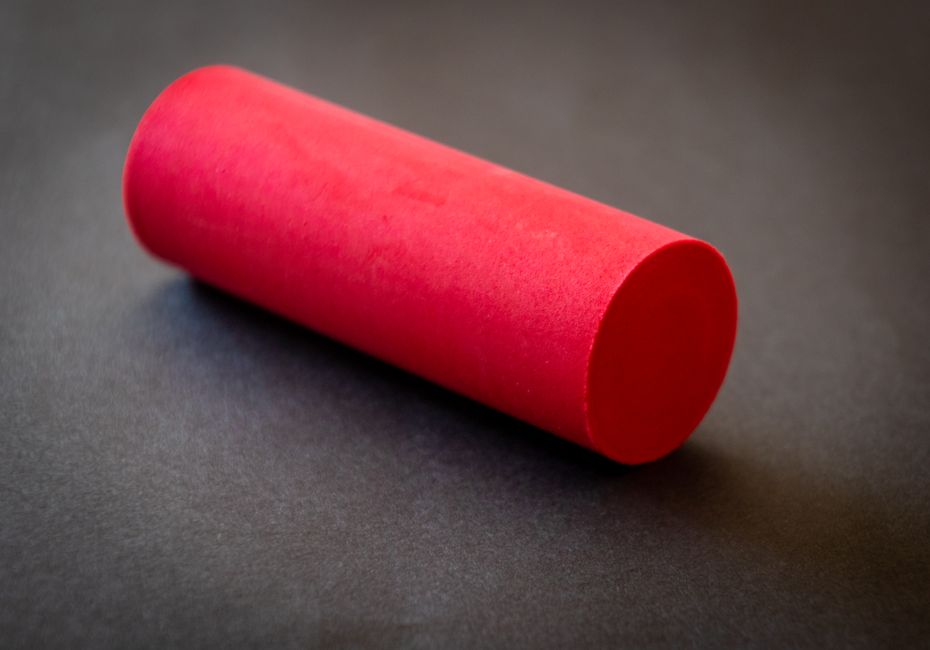
Photo by Magda Ehlers on Pexels
This method is often easier when your slices are parallel to the axis of revolution.
- Imagine slicing your 2D region into thin vertical or horizontal strips. When you revolve one of these strips around the axis, it forms a thin cylindrical shell.
- The volume of a single cylindrical shell is approximately $2 \pi \cdot (\text{average radius}) \cdot (\text{height}) \cdot (\text{thickness})$.
- If revolving around the y-axis (or any vertical line), you'll typically use vertical strips with thickness
dx.- The radius
ris the distance from the axis of revolution to the strip (e.g.,xif revolving around the y-axis). - The height
his the length of the strip (e.g.,f(x)orf(x) - g(x)). - So, $V = \int_a^b 2 \pi (\text{radius}) (\text{height}) dx$.
- The radius
- If revolving around the x-axis (or any horizontal line), you'll typically use horizontal strips with thickness
dy.- The radius
ris the distance from the axis of revolution to the strip (e.g.,yif revolving around the x-axis). - The height
his the length of the strip (e.g.,g(y)org(y) - h(y)). - So, $V = \int_c^d 2 \pi (\text{radius}) (\text{height}) dy$.
- The radius
Choosing the right method often simplifies the problem significantly.
graph TD
    A["Identify the 2D Region"] --> B{"Axis of Revolution?"}
    B -- "Horizontal (e.g., x-axis)" --> C{"How are slices aligned with axis?"}
    B -- "Vertical (e.g., y-axis)" --> D{"How are slices aligned with axis?"}

    C -- "Perpendicular to axis (dx)" --> E["Disk/Washer Method (Vertical Slices)"]
    C -- "Parallel to axis (dy)" --> F["Cylindrical Shell Method (Horizontal Slices)"]

    D -- "Perpendicular to axis (dy)" --> G["Disk/Washer Method (Horizontal Slices)"]
    D -- "Parallel to axis (dx)" --> H["Cylindrical Shell Method (Vertical Slices)"]

    E --> I["Set up integral: V = ∫ π(R² - r²) dx"]
    F --> J["Set up integral: V = ∫ 2πrh dy"]
    G --> K["Set up integral: V = ∫ π(R² - r²) dy"]
    H --> L["Set up integral: V = ∫ 2πrh dx"]

    I --> M["Calculate Integral"]
    J --> M
    K --> M
    L --> M
    M --> N["Volume of Revolution"]
3. Worked Example
Let's find the volume of the solid generated by revolving the region bounded by $y = x^2$, $y = 0$, and $x = 2$ about the y-axis.
- Sketch the region: It's the area under the parabola $y=x^2$ from $x=0$ to $x=2$.
- Identify the axis of revolution: The y-axis.
-
Choose a method:
- Disk/Washer? If we use horizontal slices (dy), the outer radius would be $x=2$ and the inner radius would be $x=\sqrt{y}$. This is feasible.
- Cylindrical Shells? If we use vertical slices (dx), they are parallel to the y-axis. This also seems feasible and might be simpler. Let's go with shells.
-
Set up the integral using Cylindrical Shells:
- Thickness: Our slices are vertical, so
dx. - Radius (r): The distance from the y-axis to a slice at
xis simplyx. - Height (h): The height of the slice is the function value,
y = x^2. - Bounds: The region is from $x=0$ to $x=2$.
The volume of a single shell is $2 \pi \cdot (\text{radius}) \cdot (\text{height}) \cdot (\text{thickness}) = 2 \pi (x)(x^2) dx = 2 \pi x^3 dx$.
Now, integrate this from $x=0$ to $x=2$:
$V = \int_0^2 2 \pi x^3 dx$
$V = 2 \pi \int_0^2 x^3 dx$
$V = 2 \pi \left[ \frac{x^4}{4} \right]_0^2$
$V = 2 \pi \left( \frac{2^4}{4} - \frac{0^4}{4} \right)$
$V = 2 \pi \left( \frac{16}{4} - 0 \right)$
$V = 2 \pi (4)$
$V = 8 \pi$ - Thickness: Our slices are vertical, so
So, the volume of the solid is $8\pi$ cubic units.
4. Key Takeaways
- Volumes of revolution calculate the 3D volume formed by spinning a 2D area around an axis.
- The Disk/Washer method uses slices perpendicular to the axis of revolution.
- The Cylindrical Shell method uses slices parallel to the axis of revolution.
- Always sketch the region and the axis of revolution; it helps immensely in choosing the method and setting up the integral.
- For the Disk/Washer method, remember $\pi (R^2 - r^2) \cdot \text{thickness}$.
- For the Cylindrical Shell method, remember $2\pi (\text{radius})(\text{height}) \cdot \text{thickness}$.
Common Mistakes to Avoid:
- Swapping methods: Don't try to use
dxslices with the Washer method if the axis of revolution is vertical, or vice-versa. - Incorrect radius/height: Make sure your radius (distance from axis) and height (length of slice) are defined correctly relative to the chosen axis and slice orientation.
- Forgetting $\pi$ or $2\pi$: These constants are essential components of the formulas.
- Squaring $f(x) - g(x)$ instead of $f(x)^2 - g(x)^2$ for washers: This is a common algebraic error that leads to incorrect results.
- Incorrect bounds: Ensure your integration limits match the extent of the 2D region being revolved.
5. Now Try It
Find the volume of the solid generated by revolving the region bounded by $y = \sqrt{x}$, $y = 0$, and $x = 4$ about the x-axis. Sketch the region, decide which method (disk/washer or shells) is more straightforward, set up the integral, and calculate the volume. Success looks like you getting a final volume of $8\pi$ cubic units.
Frequently asked about Applications of Integration: Volumes of Revolution
Get the full calculus 2 curriculum
Clone the complete plan to your dashboard for unlimited AI-generated notes, practice quizzes, and a personalised revision schedule.
Create Free Account