Foundations of Number Systems
From the math curriculum
Foundations of Number Systems
TL;DR
You'll learn about different types of numbers, how they relate to each other, and why we have them. We'll start with natural numbers and build up to real numbers, understanding their properties along the way. This foundational knowledge helps you grasp more complex math ideas later on.
1. The Mental Model
Think of number systems as increasingly larger boxes. Each new box contains all the previous boxes of numbers, plus some new ones with special properties. We start with simple counting and add complexity as needed to solve new problems.
2. The Core Material
We use numbers every day, but have you ever thought about the different kinds of numbers? Math builds on these basic categories.
2.1 Natural Numbers ($\mathbb{N}$)

Photo by Brett Jordan on Pexels
These are the numbers you use for counting: 1, 2, 3, 4, and so on. Sometimes 0 is included, but typically it starts at 1. They're also called counting numbers or positive integers.
2.2 Whole Numbers ($\mathbb{W}$)

Photo by Katerina Holmes on Pexels
This is just the natural numbers plus zero: 0, 1, 2, 3, ...
2.3 Integers ($\mathbb{Z}$)
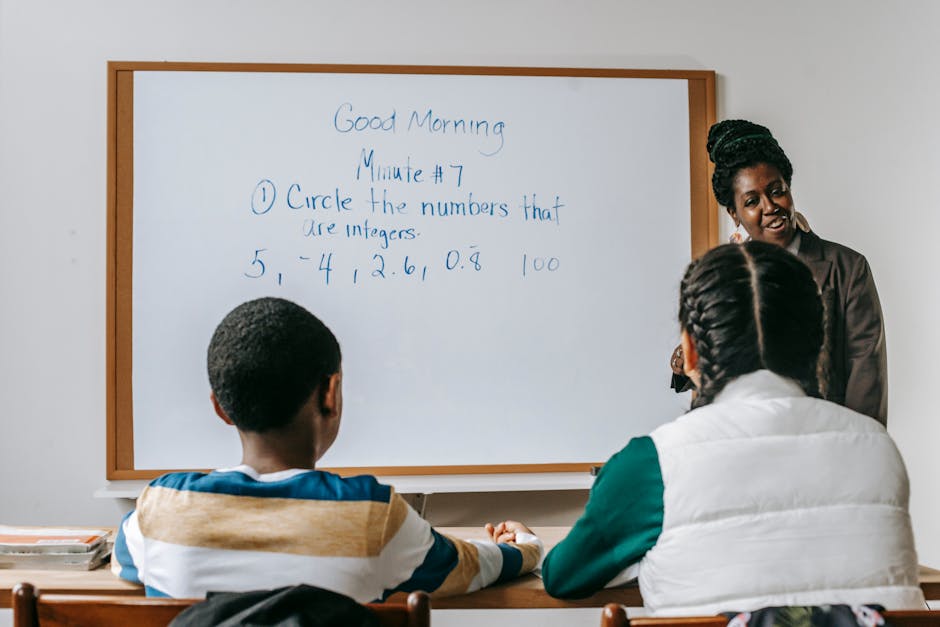
Photo by Katerina Holmes on Pexels
Now we add negative numbers! Integers include all whole numbers and their negatives: ..., -3, -2, -1, 0, 1, 2, 3, ... You use these for things like temperature below zero or debt.
2.4 Rational Numbers ($\mathbb{Q}$)
Photo by Pixabay on Pexels
These are numbers that can be expressed as a fraction $\frac{a}{b}$, where $a$ and $b$ are integers and $b$ is not zero. This includes all integers (e.g., $3 = \frac{3}{1}$), terminating decimals (e.g., $0.5 = \frac{1}{2}$), and repeating decimals (e.g., $0.333... = \frac{1}{3}$).
2.5 Irrational Numbers ($\mathbb{I}$)
These are numbers that cannot be expressed as a simple fraction. Their decimal representation goes on forever without repeating. Famous examples include $\pi$ (pi) and $\sqrt{2}$.
2.6 Real Numbers ($\mathbb{R}$)
This is the big box that contains all the rational and irrational numbers. Any number you can place on a number line is a real number. This is the set you'll work with most often in everyday math.
graph TD
    N["Natural Numbers (1, 2, 3...)"]
    W["Whole Numbers (0, 1, 2, 3...)"]
    Z["Integers (...-1, 0, 1...)"]
    Q["Rational Numbers (fractions, terminating/repeating decimals)"]
    I["Irrational Numbers (pi, sqrt(2), non-repeating decimals)"]
    R["Real Numbers (All rational and irrational numbers)"]

    N --> W;
    W --> Z;
    Z --> Q;
    Q --> R;
    I --> R;
3. Worked Example
Let's classify a few numbers into the smallest possible category they fit into.
-
-7: This isn't a natural number or a whole number because it's negative. It is an integer. It can also be written as $\frac{-7}{1}$, so it's rational. Since it's an integer, the smallest category is Integers ($\mathbb{Z}$).
-
$\frac{3}{4}$: This is clearly a fraction where the top and bottom are integers and the bottom isn't zero. It's a Rational Number ($\mathbb{Q}$).
-
$\sqrt{9}$: First, simplify it! $\sqrt{9} = 3$. Since 3 is a positive counting number, it's a Natural Number ($\mathbb{N}$).
-
$0.121221222...$ (the pattern of added 2s continues): This decimal goes on forever and does not repeat in a fixed block. This makes it an Irrational Number ($\mathbb{I}$).
-
$\sqrt{5}$: You can't simplify this to a whole number, and its decimal form ($2.236067...$) never repeats. It's an Irrational Number ($\mathbb{I}$).
4. Key Takeaways
- Every natural number is also a whole number, an integer, a rational number, and a real number.
- Rational numbers are those you can write as a fraction $a/b$, where $b \neq 0$.
- Irrational numbers are real numbers that can't be written as simple fractions.
- The set of real numbers combines all rational and irrational numbers.
- Understanding these categories helps you predict how numbers behave in calculations.
Common mistakes to avoid:
- Confusing whole numbers with natural numbers (remember, 0 is the key difference).
- Assuming all decimals are rational; only terminating or repeating decimals are.
- Forgetting that $\sqrt{x}$ can be rational if $x$ is a perfect square (like $\sqrt{4}=2$).
- Thinking all integers are positive; integers include negative numbers and zero.
5. Now Try It
Take a piece of paper and write down the numbers: $\frac{10}{2}$, $0$, $-1$, $\pi$, $0.75$, $\sqrt{16}$, $\sqrt{7}$. For each number, identify the "smallest" number system category (Natural, Whole, Integer, Rational, Irrational) it belongs to.
Success looks like: You can correctly place each number into its most specific category and explain why.
Frequently asked about Foundations of Number Systems
Get the full math curriculum
Clone the complete plan to your dashboard for unlimited AI-generated notes, practice quizzes, and a personalised revision schedule.
Create Free Account