Foundations of Chemistry: Measurement and Matter
From the Chemistry curriculum
Foundations of Chemistry: Measurement and Matter
TL;DR
Chemistry is about understanding matter and its changes, which starts with observing and measuring its properties. We'll learn how to measure accurately using the right units and how to classify different types of matter. Getting these basics down helps you build a strong foundation for everything else in chemistry.
1. The Mental Model
Think of chemistry as cooking. Before you can bake a cake, you need to know how to measure ingredients accurately and understand what those ingredients are made of. This topic gives you the fundamental tools for precisely "measuring" and "identifying" the "ingredients" of the universe.
2. The Core Material
Chemistry relies on careful observation and measurement. When we measure something, we're comparing an unknown quantity to a standard. For consistency, scientists use the International System of Units (SI Units).
2.1 SI Base Units

Photo by Freek Wolsink on Pexels
There are seven fundamental SI units from which all others are derived. You'll mainly work with these:
- Length: meter (m)
- Mass: kilogram (kg) - Note: The base unit for mass is the kilogram, not the gram.
- Time: second (s)
- Temperature: Kelvin (K) - You'll often use degrees Celsius (°C), but Kelvin is the SI base unit.
- Amount of substance: mole (mol) - This is super important in chemistry, we'll dive deeper into it later.
2.2 Derived Units & Prefixes

Photo by Vitaly Gariev on Pexels
Many quantities, like volume or density, use derived units formed from base units. For example:
* Volume: m³ (though liters, L, are commonly used for liquids: 1 L = 1 dm³ = 1000 cm³)
* Density: kg/m³ (or g/cm³ for convenience)
To handle very large or very small numbers, we use SI prefixes:
| Prefix | Symbol | Multiplier | Example |
|---|---|---|---|
| Giga | G | 10⁹ | 1 gigameter (Gm) = 1,000,000,000 m |
| Mega | M | 10⁶ | 1 megagram (Mg) = 1,000,000 g |
| Kilo | k | 10³ | 1 kilometer (km) = 1000 m |
| Centi | c | 10⁻² | 1 centimeter (cm) = 0.01 m |
| Milli | m | 10⁻³ | 1 milligram (mg) = 0.001 g |
| Micro | µ | 10⁻⁶ | 1 microgram (µg) = 0.000001 g |
| Nano | n | 10⁻⁹ | 1 nanometer (nm) = 0.000000001 m |
2.3 Uncertainty in Measurement: Significant Figures

Photo by Ann H on Pexels
Every measurement has some uncertainty. Significant figures (sig figs) tell us how precise a measurement is. They include all known digits plus one estimated digit.
-
Rules for counting sig figs:
- Non-zero digits are always significant (e.g., 24.7 has 3 sig figs).
- Zeros between non-zero digits are significant (e.g., 1005 has 4 sig figs).
- Leading zeros (at the beginning) are not significant (e.g., 0.0025 has 2 sig figs).
- Trailing zeros (at the end) are significant if there's a decimal point (e.g., 100. has 3 sig figs; 100 has 1 sig fig).
- Exact numbers (like counts or definitions, e.g., "12 eggs," "1 inch = 2.54 cm") have infinite sig figs.
-
Rules for calculations:
- Multiplication/Division: The answer has the same number of sig figs as the measurement with the fewest sig figs.
- Addition/Subtraction: The answer has the same number of decimal places as the measurement with the fewest decimal places.
2.4 Matter: Classification
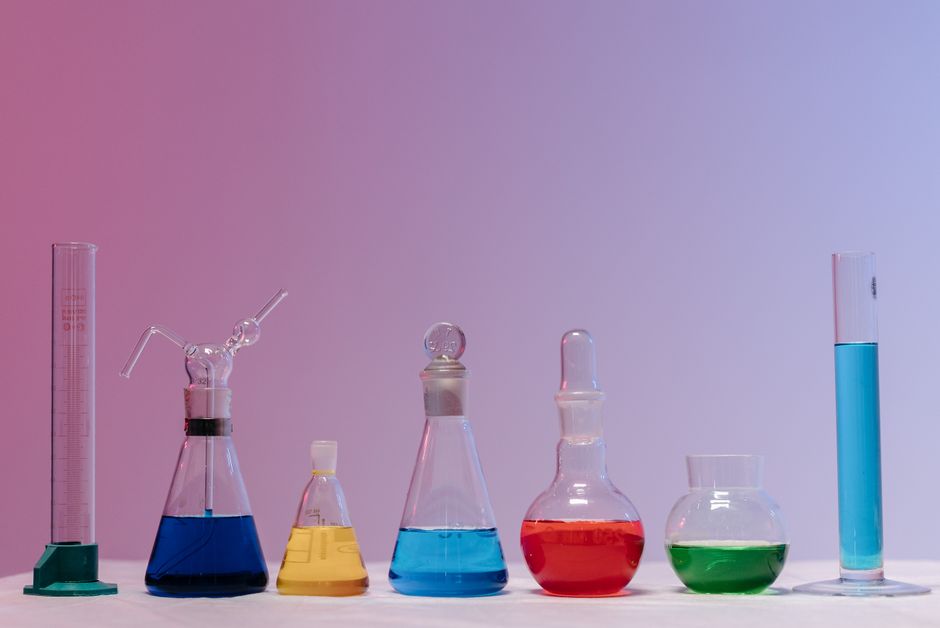
Photo by Pavel Danilyuk on Pexels
Matter is anything that has mass and takes up space. We classify matter based on its composition.
graph TD
    A["Matter"] --> B["Pure Substances"]
    A --> C["Mixtures"]
    B --> D["Elements"]
    B --> E["Compounds"]
    C --> F["Homogeneous Mixtures (Solutions)"]
    C --> G["Heterogeneous Mixtures"]
    D --> D1["Cannot be broken down chemically"]
    E --> E1["Two or more elements chemically bonded"]
    F --> F1["Uniform composition throughout (e.g., saltwater)"]
    G --> G1["Non-uniform composition (e.g., sand and water)"]
- Pure Substances: Have a fixed, uniform composition.
- Elements: The simplest form of matter; cannot be broken down into simpler substances by chemical means (e.g., Oxygen (O), Gold (Au)).
- Compounds: Two or more different elements chemically bonded together in fixed proportions; can be broken down into elements by chemical means (e.g., Water (H₂O), Salt (NaCl)).
- Mixtures: Two or more substances physically combined, not chemically bonded. Their proportions can vary.
- Homogeneous Mixtures (Solutions): Have a uniform composition throughout; components are evenly distributed and indistinguishable (e.g., air, sugar dissolved in water).
- Heterogeneous Mixtures: Do not have a uniform composition; components are not evenly distributed and can often be distinguished (e.g., sand in water, oil and vinegar dressing).
2.5 Physical vs. Chemical Properties and Changes
- Physical Properties: Can be observed or measured without changing the substance's chemical identity (e.g., color, density, melting point, boiling point, hardness).
- Physical Changes: Alter a substance's appearance but not its chemical composition (e.g., melting ice, boiling water, cutting wood).
- Chemical Properties: Describe how a substance reacts with other substances, changing its chemical identity (e.g., flammability, reactivity with acid).
- Chemical Changes (Chemical Reactions): Result in the formation of new substances with different chemical properties (e.g., burning wood, rusting iron, cooking an egg). Indicators of a chemical change include: color change, gas production (bubbles), heat/light production, and precipitate formation.
3. Worked Example
Let's say you're measuring the density of an unknown liquid. You perform the following steps:
- You measure the mass of an empty beaker: 52.34 g (4 sig figs)
- You add the liquid to the beaker and measure the combined mass: 78.102 g (5 sig figs)
- You measure the volume of the liquid using a graduated cylinder: 25.0 mL (3 sig figs - the trailing zero is significant because of the decimal point).
Now, let's calculate the density:
-
Step 1: Find the mass of the liquid.
Mass of liquid = (Combined mass) - (Mass of empty beaker)
Mass of liquid = 78.102 g - 52.34 g
For subtraction, we look at decimal places. 78.102 has 3 decimal places, 52.34 has 2. The answer must have 2 decimal places.
Mass of liquid = 25.762 g ≈ 25.76 g (after rounding to 2 decimal places) -
Step 2: Convert volume to cm³ if needed (1 mL = 1 cm³).
Volume of liquid = 25.0 mL = 25.0 cm³ -
Step 3: Calculate the density.
Density = Mass / Volume
Density = 25.76 g / 25.0 cm³
For division, we look at sig figs. 25.76 g has 4 sig figs, 25.0 cm³ has 3 sig figs. The answer must have 3 sig figs.
Density = 1.0304 g/cm³ ≈ 1.03 g/cm³ (after rounding to 3 sig figs)
4. Key Takeaways
- Use SI units (meter, kilogram, second, Kelvin, mole) for consistent scientific communication.
- SI prefixes help you express very large or very small quantities conveniently.
- Significant figures indicate the precision of a measurement and must be correctly applied in calculations.
- Matter is categorized into elements, compounds, homogeneous mixtures, and heterogeneous mixtures.
- Physical changes alter appearance but not composition, while chemical changes form new substances.
- Density is a derived physical property that relates a substance's mass to its volume.
Common Mistakes to Avoid
- Forgetting to include units in your answer. Always label numbers with the correct units!
- Confusing mass (kilograms) with weight (force due to gravity).
- Rounding too early in multi-step calculations; carry extra digits and round only at the very end.
- Not applying significant figure rules correctly, especially for trailing zeros without a decimal point.
- Mixing up elements and compounds, or homogeneous and heterogeneous mixtures.
5. Now Try It
You have a metal block. Its mass is measured as 15.37 grams. You put it into a graduated cylinder containing 20.5 mL of water, and the water level rises to 27.8 mL. Calculate the density of the metal block, making sure to apply significant figure rules correctly.
What success looks like: Your final answer for the density will have the correct units and the appropriate number of significant figures, based on the precision of the measurements provided. You'll also know if the metal would float or sink in water (density of water is approximately 1.0 g/mL).
Frequently asked about Foundations of Chemistry: Measurement and Matter
Get the full Chemistry curriculum
Clone the complete plan to your dashboard for unlimited AI-generated notes, practice quizzes, and a personalised revision schedule.
Create Free Account