Kinetic Particle Theory Fundamentals
From the Chemistry curriculum
Kinetic Particle Theory Fundamentals
TL;DR
The Kinetic Particle Theory explains that all matter is made of tiny, constantly moving particles. How these particles move and arrange themselves determines if a substance is a solid, liquid, or gas. Temperature is just a measure of the average kinetic energy of these particles.
1. The Mental Model
Imagine everything around you, even seemingly still objects, is made of tiny, invisible dancers. These dancers are always wiggling, jiggling, or zooming around. Their dance moves and how close they are define what you see.
2. The Core Material
The Kinetic Particle Theory (KPT) is a fundamental idea in chemistry and physics. It helps us understand the properties of matter – solids, liquids, and gases – by looking at what their tiny particles are doing.
Here's the main idea:
- All matter is made of tiny particles. These particles could be atoms, molecules, or ions. You can't see them with your eyes alone.
- These particles are in constant, random motion. They never stop moving, even in a solid.
- Particles have kinetic energy. Because they're moving, they have energy of motion.
- Temperature is directly related to the average kinetic energy of these particles. If you heat something up, its particles move faster and have more kinetic energy. If you cool it down, they slow down.
- There are forces of attraction between particles. These forces try to pull particles together. The strength of these forces, compared to the particles' kinetic energy, determines the state of matter.
States of Matter Explained by KPT
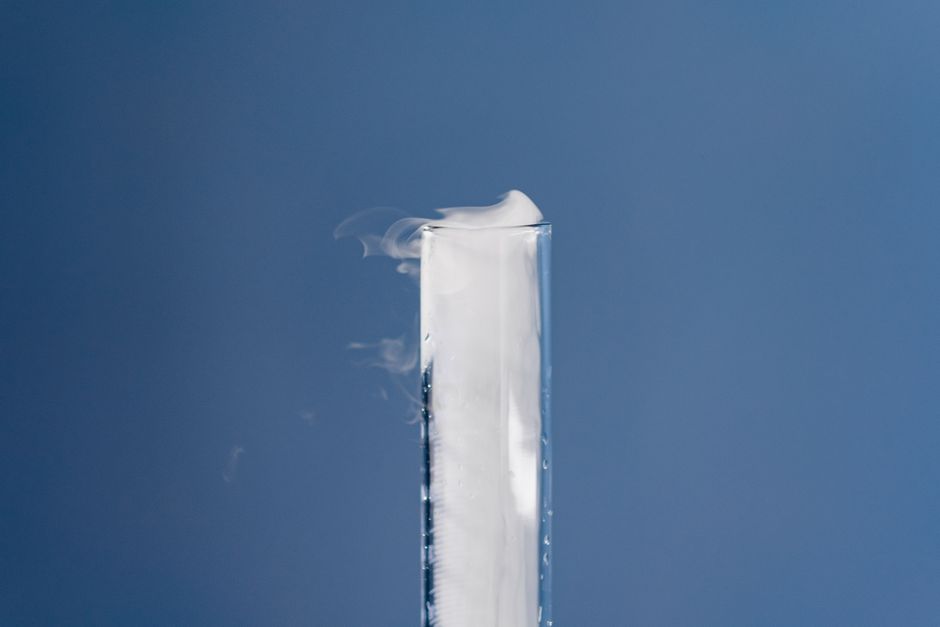
Photo by Ron Lach on Pexels
Let's look at how KPT explains solids, liquids, and gases:
graph TD
    A["Solid State"] --> B["Particles tightly packed"];
    B --> C["Vibrate in fixed positions"];
    C --> D["Strong attractive forces"];
    D --> E["Fixed shape & volume"];

    F["Liquid State"] --> G["Particles closely packed"];
    G --> H["Can slide past each other"];
    H --> I["Weaker attractive forces"];
    I --> J["Fixed volume, takes shape of container"];

    K["Gas State"] --> L["Particles far apart"];
    L --> M["Move randomly & rapidly"];
    M --> N["Very weak attractive forces"];
    N --> O["No fixed shape or volume"];

    A --- F;
    F --- K;
- Solids:
- Particles are very close together in a fixed, orderly arrangement.
- They don't move past each other; they just vibrate in their fixed positions.
- The attractive forces between particles are very strong, holding them tightly in place.
- This gives solids a definite shape and a definite volume.
- Liquids:
- Particles are still quite close together, but not in fixed positions.
- They can slide and move past each other. This is why liquids can flow.
- The attractive forces are strong enough to keep them together but not strong enough to hold them in a rigid structure.
- Liquids have a definite volume but take the shape of their container.
- Gases:
- Particles are very far apart from each other.
- They move randomly, rapidly, and in straight lines until they collide with other particles or the container walls.
- The attractive forces between gas particles are very weak, almost negligible, because the particles have too much kinetic energy to be held together.
- Gases have no definite shape and no definite volume; they expand to fill their container.
Changes of State

Photo by Jeff Wiles on Pexels
KPT also helps us understand why matter changes state:
- Melting (Solid to Liquid): When you heat a solid, its particles gain kinetic energy and vibrate faster. Eventually, they vibrate so much that they overcome the strong attractive forces and can slide past each other, forming a liquid.
- Boiling/Evaporation (Liquid to Gas): Heating a liquid gives its particles even more kinetic energy. They move faster and eventually overcome all the attractive forces, escaping into the gas phase. Evaporation happens at the surface; boiling happens throughout the liquid.
- Condensation (Gas to Liquid): Cooling a gas reduces its particles' kinetic energy. They slow down, and the attractive forces can pull them closer together to form a liquid.
- Freezing (Liquid to Solid): Cooling a liquid further makes its particles slow down enough for the strong attractive forces to pull them into fixed, orderly positions, forming a solid.
3. Worked Example
Let's consider a block of ice at -10°C, then warmed to water at 20°C, and finally boiled into steam at 120°C.
- Ice at -10°C (Solid): The water molecules are closely packed in a regular, crystal lattice structure. They're not still, though; they're vibrating in their fixed positions. The attractive forces between them are very strong, much stronger than their kinetic energy.
- Water at 20°C (Liquid): As the ice warms and melts, the molecules gain enough kinetic energy to overcome the forces holding them in fixed positions. They're still relatively close together, but they can now slide past each other. The attractive forces are still significant, keeping the water in a definite volume, but not a definite shape.
- Steam at 120°C (Gas): Further heating gives the water molecules a lot of kinetic energy. They move so fast and with such force that they completely overcome the attractive forces between them. They spread out far from each other, moving randomly and rapidly, occupying any available volume.
4. Key Takeaways
- All matter consists of tiny particles that are constantly moving.
- Particle arrangement and movement define the state of matter (solid, liquid, gas).
- Temperature is a direct measure of the average kinetic energy of these particles.
- Stronger attractive forces between particles lead to more ordered and fixed states (solids).
- Weaker attractive forces and higher kinetic energy lead to more disordered and free-moving states (gases).
- Changes of state occur when particles gain or lose enough energy to overcome or succumb to intermolecular forces.
- KPT explains phenomena like diffusion (particles spreading out) and pressure (gas particles hitting container walls).
Common Mistakes to Avoid:
- Thinking particles in a solid are completely still – they're always vibrating.
- Confusing temperature with heat – temperature is average kinetic energy, heat is total energy transferred.
- Believing attractive forces disappear entirely in gases – they're just too weak to hold particles together due to high kinetic energy.
- Forgetting that all particles, regardless of state, have some kinetic energy.
5. Now Try It
Imagine you have a deflated balloon and then you pump air into it. Using the Kinetic Particle Theory, describe what's happening to the air particles inside the balloon as you inflate it. What happens to the pressure inside the balloon, and why?
What success looks like: You should be able to explain how the number of particles, their movement, and collisions relate to the increasing size and pressure of the balloon, using KPT terms like "kinetic energy," "random motion," and "collisions."
Frequently asked about Kinetic Particle Theory Fundamentals
More from Chemistry
Get the full Chemistry curriculum
Clone the complete plan to your dashboard for unlimited AI-generated notes, practice quizzes, and a personalised revision schedule.
Create Free Account