Fundamental Concepts of Percentages
From the procent curriculum
TL;DR
Percentages are a way to express a part of a whole as a fraction of 100, making comparisons easier. You'll learn to convert between percentages, decimals, and fractions, and calculate percentage parts or wholes. Mastering these basics helps you understand discounts, growth rates, and statistics.
1. The Mental Model
Think of percentages as slices of a pie that's always cut into 100 equal pieces. If you have 25% of something, you have 25 out of those 100 pieces. It's just a standardized way to talk about proportions.
2. The Core Material
A percentage literally means "per hundred" or "out of one hundred." The symbol "%" is shorthand for "/100". So, 50% means 50 out of 100, or 50/100.
Converting Between Forms

Photo by Tima Miroshnichenko on Pexels
It's crucial to be able to move seamlessly between percentages, decimals, and fractions. They're just different ways of representing the same value.
Percentage to Decimal
To convert a percentage to a decimal, just divide by 100 (or move the decimal point two places to the left).
* Example: 75% = 75 / 100 = 0.75
* Example: 5% = 5 / 100 = 0.05
Decimal to Percentage
To convert a decimal to a percentage, multiply by 100 (or move the decimal point two places to the right) and add the "%" symbol.
* Example: 0.25 = 0.25 * 100 = 25%
* Example: 1.5 = 1.5 * 100 = 150%
Percentage to Fraction
To convert a percentage to a fraction, write the percentage value over 100 and then simplify the fraction.
* Example: 40% = 40/100 = 2/5 (after dividing top and bottom by 20)
* Example: 12.5% = 12.5/100 = 125/1000 = 1/8
Fraction to Percentage
To convert a fraction to a percentage, first convert the fraction to a decimal (divide the numerator by the denominator), then convert the decimal to a percentage (multiply by 100).
* Example: 3/4 = 0.75 = 75%
* Example: 1/3 ≈ 0.3333 = 33.33% (often rounded)
Here's a visual of these conversions:
graph TD
    A["Percentage (e.g., 75%)"] --> B["Divide by 100"]
    B --> C["Decimal (e.g., 0.75)"]
    C --> D["Multiply by 100 & add %"]
    D --> A
    A --> E["Write over 100 & simplify"]
    E --> F["Fraction (e.g., 3/4)"]
    F --> G["Divide numerator by denominator"]
    G --> C
Calculating a Percentage of a Number
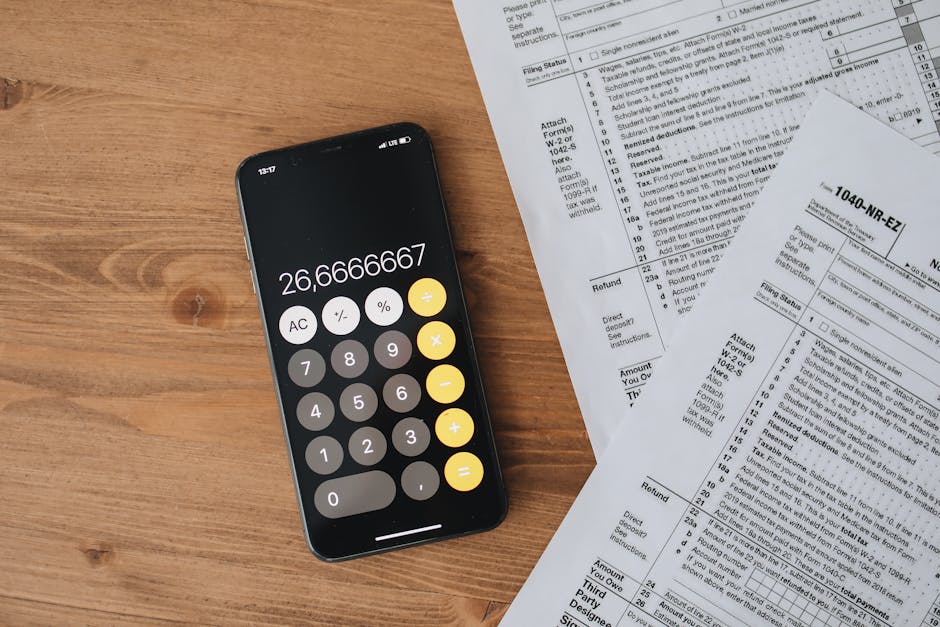
Photo by Polina Tankilevitch on Pexels
To find a percentage of a number, convert the percentage to a decimal (or fraction) and then multiply it by the number.
- Formula: Part = Percentage (as decimal) × Whole
- Example: What is 20% of 300?
- Convert 20% to a decimal: 0.20
- Multiply: 0.20 * 300 = 60
- So, 20% of 300 is 60.
Calculating What Percentage One Number Is of Another
Photo by Polina Tankilevitch on Pexels
To find what percentage one number (the part) is of another number (the whole), divide the part by the whole, then convert the resulting decimal to a percentage.
- Formula: Percentage = (Part / Whole) × 100%
- Example: What percentage is 40 of 200?
- Divide: 40 / 200 = 0.20
- Convert to percentage: 0.20 * 100% = 20%
- So, 40 is 20% of 200.
3. Worked Example
You're shopping for a new gadget that costs $250. There's a discount of 15% today. How much money do you save, and what's the final price?
-
Calculate the discount amount:
- Convert 15% to a decimal: 0.15
- Multiply the decimal by the original price: 0.15 * $250 = $37.50
- You save $37.50.
-
Calculate the final price:
- Subtract the discount from the original price: $250 - $37.50 = $212.50
- The final price is $212.50.
4. Key Takeaways
- Percentages express a value as parts per hundred, making comparisons straightforward.
- To convert a percentage to a decimal, divide by 100 (move the decimal two places left).
- To convert a decimal to a percentage, multiply by 100 (move the decimal two places right).
- To find a percentage of a number, convert the percentage to a decimal and multiply.
- To find what percentage one number is of another, divide the part by the whole and multiply by 100%.
- Percentages greater than 100% mean you have more than the original whole amount (e.g., 150% is 1.5 times the original).
Common Mistakes to Avoid:
- Forgetting to convert the percentage to a decimal (or fraction) before multiplying.
- Confusing "part" and "whole" when setting up percentage calculations.
- Incorrectly moving the decimal point (e.g., only one place instead of two).
- Not simplifying fractions or rounding decimals appropriately when converting.
5. Now Try It
Imagine you're tracking your game progress. You've completed 18 out of 40 levels.
1. What percentage of the levels have you completed?
2. If you want to reach 75% completion, how many more levels do you need to complete?
Success looks like: You have a percentage for part 1, and a whole number for part 2, showing your work for each step.
Frequently asked about Fundamental Concepts of Percentages
Study this next
Get the full procent curriculum
Clone the complete plan to your dashboard for unlimited AI-generated notes, practice quizzes, and a personalised revision schedule.
Save this course free