Percentages and Proportional Reasoning
From the Higher Benchmark Test Revision curriculum
TL;DR
Percentages help us compare parts to a whole, usually out of 100. Proportional reasoning lets us scale recipes, convert units, or understand how changes in one quantity affect another consistently. Mastering these helps you solve real-world problems involving ratios and rates.
1. The Mental Model
Think of percentages as a universal language for "parts of 100," making comparisons easy. Proportional reasoning is like using a consistent scaling factor: if you double one side of a relationship, you double the other.
2. The Core Material
What's a Percentage?

Photo by Towfiqu barbhuiya on Pexels
A percentage is simply a fraction where the denominator is 100. So, 50% means 50 out of 100, which is the same as 1/2 or 0.5. It's a way to express a part of a whole.
To convert a fraction or decimal to a percentage:
Multiply by 100.
* 0.75 = 0.75 * 100 = 75%
* 3/4 = (3/4) * 100 = 75%
To convert a percentage to a decimal or fraction:
Divide by 100.
* 25% = 25 / 100 = 0.25
* 25% = 25/100 = 1/4
Finding a Percentage of a Number
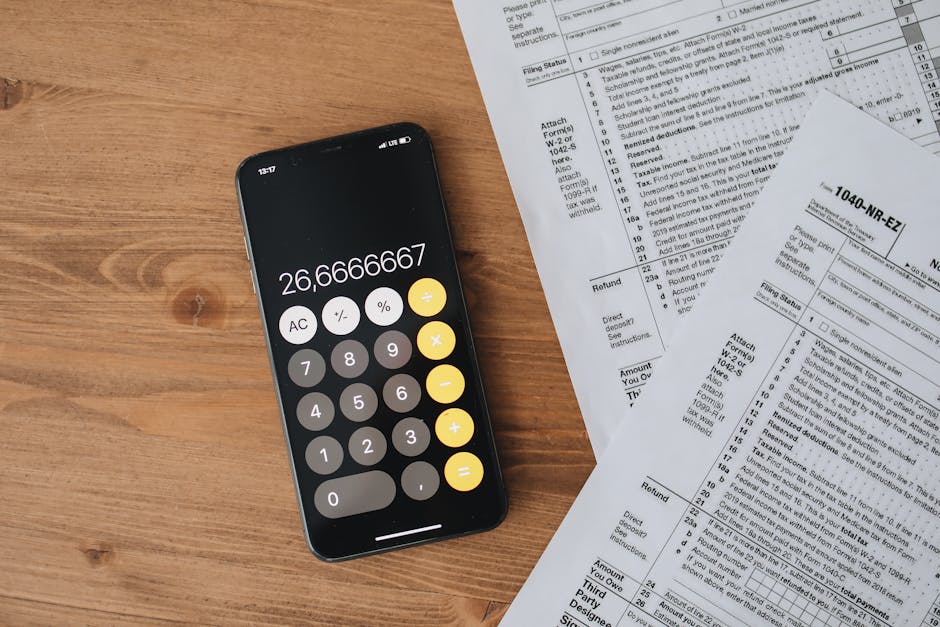
Photo by Polina Tankilevitch on Pexels
To find 'x%' of 'y', convert 'x%' to a decimal (divide by 100) and then multiply it by 'y'.
* Example: Find 20% of 300.
* 20% = 0.20
* 0.20 * 300 = 60
Percentage Change (Increase/Decrease)
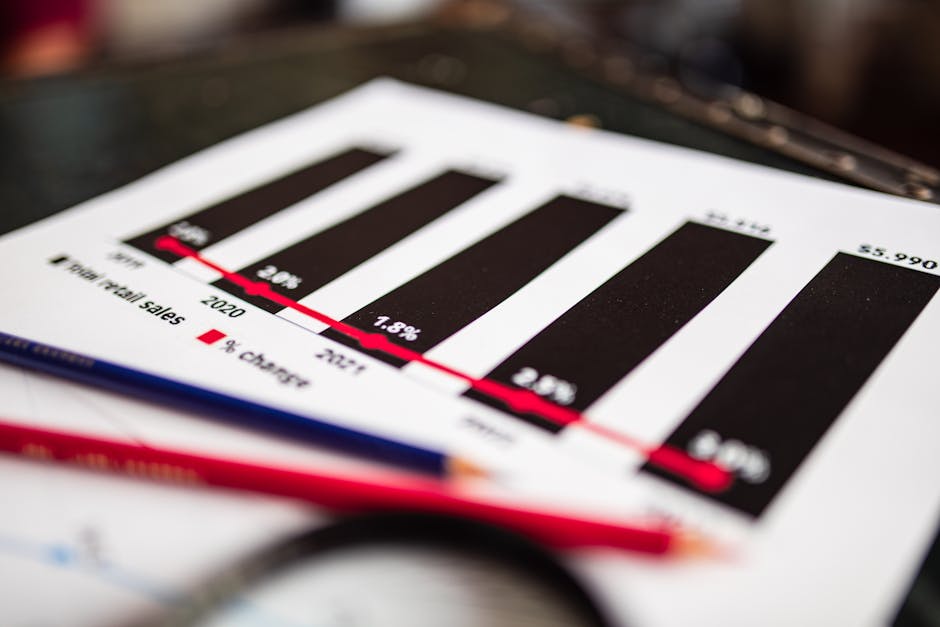
Photo by RDNE Stock project on Pexels
This tells you how much a quantity has changed relative to its original value.
Percentage Change Formula:
((New Value - Original Value) / Original Value) * 100
- If the result is positive, it's a percentage increase.
- If the result is negative, it's a percentage decrease.
Proportional Reasoning
Photo by Ann H on Pexels
This is about relationships where two ratios are equal. If A relates to B in the same way C relates to D, then A/B = C/D. We often use this to find an unknown value.
Imagine you have a recipe that serves 4 people, but you need to serve 6. You'll use proportional reasoning to scale the ingredients.
graph TD
    A["Identify the 'Whole' (Original Amount)"] --> B["Identify the 'Part' (Amount of Change or Specific Portion)"]
    B --> C{Is it a Percentage Calculation?}
    C -- Yes --> D["Use (Part / Whole) * 100%"]
    C -- No, it's about scaling --> E{Are you finding an unknown in a ratio?}
    E -- Yes --> F["Set up a Proportion: A/B = C/X"]
    E -- No, just comparing sizes --> G["Consider the Ratio directly (e.g., 1:2 means one is twice the other)"]
    D --> H["Result: Percentage"]
    F --> I["Solve for X (e.g., cross-multiply)"]
    G --> H
    I --> H
Direct and Inverse Proportion
-
Direct Proportion: As one quantity increases, the other increases at the same rate. As one decreases, the other decreases.
- Example: The more hours you work, the more money you earn (assuming a fixed hourly wage).
- Mathematically: y = kx (where k is a constant)
-
Inverse Proportion: As one quantity increases, the other decreases.
- Example: The more workers you have on a job, the less time it takes to complete (assuming they work efficiently).
- Mathematically: y = k/x (where k is a constant)
3. Worked Example
You're buying a laptop that originally cost £800. It's now on sale with a 15% discount. You also know that due to inflation, the original price of £800 was actually 25% higher than it was two years ago.
1. Calculate the sale price:
* Discount amount: 15% of £800 = 0.15 * 800 = £120
* Sale price: £800 - £120 = £680
2. Calculate the original price two years ago:
This is a bit trickier. The £800 is the price after a 25% increase. So, £800 represents 125% (100% original + 25% increase) of the price two years ago.
- Let 'X' be the price two years ago.
- 125% of X = £800
- 1.25 * X = £800
- X = £800 / 1.25
- X = £640
So, the laptop's original price two years ago was £640.
4. Key Takeaways
- Percentages express a part of a whole as a fraction of 100.
- Convert percentages to decimals (divide by 100) for calculations.
- Percentage change is always relative to the original value.
- Proportional reasoning allows you to scale quantities consistently based on a given ratio.
- Direct proportion means quantities increase or decrease together, while inverse proportion means one goes up as the other goes down.
- Cross-multiplication is a powerful tool for solving proportional equations (A/B = C/D).
Common Mistakes to Avoid:
- Mixing up the "original value" and "new value" in percentage change calculations.
- Forgetting to convert percentages to decimals (or fractions) before multiplying.
- Incorrectly applying inverse proportion when the relationship is direct, or vice versa.
- Assuming a percentage increase followed by the same percentage decrease brings you back to the original value (e.g., 10% up then 10% down doesn't get you to the starting point!).
5. Now Try It
You're making a special paint mix. The recipe calls for 2 parts blue paint to 3 parts yellow paint. You need to make 15 litres of this mixed paint.
What to do:
1. Determine the total "parts" in the ratio.
2. Calculate what percentage of the total mix is blue paint and what percentage is yellow paint.
3. Using proportional reasoning, figure out exactly how many litres of blue paint and how many litres of yellow paint you need for 15 litres of the final mix.
What success looks like:
You'll have two numbers: the exact volume of blue paint and the exact volume of yellow paint, both in litres, that add up to 15 litres.
Frequently asked about Percentages and Proportional Reasoning
Study this next
Get the full Higher Benchmark Test Revision curriculum
Clone the complete plan to your dashboard for unlimited AI-generated notes, practice quizzes, and a personalised revision schedule.
Save this course free