Foundational Concepts of Algebra
From the Y=-2x+3 curriculum
Foundational Concepts of Algebra
TL;DR
Algebra is like a puzzle where you use letters (variables) to represent unknown numbers and solve equations to find their values. It helps you describe relationships and solve problems in a more general way than just using specific numbers. Understanding how to handle variables and basic operations is key to unlocking more complex math.
1. The Mental Model
Think of algebra as a language for patterns. Instead of saying "two times some number plus three equals seven," you can write it neatly as "2x + 3 = 7." The 'x' is a placeholder for that "some number" you're trying to figure out.
2. The Core Material
Algebra builds on arithmetic by introducing variables. These are usually letters (like x, y, a, b) that stand in for unknown numbers.
Variables and Constants

Photo by Rashed Paykary on Pexels
A variable is a symbol (usually a letter) that represents a quantity that can change or is unknown.
A constant is a number whose value is fixed and doesn't change.
In the expression y = -2x + 3:
- y and x are variables.
- -2 and 3 are constants.
Expressions and Equations
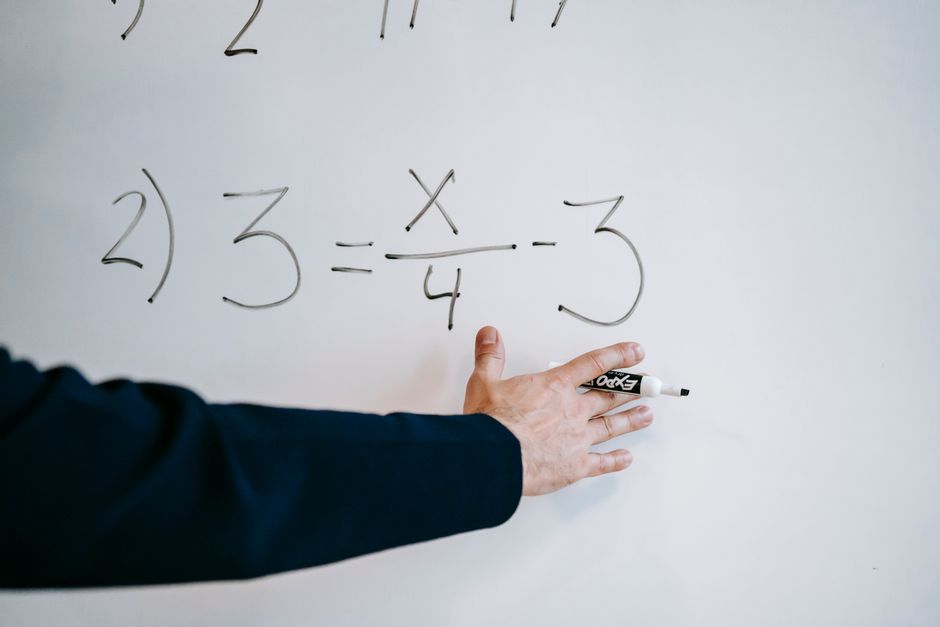
Photo by Vanessa Garcia on Pexels
An algebraic expression is a combination of variables, constants, and mathematical operations (like addition, subtraction, multiplication, division). It doesn't have an equals sign.
Example: 2x + 3 or 5a - 7b
An algebraic equation is a statement that two algebraic expressions are equal. It always has an equals sign.
Example: 2x + 3 = 7 or y = -2x + 3
Understanding Operations

Photo by DΛVΞ GΛRCIΛ on Pexels
When you see a number next to a variable, it implies multiplication. So, 2x means 2 * x.
Order of Operations (PEMDAS/BODMAS) is super important in algebra:
1. Parentheses (or Brackets)
2. Exponents (or Orders/Indices)
3. Multiplication and Division (from left to right)
4. Addition and Subtraction (from left to right)
For example, in -2x + 3, you'd multiply -2 by x before adding 3.
graph TD
    A["Problem Statement (e.g., 'What value of x makes...')"] --> B["Identify Variables & Constants"]
    B --> C["Formulate Algebraic Expression/Equation"]
    C --> D{"Isolate the Variable?"}
    D -- "No, simplify first" --> E["Apply Order of Operations (PEMDAS)"]
    D -- "Yes, solving for variable" --> F["Use Inverse Operations (add/subtract, multiply/divide)"]
    E --> C
    F --> G["Find the Solution"]
    G --> H["Verify Solution (optional but recommended)"]
Solving Basic Equations

Photo by Vanessa Garcia on Pexels
To solve an equation for a variable, your goal is to "isolate" that variable on one side of the equals sign. You do this by performing inverse operations. Whatever you do to one side of the equation, you must do to the other side to keep it balanced.
- The inverse of addition is subtraction.
- The inverse of subtraction is addition.
- The inverse of multiplication is division.
- The inverse of division is multiplication.
Let's use 2x + 3 = 7 as an example:
- Goal: Get
2xby itself. The+ 3is "in the way." - Inverse operation: Subtract
3from both sides.
2x + 3 - 3 = 7 - 3
2x = 4 - Goal: Get
xby itself. The2is multiplyingx. - Inverse operation: Divide both sides by
2.
2x / 2 = 4 / 2
x = 2
3. Worked Example
Let's take the equation y = -2x + 3 and find the value of y when x = 4.
-
Substitute the value of the known variable: Replace every instance of
xwith4.
y = -2(4) + 3
(Remember that-2(4)means-2multiplied by4.) -
Follow the Order of Operations (PEMDAS):
First, multiplication:
y = -8 + 3Then, addition:
y = -5
So, when x is 4, y is -5.
4. Key Takeaways
- Variables are placeholders for unknown or changing numbers, usually represented by letters like
xory. - Constants are fixed numerical values in an expression or equation.
- An expression is a math phrase without an equals sign; an equation states that two expressions are equal.
- Always follow the Order of Operations (PEMDAS/BODMAS) when simplifying expressions or solving equations.
- To solve for a variable, isolate it by performing inverse operations equally on both sides of the equation.
-
Algebra provides a powerful way to describe relationships and solve general problems.
-
Common Mistakes:
- Forgetting to apply an operation to both sides of an equation when solving.
- Incorrectly applying the Order of Operations, especially with negative numbers.
- Confusing
-2xwith-2minusxinstead of-2timesx. - Trying to combine terms that aren't "like terms" (e.g., trying to add
2xand3).
5. Now Try It
Using the equation y = 5x - 7, find the value of y when x = -3. What steps did you take to get there? Success looks like you correctly applying substitution and the order of operations to arrive at the correct y value.
Frequently asked about Foundational Concepts of Algebra
Get the full Y=-2x+3 curriculum
Clone the complete plan to your dashboard for unlimited AI-generated notes, practice quizzes, and a personalised revision schedule.
Create Free Account