Chemical Bonding and Molecular Structure
From the Chemistry curriculum
TL;DR
Atoms bond to achieve stability, primarily through sharing or transferring electrons to fill their outer shells. The way these bonds form dictates a molecule's shape, which profoundly influences its properties and how it interacts with other molecules. Understanding bonding and structure helps us predict chemical behavior.
1. The Mental Model
Think of atoms as being "unhappy" alone unless they have a full outer layer of electrons. They'll do whatever it takes – share, give, or take – to fill that layer, and the way they do it dictates their relationships and how they form structures.
2. The Core Material
Why Atoms Bond: The Octet Rule (and Duet Rule)

Photo by Tara Winstead on Pexels
Atoms bond primarily to achieve a more stable electron configuration, usually resembling that of a noble gas. For most atoms, this means having eight valence electrons (the electrons in their outermost shell) – this is called the octet rule. For very small atoms like hydrogen and helium, stability is achieved with two valence electrons (the duet rule).
Types of Chemical Bonds

Photo by Vitaly Gariev on Pexels
Ionic Bonds
These form when one atom transfers one or more electrons to another. This typically happens between a metal (which tends to lose electrons) and a nonmetal (which tends to gain electrons). The transfer creates oppositely charged ions (cations are positive, anions are negative) that are then attracted to each other, forming a strong electrostatic bond.
Covalent Bonds
These form when atoms share electrons. This usually happens between two nonmetals. Each atom contributes electrons to the shared pair, which then counts towards both atoms' octets (or duets).
* Nonpolar Covalent: Electrons are shared equally. This happens when the atoms have similar electronegativity (their pull on shared electrons).
* Polar Covalent: Electrons are shared unequally. One atom pulls the shared electrons more strongly, creating a partial negative charge ($\delta^-$) on that atom and a partial positive charge ($\delta^+$) on the other. This is due to a difference in electronegativity.
Drawing Molecules: Lewis Structures
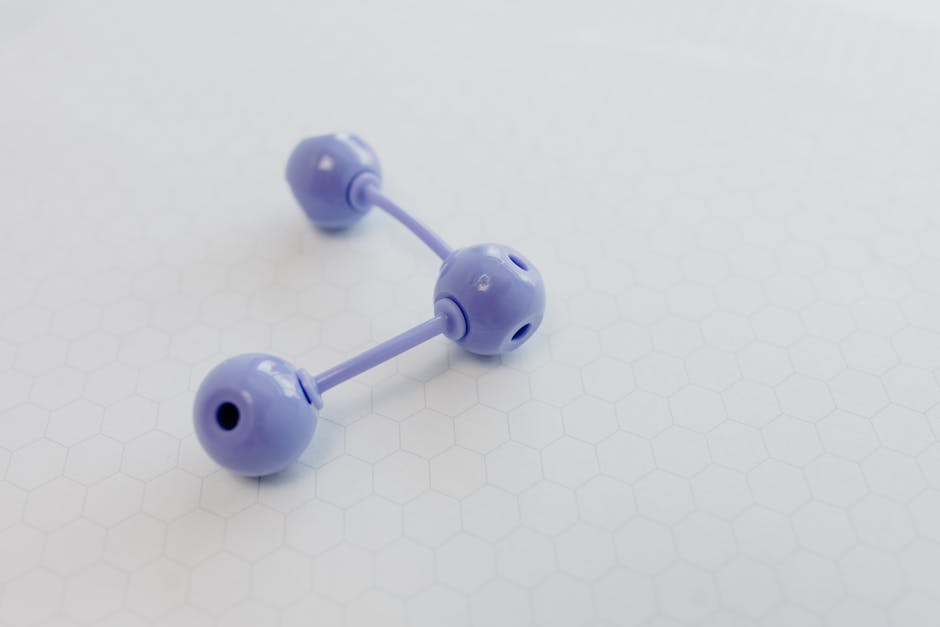
Photo by Tara Winstead on Pexels
Lewis structures are diagrams that show the bonding between atoms of a molecule and the lone pairs of electrons that may exist in the molecule. They're super useful for visualizing how electrons are arranged.
Here's how to draw them:
1. Count total valence electrons: Sum up the valence electrons for all atoms. Add electrons for negative charges, subtract for positive charges.
2. Determine central atom: Usually the least electronegative atom (never hydrogen).
3. Draw single bonds: Connect the central atom to outer atoms with single bonds (each bond uses 2 electrons).
4. Complete octets (or duets) on outer atoms: Place remaining electrons as lone pairs on outer atoms first.
5. Place remaining electrons on central atom: If any electrons are left, put them on the central atom (some central atoms can exceed an octet).
6. Form multiple bonds if needed: If the central atom doesn't have an octet, convert lone pairs from outer atoms into double or triple bonds to satisfy the central atom's octet.
Molecular Geometry: VSEPR Theory

Photo by Google DeepMind on Pexels
Once you have a Lewis structure, you can predict the 3D shape of the molecule using Valence Shell Electron Pair Repulsion (VSEPR) Theory. This theory states that electron domains (bonding pairs and lone pairs) around a central atom will arrange themselves as far apart as possible to minimize repulsion.
The shape depends on:
* Number of electron domains: Total number of lone pairs + bonding regions (single, double, or triple bonds count as one region).
* Number of lone pairs: Lone pairs repel more strongly than bonding pairs, distorting bond angles.
Here's a breakdown of common geometries:
graph TD
    A["Central Atom"] --> B{"Electron Domains"}
    B --> C1["2 Electron Domains"]
    C1 --> D1("Linear (0 lone pairs)")
    C1 --> D2("e.g., CO2")

    B --> C2["3 Electron Domains"]
    C2 --> D3("Trigonal Planar (0 lone pairs)")
    C2 --> D4("e.g., BF3")
    C2 --> D5("Bent (1 lone pair)")
    C2 --> D6("e.g., SO2")

    B --> C3["4 Electron Domains"]
    C3 --> D7("Tetrahedral (0 lone pairs)")
    C3 --> D8("e.g., CH4")
    C3 --> D9("Trigonal Pyramidal (1 lone pair)")
    C3 --> D10("e.g., NH3")
    C3 --> D11("Bent (2 lone pairs)")
    C3 --> D12("e.g., H2O")

    B --> C4["5 Electron Domains"]
    C4 --> D13("Trigonal Bipyramidal (0 lone pairs)")
    C4 --> D14("e.g., PCl5")
    C4 --> D15("Seesaw (1 lone pair)")
    C4 --> D16("e.g., SF4")
    C4 --> D17("T-shaped (2 lone pairs)")
    C4 --> D18("e.g., ClF3")
    C4 --> D19("Linear (3 lone pairs)")
    C4 --> D20("e.g., XeF2")

    B --> C5["6 Electron Domains"]
    C5 --> D21("Octahedral (0 lone pairs)")
    C5 --> D22("e.g., SF6")
    C5 --> D23("Square Pyramidal (1 lone pair)")
    C5 --> D24("e.g., BrF5")
    C5 --> D25("Square Planar (2 lone pairs)")
    C5 --> D26("e.g., XeF4")
Molecular Polarity
A molecule's overall polarity depends on two things:
1. Bond polarity: Are the individual bonds polar? (Due to electronegativity difference).
2. Molecular geometry: Do the bond dipoles cancel each other out due to symmetry, or do they add up to create an overall molecular dipole?
If bond dipoles cancel (e.g., CO2 is linear, C-O dipoles pull in opposite directions and cancel), the molecule is nonpolar. If they don't cancel (e.g., H2O is bent, O-H dipoles add up), the molecule is polar. Molecular polarity is crucial for understanding how molecules interact (e.g., "like dissolves like").
3. Worked Example
Let's determine the Lewis structure, molecular geometry, and polarity of carbon tetrachloride, CCl$_4$.
-
Total valence electrons:
- Carbon (Group 14): 4 valence electrons
- Chlorine (Group 17): 7 valence electrons each x 4 Cl atoms = 28 valence electrons
- Total = 4 + 28 = 32 valence electrons
-
Central atom: Carbon is less electronegative than chlorine, so C is central.
-
Draw single bonds: Connect C to the four Cl atoms with single bonds.
- C - Cl (4 times) = 4 bonds * 2 e-/bond = 8 electrons used.
- Remaining electrons = 32 - 8 = 24 electrons.
-
Complete octets on outer atoms: Place the remaining 24 electrons as 3 lone pairs on each Cl atom (6 electrons/Cl * 4 Cl = 24 electrons used).
- Each Cl now has 8 electrons (2 from bond + 6 from lone pairs).
- All 24 remaining electrons are used.
-
Check central atom: Carbon now has 4 bonds, meaning 8 electrons, so its octet is complete.
Lewis Structure:
     :Cl:
     |
  :Cl-C-Cl:
     |
     :Cl:
(where ":" represents a lone pair)
Molecular Geometry (VSEPR):
* Central atom (C) has 4 electron domains.
* All 4 domains are bonding pairs (0 lone pairs).
* According to VSEPR, this corresponds to a tetrahedral geometry.
Molecular Polarity:
* Bond polarity: C-Cl bonds are polar because Cl is more electronegative than C, creating a partial negative charge on Cl and partial positive charge on C. So, there are bond dipoles.
* Molecular geometry: The molecule is tetrahedral, which is a highly symmetric shape. The four C-Cl bond dipoles are of equal magnitude and point outwards from the central carbon towards the corners of the tetrahedron. Due to this perfect symmetry, these dipoles cancel each other out.
* Conclusion: CCl$_4$ is a nonpolar molecule.
4. Key Takeaways
- Atoms bond to achieve a stable electron configuration, usually an octet (8 valence electrons) or duet (2 for H/He).
- Ionic bonds involve electron transfer, forming ions that attract each other.
- Covalent bonds involve electron sharing, creating molecules.
- Lewis structures show how atoms are connected and where lone pairs are located.
- VSEPR theory helps predict a molecule's 3D shape based on minimizing electron domain repulsion.
- Molecular geometry influences whether a molecule is polar or nonpolar, which dictates its physical and chemical properties.
- Electronegativity differences determine bond polarity, while molecular symmetry determines overall molecular polarity.
Common Mistakes to Avoid:
* Forgetting to count all valence electrons correctly when drawing Lewis structures.
* Not understanding that double/triple bonds count as only ONE electron domain for VSEPR.
* Confusing bond polarity with overall molecular polarity; a molecule can have polar bonds but be nonpolar overall due to symmetry.
* Drawing resonance structures as if they're different molecules; they represent a single, averaged structure.
5. Now Try It
Draw the Lewis structure for SO$_2$, determine its molecular geometry, and state whether it's polar or nonpolar. What would happen to its geometry and polarity if it were a linear molecule instead of its actual shape?
What success looks like: You'll have a Lewis structure showing double bonds and lone pairs, correctly identify the electron domain geometry as trigonal planar and the molecular geometry as bent, and explain why it's polar. Then, you'll be able to explain how a hypothetical linear SO2 would be nonpolar due to symmetry.
Frequently asked about Chemical Bonding and Molecular Structure
Study this next
Get the full Chemistry curriculum
Clone the complete plan to your dashboard for unlimited AI-generated notes, practice quizzes, and a personalised revision schedule.
Save this course free