Historical Development of Atomic Theory
From the Atomic foundation of matter curriculum
Historical Development of Atomic Theory
TL;DR
You'll learn how our understanding of atoms evolved over centuries, from ancient philosophical ideas to modern scientific models. Key experiments and thinkers gradually refined the concept of the atom. This journey shows how science builds on previous discoveries to explain the world around us.
1. The Mental Model
Imagine trying to understand something you can't see directly. Scientists developed ideas about atoms by observing how matter behaves and then designing experiments to test those ideas. It's like building a puzzle where you only get clues, not the full picture at once.
2. The Core Material
For a long time, the idea of an atom was purely philosophical. Ancient Greeks like Democritus proposed that all matter was made of indivisible particles he called "atomos." This was a great thought experiment, but there wasn't any experimental proof.
Dalton's Atomic Theory (Early 1800s)

Photo by Steve A Johnson on Pexels
John Dalton was the first to propose a scientific atomic theory based on experimental observations, particularly the laws of definite proportions and multiple proportions. He suggested:
* All matter is made of tiny, indivisible particles called atoms.
* Atoms of a given element are identical in mass and properties.
* Atoms of different elements have different masses and properties.
* Atoms combine in simple whole-number ratios to form compounds.
* Atoms are rearranged during chemical reactions, but not created or destroyed.
Thomson's Plum Pudding Model (Late 1800s)

Photo by Mathew Thomas on Pexels
J.J. Thomson's work with cathode rays led to the discovery of the electron. He realized atoms weren't indivisible after all. His "plum pudding" model proposed that an atom was a sphere of positive charge with negatively charged electrons embedded within it, like plums in a pudding.
Rutherford's Nuclear Model (Early 1900s)

Photo by Google DeepMind on Pexels
Ernest Rutherford's famous gold foil experiment drastically changed the atomic model. He fired positively charged alpha particles at a thin sheet of gold foil. Most particles passed straight through, but a small fraction were deflected at large angles, and some even bounced back. This led to his conclusions:
* Atoms are mostly empty space.
* They have a tiny, dense, positively charged nucleus at their center.
* Electrons orbit this nucleus.
Bohr's Planetary Model (1913)
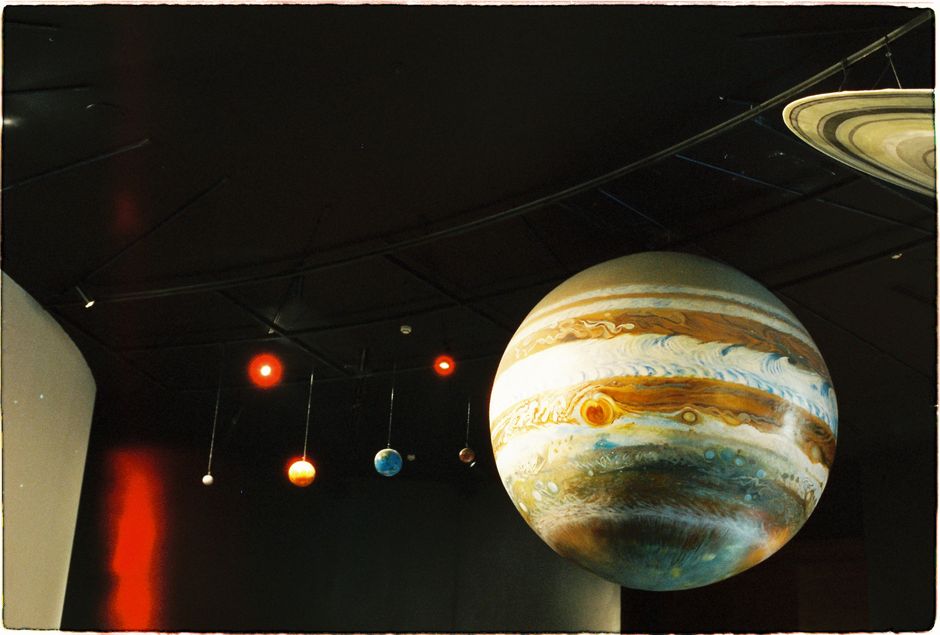
Photo by meomupmofilm on Pexels
Niels Bohr refined Rutherford's model to explain why electrons don't spiral into the nucleus and why elements produce specific line spectra. He proposed that:
* Electrons orbit the nucleus in specific, fixed energy levels or "shells."
* Electrons can jump between these levels by absorbing or emitting specific amounts of energy (quanta).
* Electrons don't radiate energy while in a stable orbit.
Quantum Mechanical Model (Modern)
The modern atomic model is based on quantum mechanics. It's more complex than Bohr's model, stating that electrons don't orbit in fixed paths but exist in probability clouds called orbitals. This model incorporates the wave-particle duality of matter and describes the probable location of electrons around the nucleus.
Here's a diagram showing the progression of these models:
graph TD
    A["Ancient Greeks (Democritus)"] --> B["Dalton's Atomic Theory (Indivisible spheres)"]
    B --> C["Thomson's Plum Pudding Model (Electrons embedded in positive sphere)"]
    C --> D["Rutherford's Nuclear Model (Dense nucleus, electrons orbit)"]
    D --> E["Bohr's Planetary Model (Electrons in fixed energy levels)"]
    E --> F["Quantum Mechanical Model (Electron probability clouds/orbitals)"]
3. Worked Example
Let's trace how a single observation led to a major shift.
Observation: When cathode rays were passed through a vacuum tube, they were deflected by electric and magnetic fields.
Initial thought (before Thomson): Atoms are indivisible. How could an indivisible particle be deflected?
Thomson's Experiment: He measured the charge-to-mass ratio of the cathode ray particles and found them to be much lighter than any known atom and negatively charged.
Conclusion: These particles (electrons) must be smaller components of atoms. This directly contradicted Dalton's idea of indivisible atoms.
New Model: Thomson proposed the "plum pudding" model where these tiny negative electrons were scattered within a larger, positively charged sphere, maintaining overall neutrality. This shows how experimental evidence forced a revision of the prevailing atomic theory.
4. Key Takeaways
- Early atomic ideas were philosophical; Dalton introduced experimental evidence to form a scientific theory.
- Thomson's discovery of the electron proved atoms weren't indivisible, leading to the plum pudding model.
- Rutherford's gold foil experiment revealed the atom's dense, positively charged nucleus and mostly empty space.
- Bohr explained electron stability and line spectra by proposing electrons exist in specific energy levels.
- The quantum mechanical model describes electrons in probabilistic orbitals, moving beyond fixed paths.
- Each model built upon and refined previous ones, often correcting earlier misconceptions.
Common Mistakes to Avoid:
- Confusing the order of the models; they developed chronologically based on new evidence.
- Thinking that a "later" model completely invalidates "earlier" ones; often, earlier models are simplified versions that are still useful in certain contexts.
- Believing that atoms are truly indivisible or solid spheres; that idea was disproven early on.
- Assuming Bohr's fixed orbits are what electrons actually do; the modern model uses probabilities.
5. Now Try It
Draw a simple diagram representing each of the five major atomic models discussed (Dalton, Thomson, Rutherford, Bohr, Quantum Mechanical). For each, briefly list one key feature and one limitation (what it couldn't explain or what was later proven wrong). What success looks like: You'll have five distinct drawings, each with a correct feature and limitation, clearly demonstrating your understanding of their progression and refinements.
Frequently asked about Historical Development of Atomic Theory
Get the full Atomic foundation of matter curriculum
Clone the complete plan to your dashboard for unlimited AI-generated notes, practice quizzes, and a personalised revision schedule.
Create Free Account